
SK hynix Connects the HBM4 Ramp With Long-Term Agreements Covering More Than Half of 2027 and 2028 Capacity
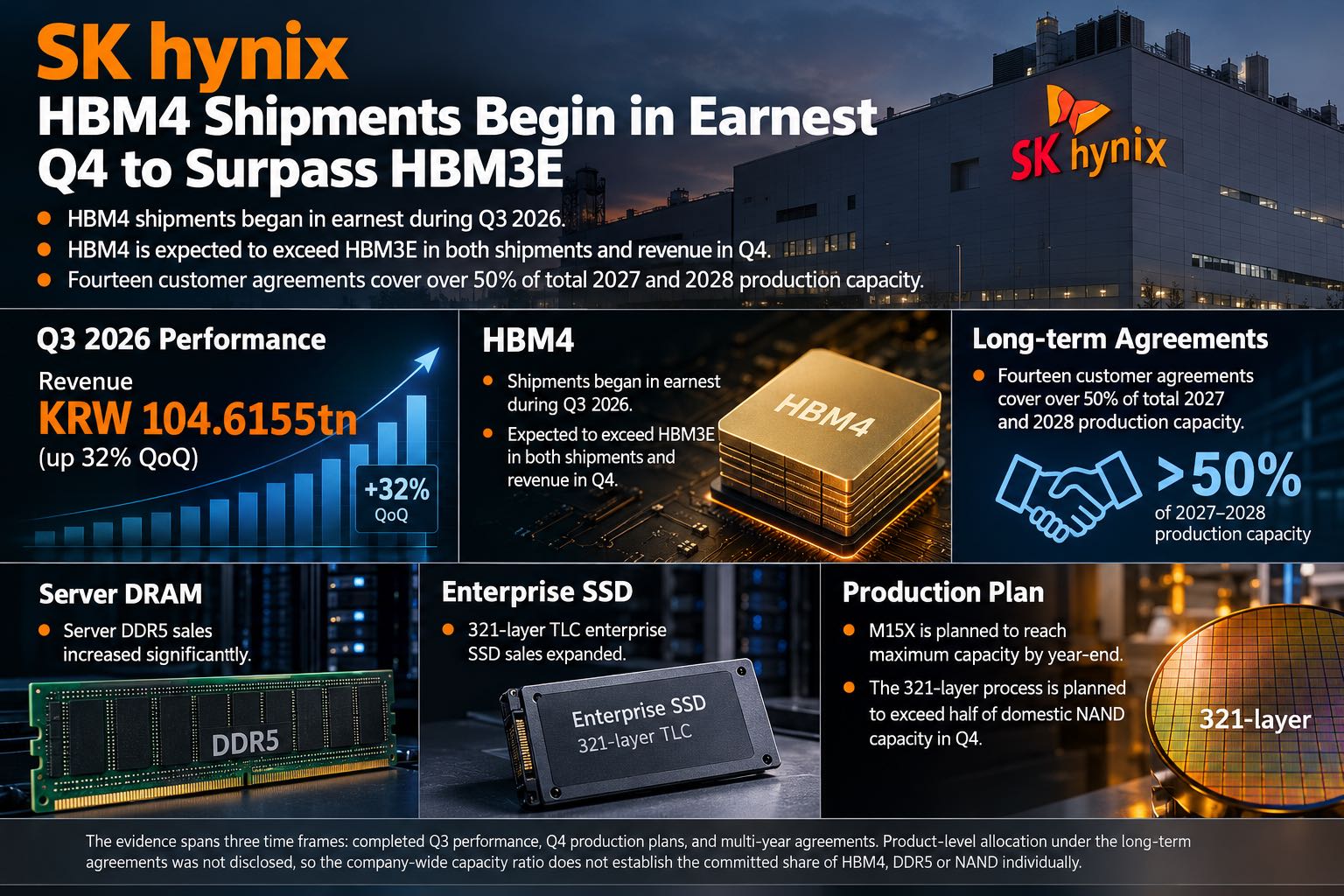
SK hynix reported preliminary third-quarter 2026 revenue of KRW 104.6155 trillion, supported by server DDR5, HBM4 and 321-layer TLC enterprise SSD growth. Management expects HBM4 to overtake HBM3E in both shipments and revenue during the fourth quarter as M15X moves toward maximum capacity. Long-term agreements with 14 major customers cover volumes equivalent to more than half of total production capacity in 2027 and 2028. The combination improves forward demand visibility, but the company did not disclose product-level allocation under those contracts.
Q3 Performance Establishes the Starting Point
SK hynix released preliminary financial results for the third quarter of 2026 on October 28. Revenue reached KRW 104.6155 trillion, 32% higher than the second quarter and 328% above the prior-year period. Operating profit was KRW 83.3338 trillion, up 38% sequentially. The company links the records to rising prices for key products and stronger sales of high-value memory serving AI infrastructure.
The product commentary is more useful for supply-chain analysis than the headline totals alone. Server DDR5 sales increased significantly, HBM4 shipments began in earnest, and 321-layer TLC enterprise SSD sales expanded. These are completed-quarter statements, although the financial review has not been finalized and the figures remain subject to change during the audit process.
The results describe one supplier’s revenue and mix. They do not represent a global memory price index, and the growth rates cannot be applied to component volumes or contract prices without product-level data.
HBM4 Changes the Internal Production Mix
SK hynix plans to raise M15X to maximum capacity by the end of the year to increase HBM4 production. Management expects HBM4 to exceed HBM3E in both shipment volume and revenue in the fourth quarter, establishing HBM4 as the company’s mainstream HBM product.
This guidance establishes an internal mix transition, not an industry-wide completion point. Different accelerator platforms, stack configurations and qualification schedules can keep HBM3E relevant even as SK hynix shifts its own output and revenue toward HBM4.
The sequence also contains distinct evidence states. HBM4 shipments began during Q3. The M15X level is a year-end target. The HBM4 crossover is a fourth-quarter expectation. A procurement assessment that records each state separately avoids treating planned capacity as delivered supply.
No open-market lead time, channel stock level, customer allocation or stack-specific output volume appears in the release. Those omissions limit the use of the announcement for short-term availability decisions.
Long-Term Agreements Extend the Visibility Window
The company has signed long-term agreements with 14 major customers, including leading global cloud service providers. Secured volumes correspond to more than 50% of total production capacity for both 2027 and 2028. SK hynix is also discussing longer contract periods with customers, while typical terms run for five years.
The agreements use a mechanism that can reflect market conditions within an agreed price range. This structure combines volume visibility with some pricing flexibility, rather than fixing every future transaction at one static number.
The most important limitation is scope. SK hynix reports the agreement volume against total production capacity. It does not break the figure down by HBM4, HBM3E, server DDR5, LPDDR5 SOCAMM, enterprise SSD or other NAND products. It also does not identify the share held by each customer.
More than half of company-wide capacity under long-term agreements is therefore not the same as more than half of every product being committed. The disclosure supports a demand-visibility conclusion, not a product-specific allocation conclusion.
Process Transitions Support Several Data-Center Products
The company plans to increase the share of its 1c DRAM process and expand sales of DDR5 and LPDDR5 SOCAMM for AI servers. In NAND, it intends to raise the 321-layer process to more than half of domestic production capacity in the fourth quarter, supporting high-performance and high-capacity enterprise SSD supply.
These transitions show that AI infrastructure demand reaches multiple memory layers. HBM sits next to the accelerator, server DDR5 supports CPU memory, SOCAMM addresses compact high-capacity configurations, and enterprise SSD provides the persistent storage tier. The release does not assign a common growth rate or pricing path to those products.
The domestic-production qualifier for 321-layer NAND is also material. It does not describe the company’s complete worldwide NAND capacity, and it should not be converted into a global 321-layer production share.
A Supply View Through 2030
SK hynix expects demand to exceed supply through 2030. Management cites the technical difficulty of advanced processes and the long lead time needed to build production facilities. It also plans a significant increase in investment next year as Yongin Phase 1 enters full-scale operation and other infrastructure projects advance.
This is a strategic outlook rather than a current shortage bulletin. It does not establish an allocation condition for all memory types, and it does not provide accepted contract prices or confirmed delivery windows. A broad supply view can frame planning, but product-specific procurement still depends on qualification, contract coverage, process mix and customer priority.
The company says investment scale and timing will remain flexible, based on customer demand, product competitiveness, profitability and investment efficiency. Capacity additions therefore remain conditional rather than automatic.
Evidence That Matters in the Next Updates
Several future disclosures can test the October position. The first is whether M15X reaches the planned year-end level. The second is whether HBM4 actually exceeds HBM3E in both fourth-quarter shipments and revenue. The third is the reported share of 1c DRAM and 321-layer domestic NAND production. The fourth is any change in the volume or product scope of the 2027 and 2028 long-term agreements.
Together, Q3 performance, near-term process transitions and multi-year contracts show a memory supplier organizing capacity around AI-server demand. They do not show identical conditions across all DRAM and NAND categories. Maintaining that distinction keeps the disclosure useful for BOM planning without turning company guidance into a market-wide shortage claim.