
Intel’s Q3 Results Show Xeon Supply Expansion Against a Diverging Compute Demand Cycle
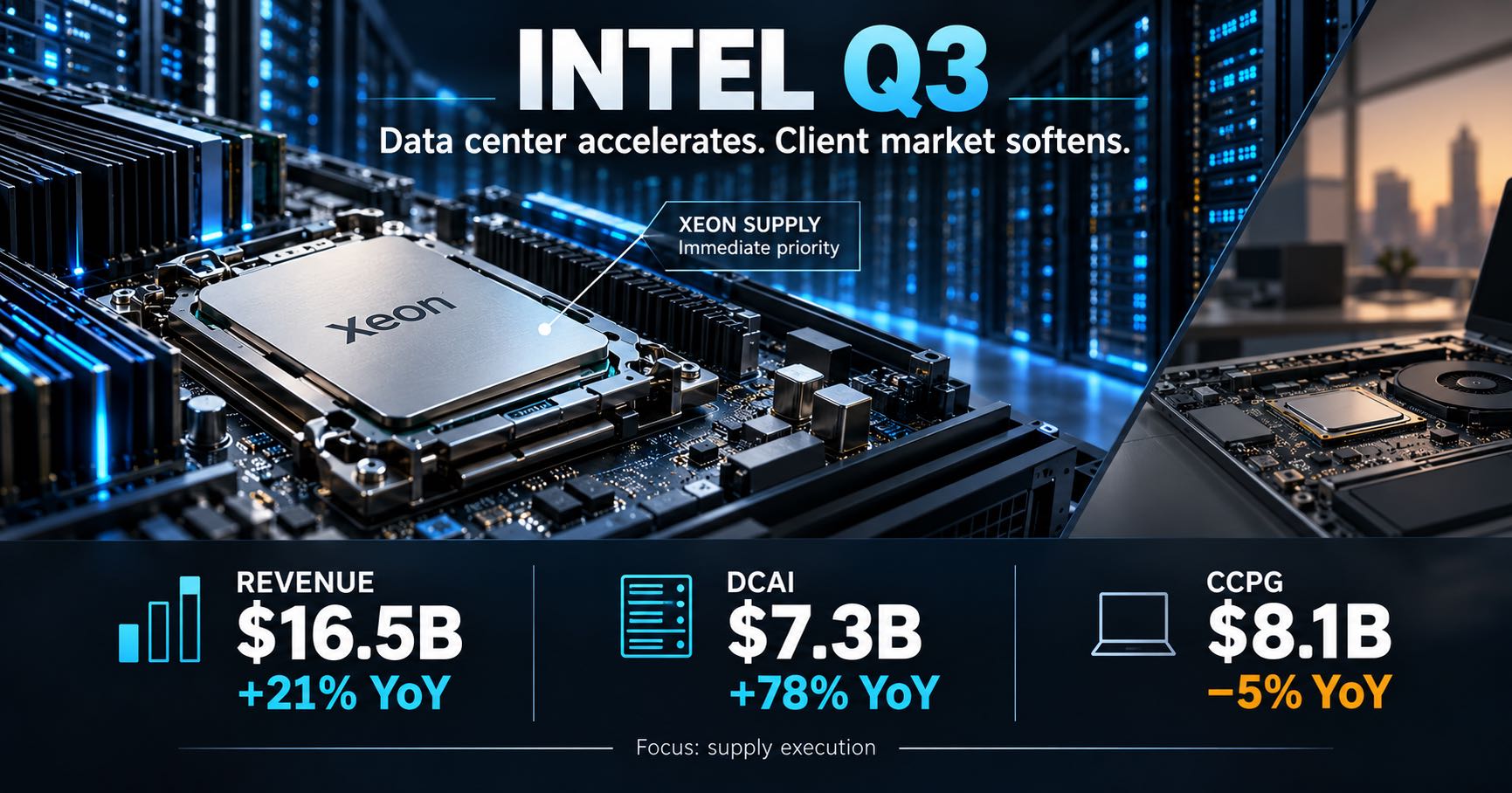
Intel’s Q3 2026 results separate two compute demand cycles within one supplier. DCAI revenue grew 78% year over year to $7.3 billion, while CCPG revenue declined 5% to $8.1 billion. Management is directing capacity and working capital toward additional Xeon supply as it expects PC weakness to persist into the first half of 2027.
A Quarter Led by Data Center Acceleration
Intel reported Q3 2026 revenue of $16.5 billion, up 21% year over year. Total Intel Products revenue reached $15.4 billion, an increase of 22%. Within that total, Data Center and AI generated $7.3 billion, up 78%, while Client Computing and Physical AI generated $8.1 billion, down 5%. Intel’s CFO characterized the result as the company’s strongest data center revenue growth in 15 years.
The segment split is more informative than the consolidated growth rate alone. Data center momentum provided the principal growth engine, while client computing moved in the opposite direction. Intel also reported that revenue, gross margin and earnings per share exceeded guidance. That combination links the data center increase with improved company-level execution, although it does not establish a uniform demand pattern across Intel’s portfolio.
Xeon Supply as the Immediate Execution Priority
Intel’s CEO said CPU demand remained robust and identified the release of additional supply for the Xeon family as the immediate priority. The CFO also said the company would continue disciplined investments in capacity and working capital to increase supply and support future growth.
The release does not provide SKU-level allocations, order lead times or transaction pricing. It supports a conclusion about Intel’s supply-expansion priority, not a blanket shortage declaration for every Xeon product. The relevant B2B signal is the connection between a 78% increase in DCAI revenue, management’s description of extraordinary Xeon demand and the stated need to unlock more supply. Availability still depends on platform, configuration, geography and delivery period.
Intel’s product highlights add roadmap context without changing that boundary. The company announced plans for a multiyear Oracle collaboration spanning current and future Xeon platforms, including planned OCI X14 offerings based on Diamond Rapids. It also presented next-generation Xeon rack designs and described support for Meta’s Muse Spark Open on upcoming Intel GPU D-series and Xeon platforms. These items remain collaboration, roadmap and demonstration disclosures rather than shipment commitments for specific systems.
Client Computing Under a Slower PC Outlook
CCPG revenue of $8.1 billion was 5% below the prior-year period. Intel said the PC slowdown was expected to continue at least through the first half of 2027. That company outlook provides a clear counterweight to the data center result. The quarter does not support a single demand narrative covering both servers and PCs.
For OEM and EMS planning, the release indicates that server-side supply expansion and client-side demand moderation can coexist. The client decline is a segment-level revenue result and does not identify specific Core processor models, customer inventories or channel price movements. It defines the direction of the business unit without establishing a part-level excess-inventory or discounting conclusion.
Foundry Growth With an Intersegment Boundary
Intel Foundry reported Q3 revenue of $6.7 billion, up 58% year over year. The release states that operating-segment revenue includes intersegment transactions, and Intel recorded $6.3 billion of intersegment eliminations before arriving at total net revenue. The foundry figure consequently cannot be treated as an external-customer revenue measure.
Intel also reported the October release of the Intel 14A 0.9 process design kit. The milestone shows continued process and ecosystem work, but the earnings release does not attach external production volume or customer revenue to the PDK release. Process availability, customer engagement and recognized external foundry revenue represent different stages of commercialization.
Margin and Cash Generation Support the Supply Program
GAAP gross margin reached 43.0%, up 4.8 percentage points from Q3 2025. Non-GAAP gross margin was 44.1%, up 4.1 points. GAAP operating margin increased to 15.3% from 5.0%, while non-GAAP operating margin rose to 19.6% from 11.2%. Intel generated $5.1 billion in operating cash flow.
Intel also completed a $23 billion public equity offering, which the company said was intended to support future growth while maintaining its balance sheet and investment-grade rating. These disclosures provide financial context for the planned capacity and working-capital investment. They do not specify the amount directed to Xeon supply, but they show that the supply program sits alongside stronger quarterly margins, positive cash generation and a larger capital base.
Q4 Guidance Sets a Lower Near-Term Baseline
Intel guided Q4 2026 revenue to $15.0 billion to $16.0 billion, with GAAP gross margin of 37.1% and non-GAAP gross margin of 38.0%. The midpoint of the revenue range is $15.5 billion, below the Q3 reported level, and both gross-margin forecasts are below the Q3 results.
The guidance, combined with Intel’s PC commentary, keeps the near-term outlook measured despite DCAI acceleration. The operating task is not only capturing Xeon demand but converting capacity and working-capital investment into deliverable supply while the client market remains softer. Q3 established the growth signal; subsequent quarters will show how effectively Intel expands supply within the revenue and margin framework stated for Q4.
A Split Market With One Clear Operational Focus
Intel’s Q3 release presents a portfolio divided between fast data center growth and a weaker client environment. DCAI’s 78% increase, the company’s strongest data center growth claim in 15 years and management’s focus on Xeon supply form the central signal. CCPG’s 5% decline and the expected PC slowdown limit any broader interpretation.
The B2B conclusion is narrow and specific. Intel is prioritizing additional Xeon supply in response to company-reported demand, while the official release provides no part-level allocation, lead-time or pricing data. Monitoring therefore centers on supply execution, platform availability and the conversion of roadmap announcements into commercial systems, with Q4 guidance providing the next financial baseline.