
The SiC Paradox of 2026: Substrate Glut, Device Tightness, and Why the 8-Inch Transition Hands China the Leverage as AI Data Centers Go 800V
A June 4 DigiTimes exclusive describes China consolidating control of the silicon carbide supply chain as the industry pivots to 8-inch wafers. With Chinese 6-inch substrates quoting near $500 against still-constrained automotive SiC MOSFETs, and 800V HVDC AI data centers emerging as a second demand pillar, OEM and EMS sourcing teams face a market moving in two directions at once. This analysis maps the structural shift and its procurement consequences.
On June 4, DigiTimes published an exclusive report describing how China is tightening its grip on the silicon carbide supply chain at precisely the moment the industry transitions from 6-inch to 8-inch wafers. The timing matters. At Computex 2026, the dominant theme on the show floor was AI data center infrastructure, and silicon carbide — long narrated as an electric-vehicle story — re-emerged as a foundational material for the 800-volt high-voltage direct current power architectures that hyperscale AI deployments now demand. For sourcing organizations, the report crystallizes a market that has quietly split into two contradictory halves, and the contradiction itself is where procurement risk and opportunity now live.
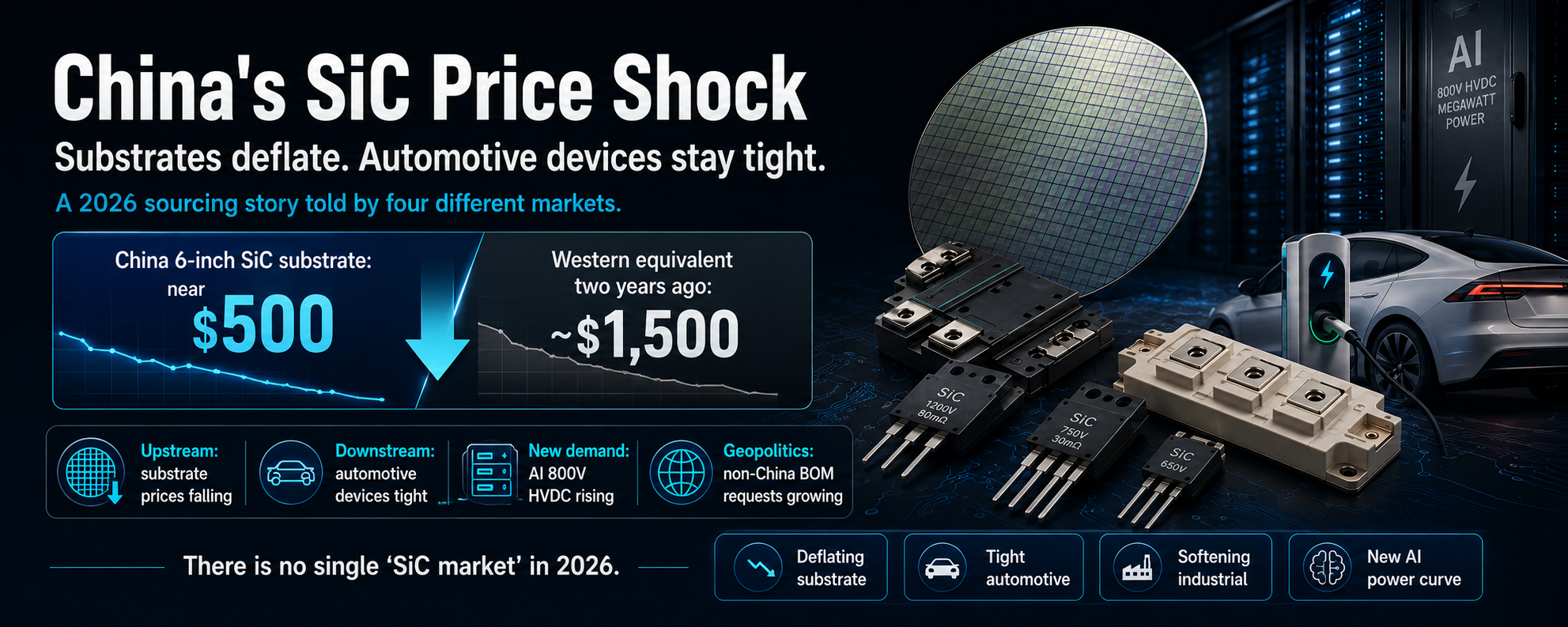
The upstream half of the market is in outright deflation. Chinese suppliers now quote 6-inch SiC substrates at levels around $500 per piece, a price point that would have seemed implausible two years ago when Wolfspeed's equivalent product commanded roughly $1,500. TrendForce had already documented price erosion approaching 30% annually back in 2024, and the trajectory never meaningfully reversed. Behind the price curve sits a capacity story: subsidized expansion by SICC, TanKeBlue and a long tail of domestic entrants has concentrated the majority of new global substrate capacity inside China, even as Wolfspeed's 2025 Chapter 11 restructuring left the Western substrate base consolidating rather than growing. The 8-inch transition amplifies this dynamic rather than resetting it. Larger wafers reward exactly the kind of scale and capital intensity that subsidized Chinese producers can sustain through a price war, and the first 12-inch samples shown by Chinese suppliers signal an intent to lead the next node rather than follow it.
The downstream half tells the opposite story. Automotive-qualified SiC MOSFETs for traction inverters and onboard chargers remain structurally constrained in 2026; onsemi's SiC power families for EV traction continue to appear on constrained-supply lists, and Western IDM power pricing remains in a hiking cycle, with a second round of increases taking effect this summer. The explanation is not hypocrisy but physics and process: a $500 substrate does not become an AEC-Q101-qualified device without production-line qualification, yield maturation and a development cycle measured in years. Device-level pricing power therefore remains with the IDMs that hold automotive qualifications, regardless of what happens to input costs. Buyers who read substrate headlines and expect device quotes to follow within a quarter or two will be disappointed — and under-positioned.
What makes 2026 different from the SiC narrative of the past five years is the arrival of a second demand pillar. The NVIDIA-led 800V HVDC architecture pushes AI rack power density from tens of kilowatts toward megawatt scale, and silicon carbide content rises through the rectification and DC-DC conversion stages of that power chain. Demand that was once a single-threaded EV story is becoming a dual-engine one, and data center build-out timelines — driven by hyperscaler capital expenditure rather than consumer auto cycles — are both faster and less price-sensitive than the vehicle programs SiC suppliers originally built their roadmaps around. When EV growth disappointed in 2024 and 2025, the resulting capacity overhang fed the substrate price war; AI infrastructure is now absorbing that overhang from the other direction.
The geopolitical dimension deserves more attention than it typically receives in component-level planning. China's export controls on gallium and germanium established a precedent for treating compound-semiconductor inputs as strategic leverage, and a SiC substrate base concentrated in Chinese hands is a structurally similar exposure. The DigiTimes framing — China "tightening its grip" — is not merely commercial observation. Western OEMs have already begun requesting non-China BOM options for power stages, and the cost of that insurance is rising as the capacity gap widens. Sourcing teams should expect dual-sourcing requirements to flow down from end customers into power-stage BOMs over the next several quarters, much as they did for memory and passives in earlier cycles.
The practical conclusions for OEM and EMS procurement are fourfold. First, treat automotive-grade SiC MOSFETs as a lock-now category: allocation for H2 2026 should be secured against a backdrop of continuing list-price increases, not deferred in hope of substrate deflation passing through. Second, treat industrial, solar and energy-storage sockets as the genuine beneficiaries of upstream deflation — second-tier and Chinese device brands will price aggressively into those applications first, and H2 quotes there are worth re-tendering. Third, begin China-brand qualification programs now while planning for 12–18 month cycles, so that the option value exists when price gaps widen further. Fourth, price the geopolitical scenario explicitly: a non-China SiC supply path costs more today, but the premium is an insurance contract against a concentration risk that the 8-inch transition is making structurally worse.
The deeper lesson of this cycle is that averages mislead. There is no single "SiC market" in 2026 — there is a deflating substrate market, a tight automotive device market, a softening industrial device market, and a new AI power demand curve, all moving on different clocks. Procurement strategies built on the aggregate narrative will mistime every one of them. The organizations that perform best in the second half will be those that disaggregate the story and position against each curve separately.
Sources: DigiTimes, TrendForce, Semiconductor Today