
When Chinese DRAM Starts Closing the Price Gap: What Narrowing DDR5 Spreads Signal for OEM and EMS Second-Sourcing Strategy Into 2027
DDR5 module spot prices reached a fresh record this week even as China-made dies began narrowing the gap to established suppliers — a combination that reads as contradiction only until you separate the commodity tier from the server tier. For OEM and EMS sourcing teams, the more consequential development is not the spot print but the arrival of a credible second source at the low end, and the qualification, lead-time and policy questions that come with it.
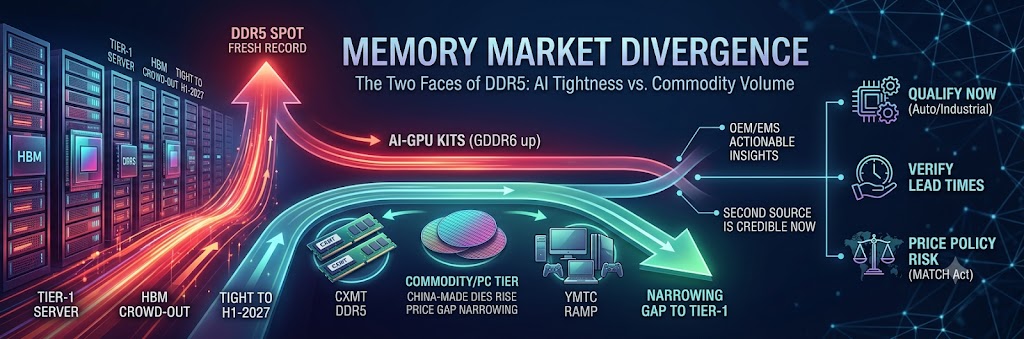
The memory market produced an apparent contradiction this week. On July 21, DigiTimes reported that DDR5 module spot prices had reached a fresh all-time high, driven by AI and server demand absorbing available supply — and in the same breath noted that China-made dies were beginning to narrow the price gap to the established tier-1 suppliers. A market cannot set records and see its price spreads compress at the same time, the reasoning goes, unless the two statements are describing two different markets. That is precisely what is happening, and the distinction matters more to a sourcing organization than either headline does on its own.
The tier-1 server market is not loosening. Every wafer redirected to high-bandwidth memory removes roughly three wafers' worth of DDR5 capacity, and that structural crowd-out keeps high-density server DDR5 and RDIMM tight until new capacity — SK Hynix's M15X, Micron's Idaho expansion — reaches volume in the first half of 2027. Nothing about the spot record contradicts that. What has changed is that at the commodity and PC end of the market, Chinese suppliers now have enough product moving to compress the spread that established makers have historically enjoyed. The record and the narrowing are both true because they describe opposite ends of the same category.
The supply picture behind the compression is now concrete rather than speculative. CXMT is projected to reach roughly 350,000 wafer starts per month of DRAM capacity by the end of 2026, closing to within a rounding error of Micron's scale, on the back of 2025 revenue near $8 billion — a 130% year-over-year increase — and it is targeting HBM mass production in Shanghai by year-end. YMTC's new Wuhan facility ramps in the second half of 2026, with roughly half its planned output steered toward DRAM rather than NAND, an unusual allocation that signals how deliberately Chinese producers are positioning for the commodity DRAM opportunity. For a sourcing team, the practical consequence is that the approved-vendor list for commodity DDR5 and legacy DDR4 will carry a growing number of Chinese part numbers through 2027, and treating them as unavailable is no longer the safe default it was a year ago.
That opportunity, however, is bounded on three sides, and each boundary is a work item rather than a footnote. The first is qualification. Substituting a Chinese die for an established one obliges the end customer to re-run validation, and for industrial or automotive programs that cycle runs one to two quarters; an organization that wants Chinese dies designed into a 2027 BOM has to begin the qualification work now, not when the price advantage becomes irresistible. The second is lead time and lot stability — a capacity ramp is not the same as a specific part number being reliably on the shelf, and the discipline of verifying actual delivery and batch-to-batch consistency lot by lot separates a genuine second source from a spot gamble. The third, and the one most easily underweighted, is policy. US measures such as the MATCH Act explicitly name CXMT and YMTC, and any supply chain with meaningful US exposure has to weigh the risk of building a primary-source dependency on Chinese memory against the very real possibility of future restriction. Second-sourcing for benchmarking and negotiating leverage is prudent; migrating primary supply onto Chinese dies without pricing in that policy tail is not.
It is worth situating all of this against the broader pressure in the memory complex, because the Chinese supply valve is not the only thing moving. GDDR6 spot prices have roughly tripled from about $2.5 to $7.5 per gigabyte over this cycle, and AMD's approximately 10% increase on GPU-plus-GDDR6 kits to board partners took effect this month — evidence that the same tier-1 capacity constraint pinning server DDR5 is now pushing cost into graphics and edge-AI boards as well. The pressure is bleeding into every corner of the market that touches a memory die, and against that backdrop the emergence of Chinese commodity supply reads less as a threat to incumbents and more as one of the few available release valves — one that relieves the commodity tier while leaving the server tier exactly as tight as it was.
The strategic takeaway for OEM and EMS teams is therefore narrower and more actionable than the headlines suggest. The narrowing DDR5 gap is not a signal that memory is turning; it is a signal that a second source has become credible at one specific tier, on a timeline that rewards qualification work started now and punishes the assumption that a price advantage can be captured on demand. Teams that begin dual-sourcing qualification on commodity densities this quarter, verify lead times before they commit volume, and price the policy risk explicitly will enter 2027 with genuine optionality. Teams that wait for the spread to become obvious will find the qualification runway gone and the option foreclosed — holding a tier-1 dependency at a moment when the market has quietly handed everyone else an alternative.