
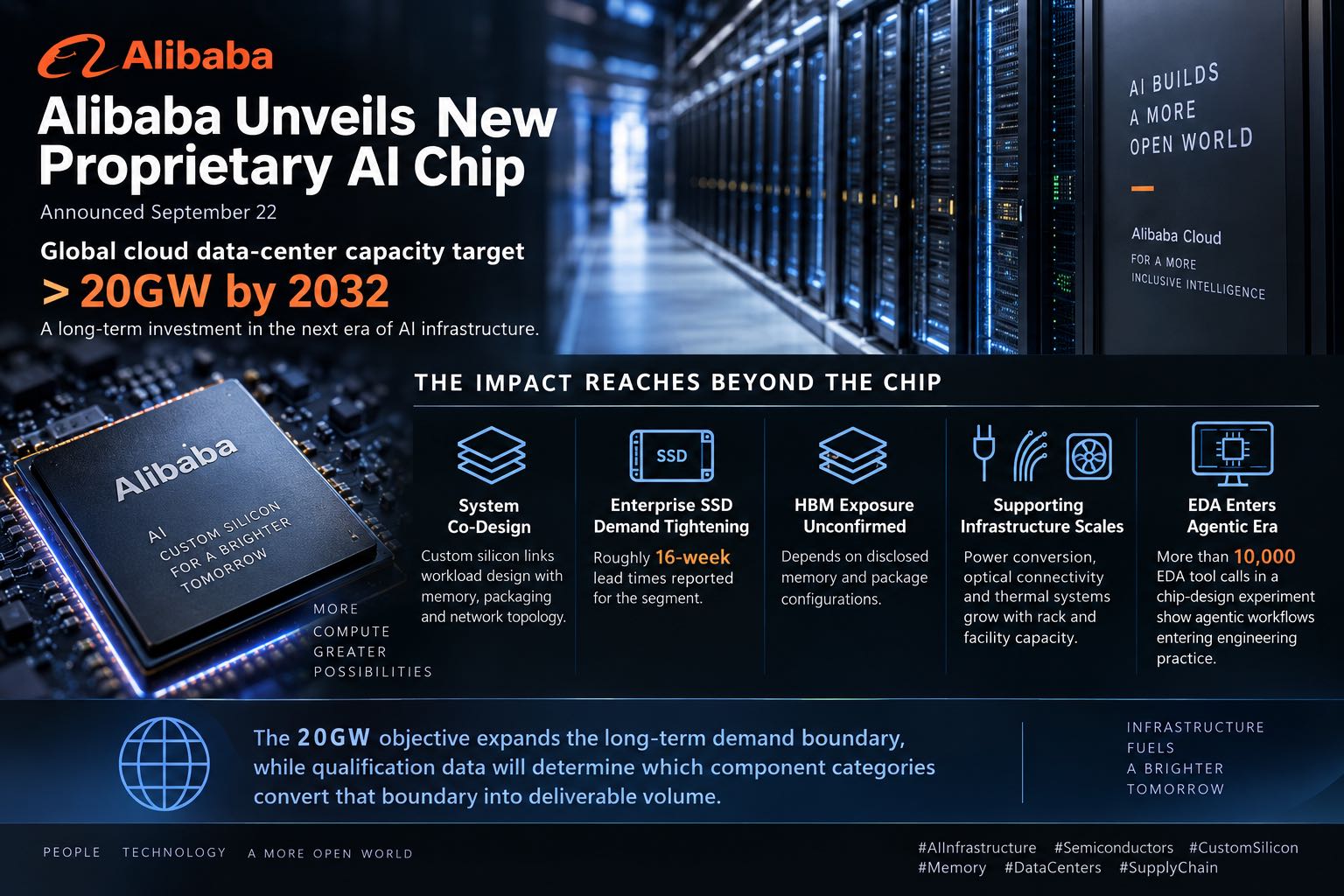
Alibaba's Custom AI Chip and 20GW Cloud Roadmap Expand the Qualified Supply Chain for Compute, Memory and Storage
Alibaba announced proprietary AI silicon and a target of more than 20GW of global cloud data-center capacity by 2032. The initiative connects models, chips, agentic services and physical infrastructure. Commercial impact depends on disclosed process, packaging, memory architecture and production qualification rather than the announcement alone.
Platform integration becomes the primary signal
Alibaba's September 22, 2026 announcement is significant because proprietary AI silicon was presented as part of a complete cloud platform rather than an isolated processor. The roadmap combines Qwen models, agentic cloud services, mobile agents and physical infrastructure. This architecture allows the cloud provider to coordinate workload behavior, compiler and runtime software, memory use, network topology and accelerator design.
The release does not disclose the fabrication node, foundry, die size, HBM generation, package topology, SerDes rate or production schedule. Those details define actual component consumption. A strategic announcement supports a long-term demand thesis, but procurement exposure begins only when package configuration, system BOM, qualification status and committed deployment dates become visible.
A 20GW infrastructure envelope
Alibaba intends to expand global cloud data-center capacity beyond 20GW by 2032. Power capacity cannot be translated directly into accelerator shipments because rack density, utilization, redundancy and platform efficiency change over time. It does establish a broad infrastructure envelope across compute, network, storage, power delivery, cooling and backup systems.
Custom accelerator servers require host CPUs, memory, baseboard management, timing, networking and security components. Scale-out fabrics require switch silicon, retimers, DSPs, optical engines and high-speed connectors. Higher rack power raises the value of voltage conversion, MOSFETs, SiC devices, current sensing and thermal control. Facility buildout therefore creates several qualification lanes rather than one uniform semiconductor demand pool.
Memory and storage follow different constraints
The proprietary chip could use HBM, DDR, LPDDR or tiered memory. Training-oriented and high-throughput inference platforms generally increase demand for HBM bandwidth and advanced packaging. Cost-optimized inference can place more emphasis on capacity efficiency and KV-cache tiering across DRAM and enterprise SSDs. Alibaba has not disclosed enough information to select one configuration.
Enterprise SSD conditions provide a current reference. TrendForce reported on September 21 that North American cloud providers raised fourth-quarter demand forecasts, with orders likely to exceed elevated third-quarter levels. TLC and QLC both contribute, and lead times of around 16 weeks indicate stronger supplier control over enterprise capacity. This segment should not be conflated with consumer NAND, where supply expansion and weaker device demand can create different pricing.
Agentic EDA moves from concept to workflow
Alibaba said a model spent more than 60 hours improving through a chip-design experiment, executed over 10,000 EDA tool calls and produced production-grade bus modules. The result is narrower than autonomous SoC development, but it is operationally relevant. It links specification, code generation, verification and tool execution in a measurable loop.
The impact on semiconductor demand is not one-directional. Faster iteration could produce more tape-out candidates and increase prototype demand. It could also standardize reusable IP and concentrate volume in fewer successful platforms. Verification coverage, licensing, PPA results, mask cost, first-silicon success and qualification time determine which effect dominates.
Qualification creates the commercial boundary
The next decisive data points are foundry selection, process node, advanced-package route, memory stack count, substrate and OSAT partners, network architecture, system form factor and production ramp. Initial deployment geography also matters because power availability, export controls and local supply chains shape configuration choices.
Supplier opportunity is strongest where components can meet platform validation, reliability, lifecycle and volume-capacity requirements. Nominal availability in the spot market is not equivalent to qualified supply. Custom silicon increases differentiation, but it also increases the cost of substitution after hardware and software have been co-optimized.
A synchronized expansion cycle
Alibaba's roadmap places silicon and infrastructure in one expansion cycle. The 20GW target broadens long-term demand for compute, memory, networking, storage and power, while proprietary chips make the exact mix more platform-specific. The supply chain must synchronize wafer capacity, advanced packaging, memory, substrates, system integration and data-center deployment.
The market implication is a wider but more conditional opportunity. Aggregate cloud capacity supports durable component demand, yet each supplier's addressable share depends on disclosed architecture and completed qualification. Platform-level evidence will remain more useful than broad AI infrastructure forecasts.
Capacity measured through deployment milestones
The 2032 target spans multiple accelerator, memory and network generations. Initial data-center phases may continue to rely on merchant GPUs while proprietary devices move through validation. Later phases can adopt a different memory hierarchy, package architecture or optical fabric. The aggregate power objective therefore cannot be assigned to a single silicon platform.
Useful milestones include energized megawatts, installed rack density, named server designs, qualified package capacity and committed wafer starts. Building announcements identify future infrastructure, but only commissioned facilities generate sustained component consumption. In the same way, tape-out confirms design progress while packaged yield, system validation and software readiness determine deployable supply.