
When the Bottleneck Moves Onshore: What TSMC's $100 Billion Arizona Expansion and Two Advanced Packaging Facilities Signal for OEM and EMS Sourcing Strategy
TSMC's July 16 announcement of an additional $100 billion for Arizona brought its total commitment to the state to $265 billion and, for the first time, placed advanced packaging capacity outside Taiwan. Read alongside 2Q26 results and this week's lead-time reporting, the announcement is less a supply relief signal than a formal acknowledgement of where the binding constraint in this cycle actually sits.
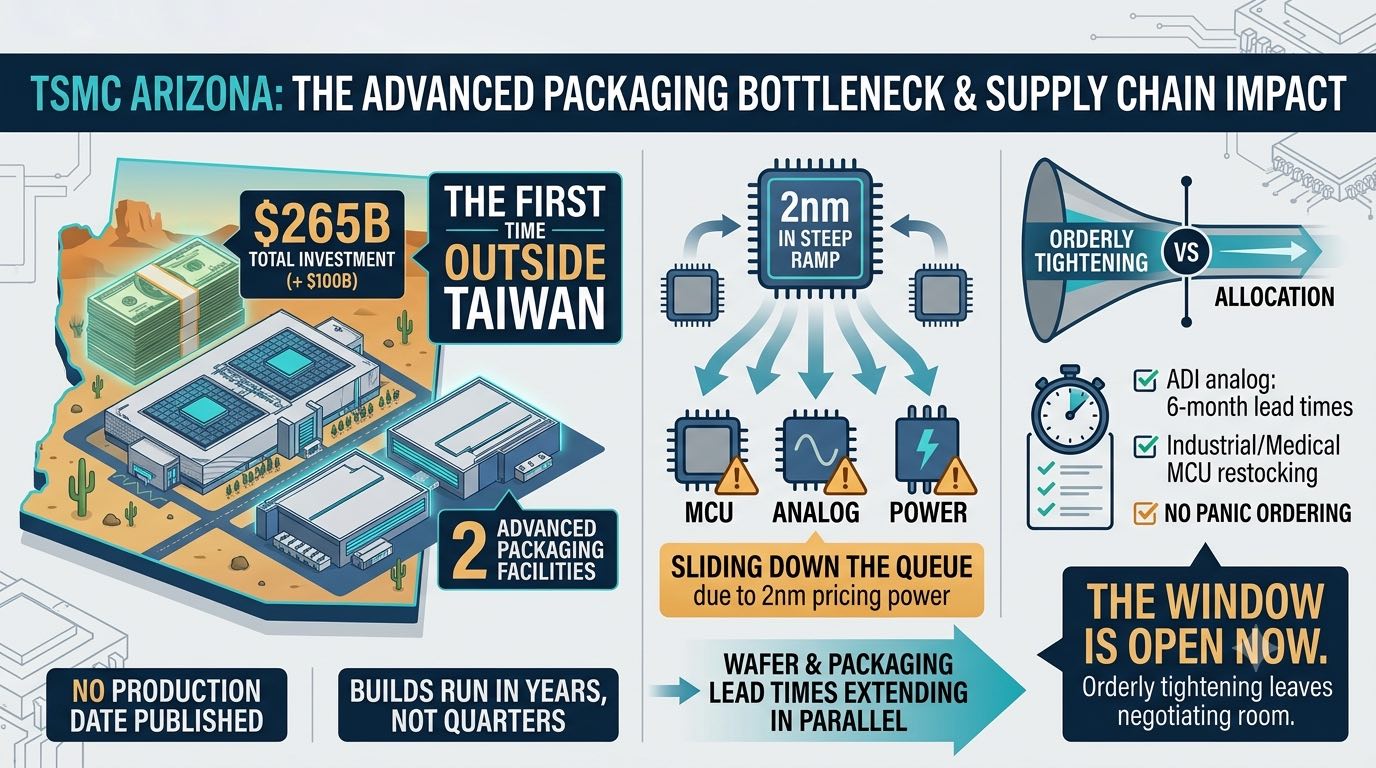
On 16 July 2026, TSMC announced an additional $100 billion investment in Arizona, funding four further fabs at 2nm and beyond. The announcement lifts the company's total committed investment in the state to $265 billion, covering ten fabs, two advanced packaging facilities and a research and development centre. Chief Executive C.C. Wei described the programme as support for "strong multi-year demand from our leading U.S. customers." The announcement arrived on the same day as second-quarter results, and the market reaction understandably concentrated on the earnings.
For sourcing organisations, however, the more consequential detail is structural rather than financial. Two of the facilities in the programme are advanced packaging plants. This represents the first occasion on which TSMC has committed advanced packaging capacity outside Taiwan, and it is worth pausing on what that implies. Until this announcement, effectively the entirety of the company's advanced packaging capability has been concentrated on a single island, which means that every accelerator dependent on TSMC's most advanced packaging has passed through one geographic chokepoint exposed to seismic, meteorological, energy and geopolitical risk simultaneously.
A capital commitment of this magnitude, directed specifically at packaging rather than at wafer fabrication alone, should be read as a statement about where the company sees its own constraint. Firms do not deploy capital at this scale against problems they consider comfortably solved. The reasonable inference is that packaging, not wafer supply, is the binding limitation in the current cycle — and that TSMC has now confirmed as much through its capital allocation rather than through commentary.
The earnings context reinforces rather than softens this reading
TSMC's second-quarter results, released the same day, showed revenue of $40.20 billion, an increase of 33.7% year over year and 12.0% sequentially, with gross margin at 67.7% and operating margin at 60.3%. By process node, 2nm accounted for 3% of wafer revenue, 3nm for 30%, 5nm for 33% and 7nm for 11%, bringing advanced technologies to 77% of the total. By end-market platform, high performance computing represented 66% of revenue and smartphones 22%.
Third-quarter guidance is where sourcing teams should focus. TSMC expects revenue of $44.6 billion to $45.8 billion, gross margin of 65% to 67% and operating margin of 56% to 58%, assuming an exchange rate of 32 New Taiwan dollars to the US dollar. Chief Financial Officer Wendell Huang attributed the outlook to continued leading-edge demand, specifically citing the steep ramp of 2nm. That represents a further sequential step of roughly 11% to 14% on top of an already record quarter.
The implication for mature-node procurement is direct and frequently underappreciated. Leading-edge ramps consume capital expenditure and back-end capacity concurrently. Every increment of 2nm ramp draws on the same packaging, test and substrate resources that mature-node products require, and it does so with pricing power that mature-node products cannot match. Expansion of microcontroller, analog and power capacity therefore moves further down the allocation queue as a mechanical consequence of leading-edge success, not as a separate market development.
What is actually happening to lead times this week
Against this backdrop, reporting from Digitimes on 16 July described cloud AI demand squeezing capacity, with wafer and packaging lead times extending in parallel, and noted that Analog Devices has informed customers that lead times on certain analog products have reached six months. A separate report the same day described microcontroller lead times stretching on the back of industrial automation and medical device restocking, while observing that the distribution channel has so far avoided the panic ordering behaviour characteristic of the pandemic period.
That last distinction deserves emphasis. Orderly tightening and panic tightening call for different responses. In an orderly tightening, negotiating room on price, terms and delivery commitments still exists, and buyers who move deliberately can secure favourable positions. Once panic ordering begins, that room closes rapidly and allocation replaces negotiation. The current window appears to be the former, which argues for acting now rather than waiting for confirmation.
The wider chain data supports the same conclusion. Digitimes' monthly tracker published on 14 July showed all thirteen tracked sub-sectors of Taiwan's semiconductor supply chain recording year-over-year revenue growth in June, with aggregate foundry revenue reaching $15.13 billion, an increase of 54%. Broad-based expansion of this kind tends to expose the least elastic step in the chain first, and the evidence assembled this week consistently identifies that step as the back end.
Implications for sourcing strategy
Three adjustments follow reasonably from this evidence.
First, the Arizona announcement should not enter demand planning as a near-term supply improvement. No production timeline was published for either packaging facility, and TSMC's Arizona projects have historically required multi-year periods from groundbreaking to volume production. Sourcing teams should expect commercial counterparties to invoke the announcement in price negotiations during the coming weeks and should be prepared to separate long-dated capacity commitments from current delivery performance in those discussions.
Second, packaging-intensive components warrant earlier commitment than their historical lead times would suggest. Where a bill of materials depends on FCBGA, system-in-package or large-format substrate content, the constraint is now explicitly acknowledged by the largest supplier in the industry. Buffer stock policies calibrated to a wafer-constrained world will understate exposure in a packaging-constrained one.
Third, mature-node parts quoted beyond sixteen weeks merit immediate last-time-buy evaluation. The combination of leading-edge crowd-out, six-month analog lead times and orderly rather than panicked channel behaviour describes a window that is open now and unlikely to remain open through the fourth quarter. Organisations with long-lifecycle industrial or medical programmes in particular should bring their last-time-buy reviews forward rather than allowing them to follow the normal annual cadence.
Conclusion
The figure that will circulate from this announcement is $265 billion. The more useful observation is what that capital is being asked to solve. For several years the industry has treated component scarcity as fundamentally a wafer capacity problem, and has planned on the assumption that new fabs resolve it. This cycle does not fit that model. Wafer capacity is expanding rapidly and 2nm is ramping steeply. The step that constrains delivery is the one that converts wafers into usable packages, and that step carries longer build cycles, heavier geographic concentration and fewer qualified alternatives than wafer fabrication does.
TSMC's decision to place advanced packaging outside Taiwan for the first time is, read plainly, an acknowledgement of that asymmetry. Sourcing organisations that update their constraint model accordingly will plan more accurately over the next eighteen months than those that continue to read fab announcements as supply relief.