
Supermicro’s $18.5B–$19.5B Preliminary Quarter Resets the AI Rack Demand Baseline
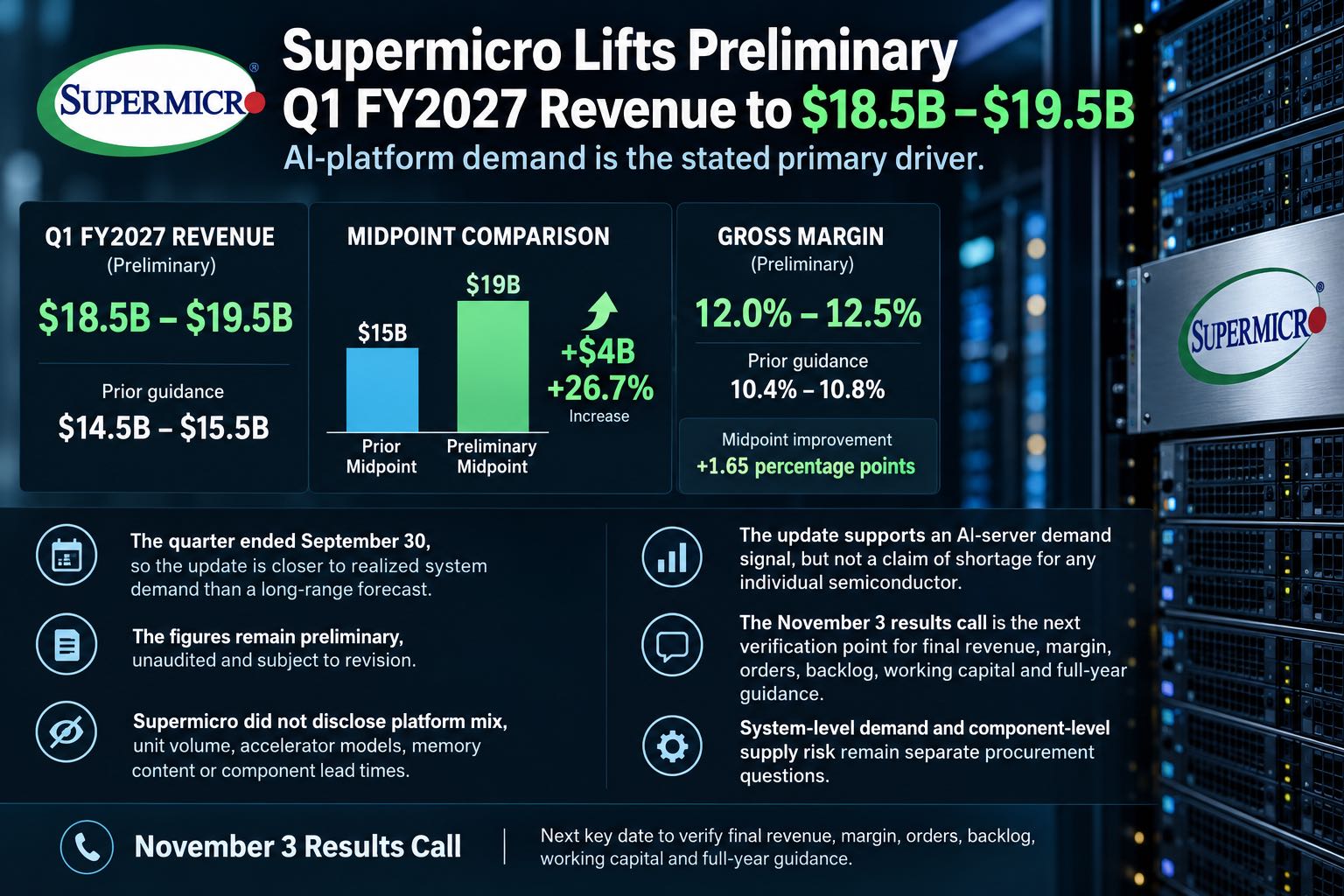
Supermicro estimates fiscal Q1 2027 revenue at $18.5 billion to $19.5 billion, lifting the midpoint 26.7% above prior guidance. Preliminary gross margin also exceeds the earlier range, with customer and product mix cited as the main reason. The completed-quarter update strengthens the system-level AI infrastructure demand signal without proving a shortage in any individual component category. Final results on November 3 remain the next checkpoint because the figures are unaudited and subject to revision.
A guidance reset driven by AI platform demand
Supermicro’s October 20 preliminary update resets the near-term scale of the AI infrastructure discussion. For the fiscal first quarter ended September 30, 2026, the company now estimates revenue of $18.5 billion to $19.5 billion, compared with its prior guidance of $14.5 billion to $15.5 billion. Both endpoints moved up by $4.0 billion, and the midpoint increased from $15.0 billion to $19.0 billion, a 26.7% uplift. Supermicro attributed the change primarily to increased demand for AI platforms. Because the period has already closed, the announcement is a preliminary estimate of business completed during the quarter rather than a multi-year market forecast. That makes it a relatively direct demand signal from the systems layer, although the figures remain unaudited and subject to closing adjustments.
Revenue scale and margin composition
The gross-margin update adds an important qualification to the revenue figure. Supermicro estimates a range of 12.0% to 12.5%, above the earlier 10.4% to 10.8% guidance. At the midpoint, the improvement is 165 basis points, and the company cites customer and product mix as the principal reason. This indicates that the upside was not described solely as additional low-margin shipment volume. Historical context remains necessary, however. Supermicro reported $11.1 billion of revenue and a 17.5% gross margin for the preceding fiscal fourth quarter. The new revenue midpoint is about 71% higher sequentially, while the preliminary margin midpoint is 5.25 percentage points lower. The combination points to rapid scaling with a materially different mix, not uniform pricing power across every AI system or component category.
A stronger system-level demand marker
The update is significant because server-platform revenue sits closer to physical deployment than announcements about model roadmaps or planned data-center capacity. Supermicro integrates processors, accelerators, memory, storage, networking, power and cooling into complete systems, so a quarterly upside of this size indicates that customers accepted substantially more platform value than the company had embedded in its August outlook. In that August release, Supermicro reported more than $60 billion in new fiscal fourth-quarter orders and record backlog, while setting fiscal 2027 revenue guidance at $65 billion to $72 billion. The October update does not refresh backlog or raise the full-year range. At the $19.0 billion midpoint, the first quarter would represent roughly 26% to 29% of that previously stated annual range, increasing the importance of shipment cadence and customer mix in later quarters.
Procurement implications across the AI rack
For OEM, EMS and procurement organizations, the signal supports a higher planning baseline for AI rack integration, but it does not establish a general component shortage. The release provides no unit count, accelerator generation, memory density, storage configuration, customer identity, regional mix, lead time or allocation data. A system-level revenue beat can pull demand forward across the bill of materials, yet the effect may be concentrated in a small number of high-value configurations or large customer programs. Relevant indicators therefore remain configuration-specific: confirmed build schedules, integration capacity, power and cooling readiness, memory and storage qualification status, and supplier delivery commitments. The evidence supports closer synchronization between system demand and component forecasts. It does not support a blanket inventory build or a claim that GPUs, DRAM, NAND, networking and power components are all tightening at the same rate.
The distinction between demand confirmation and supply constraint is central. A platform vendor can grow revenue by securing more allocations, improving integration throughput, shipping higher-value racks or serving a different customer set, even when some component markets remain balanced. Conversely, constrained components could be present without being named in the update. The release therefore raises the probability of sustained high consumption at the system level but leaves the distribution of that consumption unresolved.
Mix quality as the next operating variable
The margin revision also changes the interpretation of the demand surge. A 12.0% to 12.5% preliminary gross margin is better than management expected for the quarter, which suggests that the incremental revenue carried a more favorable customer and product mix than the original plan assumed. It remains well below the preceding quarter’s 17.5%, however, so the update does not establish a straight-line margin expansion story. For supply-chain participants, that gap matters because different mixes can imply very different component consumption patterns. Rack-scale systems, partial configurations, storage-heavy platforms and complete liquid-cooled deployments do not create identical demand across memory, networking, power delivery or thermal components. Until product detail is disclosed, the revenue surprise is best treated as confirmation of strong aggregate platform demand rather than evidence for any single component thesis.
Preliminary status and the November 3 checkpoint
The October release is deliberately narrow. It does not disclose final revenue, earnings, cash flow, updated annual guidance, new orders, backlog conversion, customer concentration or the composition of the AI-platform increase. Supermicro also states that its independent auditor has not audited, reviewed, compiled or performed procedures on the preliminary revenue and gross-margin estimates. Final results may therefore differ as financial statements are completed. The scheduled November 3 earnings call becomes the next confirmation point for the final ranges, the next-quarter outlook, the durability of AI-platform demand and any additional detail on mix or delivery timing. Until then, the defensible conclusion is specific: Supermicro’s completed September quarter appears materially larger and more profitable than its own guidance implied, while component-level supply and pricing conclusions remain unproven.