
When Repricing Becomes Category-Wide: What ST's Third 2026 Increase and 52-Week Power Lead Times Mean for OEM and EMS Sourcing
STMicroelectronics' third price increase of 2026 became effective on August 23, covering power ICs, general-purpose MCUs, NFC RF chips and power semiconductors, with automotive MCU pricing up a cumulative 15–20% and power device lead times running from 30 to 52 weeks. Read alongside comparable moves from TI, NXP, Infineon and onsemi, the event marks the point at which analog and power repricing stops being a supplier-specific negotiation and becomes a structural feature of the category. This analysis examines the cadence of the 2026 rounds, the way lead times and pricing reinforce one another, and the implications for OEM and EMS sourcing strategy through 2027.
The event and its tense
STMicroelectronics implemented its third price increase of 2026 with effect from August 23, covering power ICs, general-purpose MCUs, NFC RF chips and power semiconductors. The percentage applied in this round has not been disclosed, though the company has confirmed that automotive MCU pricing now stands 15–20% above prior levels on a cumulative basis. The stated drivers are consistent with the two earlier rounds: strong semiconductor demand across multiple end sectors, combined with rising costs in transportation, energy, raw materials and outsourced manufacturing services. For sourcing organisations, the operative detail is that the effective date has already passed, which means the order book has been divided into lines that were price-locked before August 23 and lines that were not, with the latter now transacting at the new level.
Cadence as a planning input
The three 2026 rounds form a measurable rhythm rather than a series of isolated events. The first was announced on March 24 and took effect on April 26, an interval of thirty-three days. The second was announced on May 28 and took effect on June 28, an interval of thirty-one days. The third was reported on August 21 and took effect on August 23. Measured between effective dates, the gaps run sixty-three and fifty-six days, placing the supplier on a roughly two-month adjustment cycle. The scope of coverage has widened at each step, beginning with automotive power components, extending into general-purpose MCUs and power ICs in the second round, and adding NFC RF in the third. This pattern of incremental category absorption suggests the supplier is working through its portfolio rather than repeating pressure on the same lines, and extrapolating the cadence places a fourth window around October. That extrapolation carries the status of a rhythm read rather than a supplier announcement, which makes it appropriate as grounds for building a price-adjustment mechanism into long-term agreement terms and inappropriate as a basis for forward quotation.
Lead times and the limits of contractual cover
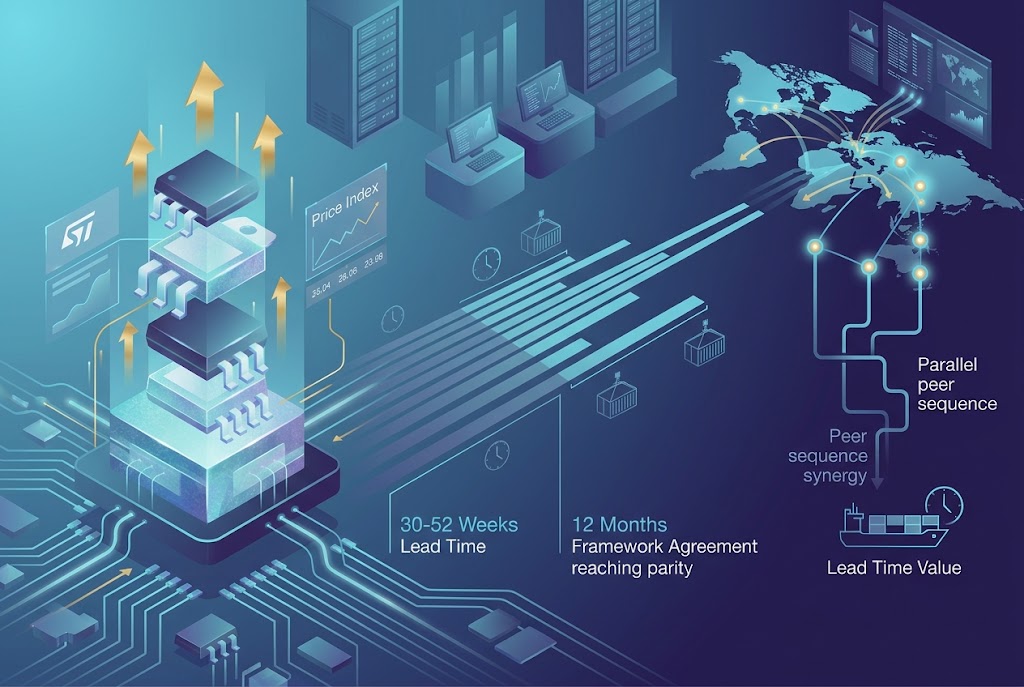
The lead time structure disclosed alongside the increase gives the pricing action its underlying condition. Power devices are running generally above thirty weeks, with certain categories reaching fifty-two weeks, which places delivery of parts ordered today in August 2027. The significance of that figure extends past stocking rhythm into the question of what contractual instruments can actually support. Most annual framework agreements provide twelve months of cover, so a fifty-two week lead time has reached parity with the agreement that is meant to secure it, and a delivery commitment made to a customer on the strength of such an agreement lacks structural support when the agreement can expire while the parts remain in transit. Lead time and price also reinforce one another rather than standing in sequence. A long order queue supplies the commercial conditions under which a supplier can reset pricing, and the reset price does nothing to shorten the queue, which means both figures should be read as two measurements of a single supply-demand state rather than as cause and effect.
From supplier action to category structure
The decisive change in this window is not the ST increase in isolation but its position within a peer sequence that now spans the analog and power complex. Texas Instruments has adjusted pricing five times in the past twelve months. NXP raised automotive and industrial MCU pricing 5–15% with effect from August 1. Infineon has run two rounds this year, with the July round lifting AI server power and automotive power device pricing 10–20%. onsemi implemented increases on selected categories effective April 1. ST's August 23 round is the most recent link in a chain that covers analog, power, MCU and RF front-end products across five major suppliers. The strategic consequence is that substitution logic premised on moving volume to an alternative supplier in order to avoid an increase no longer holds within these categories, because the alternative supplier is moving in the same direction on a comparable schedule. Second-source qualification retains its value in this cycle, but that value has relocated from price protection to lead time and availability, and sourcing strategies that continue to justify dual-source programmes on price grounds are working from a premise the market has already invalidated.
Implications for OEM and EMS sourcing through 2027
Several positions follow from this structure. Reconciliation of the pricing basis on open ST orders with distribution partners is warranted within the current week, given that the August 23 date has already split the order book. Volume requirements for the first half of 2027 in ST power devices align with a placement decision before the current quarter closes, which is what the thirty to fifty-two week lead time structure implies. Outbound quote validity of four weeks or less is consistent with a supplier cadence running at roughly two-month intervals, and validity periods materially longer than that carry exposure to being overtaken inside the next adjustment window. Automotive and industrial BOM quotations constructed on 2025 pricing have lost their validity as costing instruments, and a full recalculation pass within the quarter is the corresponding requirement.
Separating the analog cycle from the memory cycle
A final distinction bears on planning quality. The 2026 shortage narrative has been dominated by AI-driven memory allocation, and the gravitational pull of that narrative encourages treating all category tightness as expressions of a single underlying curve. Analog and power devices do not sit on that curve. The drivers in this round are capacity structure and cost pass-through, with no direct dependency on HBM allocation decisions or DDR5 contract pricing, and the relief timing is therefore not synchronised either. Expectations of memory market loosening in the second half of 2027 carry no read-across to automotive MCUs and power devices, and the assessment that structural tightness in these categories extends at least into mid-2027 stands unchanged after this round. Within a single bill of materials, memory and analog-power content require two independent stocking logics and two independent quote-validity horizons, and consolidating them under one planning assumption is the most consequential scheduling error available in the current cycle.