
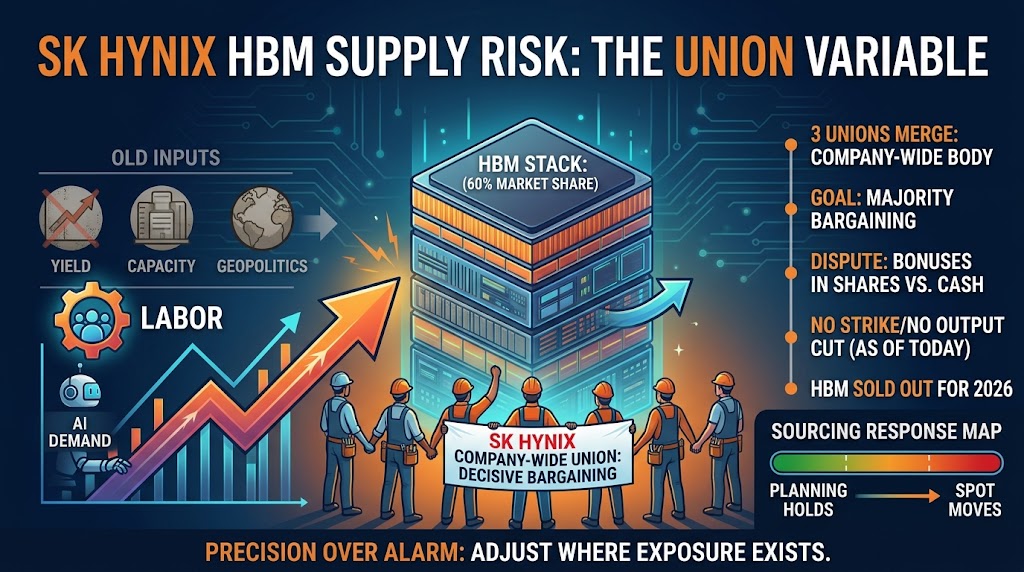
When Labor Risk Meets the Allocation Peak: What SK Hynix's Union Consolidation Signals for HBM and DDR5 Sourcing Strategy
SK Hynix's Korean workforce consolidated three unions into a single company-wide body on August 13, with annual wage talks deadlocked over whether bonuses are paid in cash or shares. For OEM and EMS sourcing teams, the specifics of a Korean labor negotiation matter less than the structural read: for the first time in this cycle, the world's largest HBM supplier carries an organized labor variable, and it arrives precisely as allocation is at its tightest. This piece frames what the development does — and doesn't — change for HBM, server DDR5 and enterprise-SSD sourcing strategy.
The temptation, reading a headline about a Korean union merger, is to file it under "local labor news" and move on. For sourcing organizations building AI infrastructure, that would be a mistake — not because a strike is imminent, but because the development changes the shape of the risk model that governs a large and growing share of the bill of materials.
Here is what happened. On August 13, SK Hynix's Korean employees merged three previously separate unions — organized by job category and by site — into a single company-wide union. Roughly 2,500 of the company's approximately 35,000 Korean employees joined in the initial wave, and the explicit objective is to recruit a majority of the workforce, which would give the consolidated body decisive control over collective bargaining. The immediate dispute concerns bonuses: under a ten-year agreement reached last year, the company committed to paying bonuses in cash from 10% of annual operating profit, and management is now proposing to pay the majority of that in shares instead. The comparison workers draw is with Samsung, which allocates a special bonus from 10.5% of semiconductor operating profit paid in stock. No strike or production disruption has been announced, and it is important to hold that fact firmly: as of today, nothing has changed on the physical supply side.
What has changed is the risk model. Until now, the supply-side variables a sourcing team had to price into an HBM or high-density DDR5 program were essentially three: process yield, capacity allocation, and geopolitics. The union consolidation adds a fourth — organized labor at the single most important supplier in the category — and it does so at the least forgiving possible moment. SK Hynix holds roughly 60% of the HBM market; its output cadence is not one input among many but the dominant determinant of tightness across the AI-server chain. A variable introduced at that node, during a window in which HBM is already sold out for 2026 and enterprise-SSD and server-DRAM allocation is being rationed by long-term agreement, does not need to materialize into a work stoppage to matter for planning. It only needs to exist to widen the distribution of outcomes a responsible sourcing plan has to cover.
The correct posture, therefore, is neither alarm nor dismissal. It is to treat the development as a defined, monitorable tail risk with two clear escalation triggers, and to adjust planning assumptions rather than immediate purchasing behavior. The first trigger is whether the unified union achieves majority membership; crossing that threshold converts bargaining leverage from symbolic to structural and materially raises the probability that the dispute is resolved on terms that involve, at some stage, the credible threat of collective action. The second trigger is any movement from negotiation into partial stoppage, slowdown, or output curtailment — the point at which the variable stops being organizational and becomes physical. Sourcing teams should map both triggers to a specific response: until they are met, existing allocation and scheduling assumptions hold; once either is met, the appropriate assumption is that secondary-market spot pricing on HBM-adjacent memory will move ahead of contract pricing, and that the cost of having under-secured 2027 allocation rises accordingly.
It is equally important to keep this variable analytically separate from the demand-side and competitive stories that ran the same week, because conflating them produces exactly the wrong conclusion. Samsung's reported HBM4 yield improvement to approximately 80% and NVIDIA's roughly $500 billion AI financing consortium are both real and both material, but they describe, respectively, the competitive landscape among suppliers and the durability of demand — neither loosens the physical supply that SK Hynix's output governs. A sourcing team that reads "Samsung is catching up in HBM4" as a signal that supply is about to ease, and simultaneously discounts the SK Hynix labor variable as noise, will have moved its risk assumptions in precisely the wrong direction. The more defensible synthesis is that demand remains structurally firm, competitive supply is improving only slowly and from a constrained base, and the dominant supplier has just acquired a new source of output uncertainty. That combination argues for more allocation discipline, not less.
For OEM and EMS teams, the practical implications differ by exposure. Programs built on HBM, high-density server DDR5, or enterprise SSD are directly exposed to SK Hynix output and should not be scheduled on the assumption of smooth second-half supply; where 2027 allocation is not yet secured, the case for locking it now is stronger this week than it was last week. Programs carrying consumer-grade DRAM, LPDDR, or eMMC are indirectly exposed — already pressured by the diversion of capacity toward AI servers — and the appropriate response is to ensure quotes carry explicit allocation-risk language rather than spot-based commitments. Parts with no SK Hynix exposure require no change, and treating them as if they did would only erode pricing credibility with customers. The discipline that distinguishes a mature sourcing function here is precision: adjusting exposure where exposure exists, and resisting the reflex to reprice the entire memory book on the strength of a single, still-unresolved labor development.
The broader lesson is about how supply risk is modeled in a supercycle. For most of the past eighteen months, the AI-memory story has been almost entirely a demand-and-capacity narrative — a machine running in one direction, with the only real questions being how fast prices rise and how long allocation stays rationed. SK Hynix's union consolidation is a reminder that the suppliers at the center of that machine are themselves organizations, subject to the same human and institutional pressures as any other, and that in a year of record profitability those pressures find expression. It does not change the direction of the cycle. It does add a line to the risk register that was not there before — and the sourcing teams that add it now, calmly and with defined triggers, will be the ones positioned to act half a step ahead if the variable ever moves from the negotiating table to the production line.