
Samsung Strike Risk Adds New Uncertainty to the AI Memory Supply Chain
Samsung's labor dispute may add new uncertainty to the global memory supply chain, while AI inference demand continues to support NAND Flash, SSD, DRAM and server memory demand. WingCore helps customers monitor sourcing risks and secure usable semiconductor inventory.
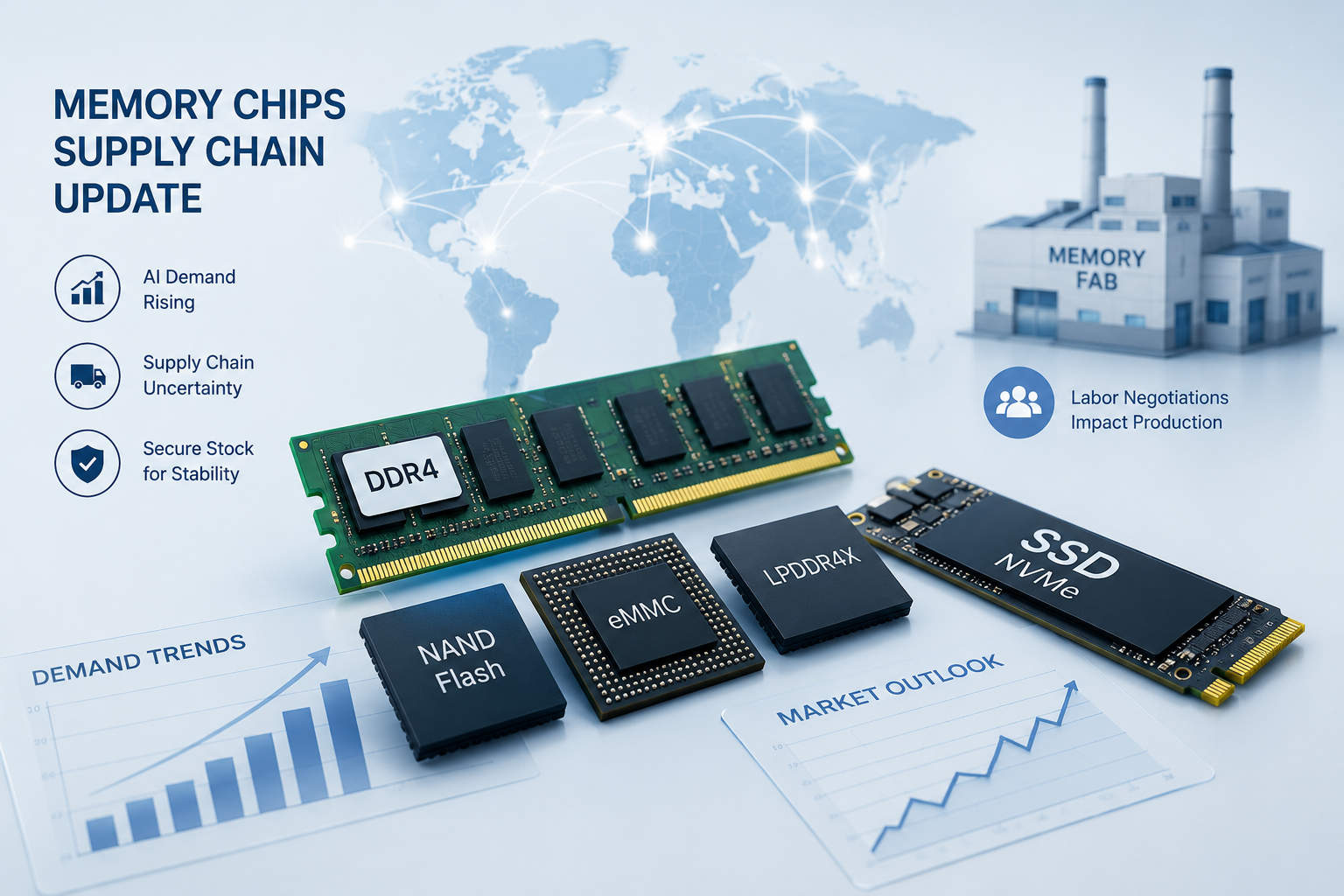
The memory chip market has been under pressure for a while now — AI demand keeps climbing, data center investment keeps expanding, and high-performance storage stays tight. Over the past two days, another risk has surfaced: Samsung Electronics and its South Korean labor union failed to reach a wage agreement, and the union is planning an 18-day strike starting in late May, involving more than 50,000 employees.
For the semiconductor industry, this is more than a labor news cycle. Samsung is one of the world's largest memory suppliers, and any uncertainty around its production or shipment schedules quickly shifts expectations across DRAM, NAND Flash, SSDs and AI-adjacent semiconductor markets. Even if production lines never actually pause at scale, buyers usually start adjusting their stocking, quoting and substitution behavior well in advance.
This arrives at a moment when memory is becoming a more central piece of AI infrastructure. As AI moves from model training into large-scale inference, data centers need faster, larger and more reliable storage. NAND Flash, enterprise SSDs, high-capacity DRAM, HBM and server memory have moved from supporting roles into structural parts of how AI actually scales. The sustained equity-market attention on Sandisk, Micron, SK Hynix and Samsung reflects exactly that shift.
For OEMs, EMS manufacturers, industrial equipment companies and automotive customers, the question is not whether one news event will immediately cause shortages. It is that supply chain uncertainty is rising across the board. Standard memory components that used to flow through routine procurement cycles may now require earlier planning, faster decisions, and closer verification of available lots.
This is especially true for DDR4, LPDDR4/4X, eMMC, UFS, NAND Flash, industrial SSDs and selected automotive or industrial memory devices. These are not the newest technologies, but many of them are still embedded in long-lifecycle projects where qualification and replacement approval take time. Even a modest supply disruption can quickly turn into procurement pressure.
Three habits help in this environment: confirm future demand earlier, map possible alternatives before a shortage forces you to, and evaluate whether the inventory you can find is actually usable for your project. For industrial and automotive applications, usable stock is not just about availability — brand, package, capacity, temperature grade, date code, traceability and qualification status all matter.
Our read at WingCore is that the current memory market is not driven by price alone. It is shaped by AI demand, capacity allocation, supply stability and project qualification requirements working together. A useful sourcing partner helps customers see which parts to secure early, which models have realistic alternatives, and which inventories actually carry market value.
As AI infrastructure continues to expand, the memory chip market is likely to stay volatile. Companies using DRAM, NAND, eMMC, UFS, SSD or LPDDR products will need clearer market visibility and more flexible sourcing support to navigate it.
WingCore continues to monitor global memory market developments and provide practical sourcing support for semiconductor buyers worldwide.