
Samsung Confirms LPDDR4 and LPDDR4X End-of-Life: The Quiet Forced Migration for Industrial and Long-Lifecycle Products
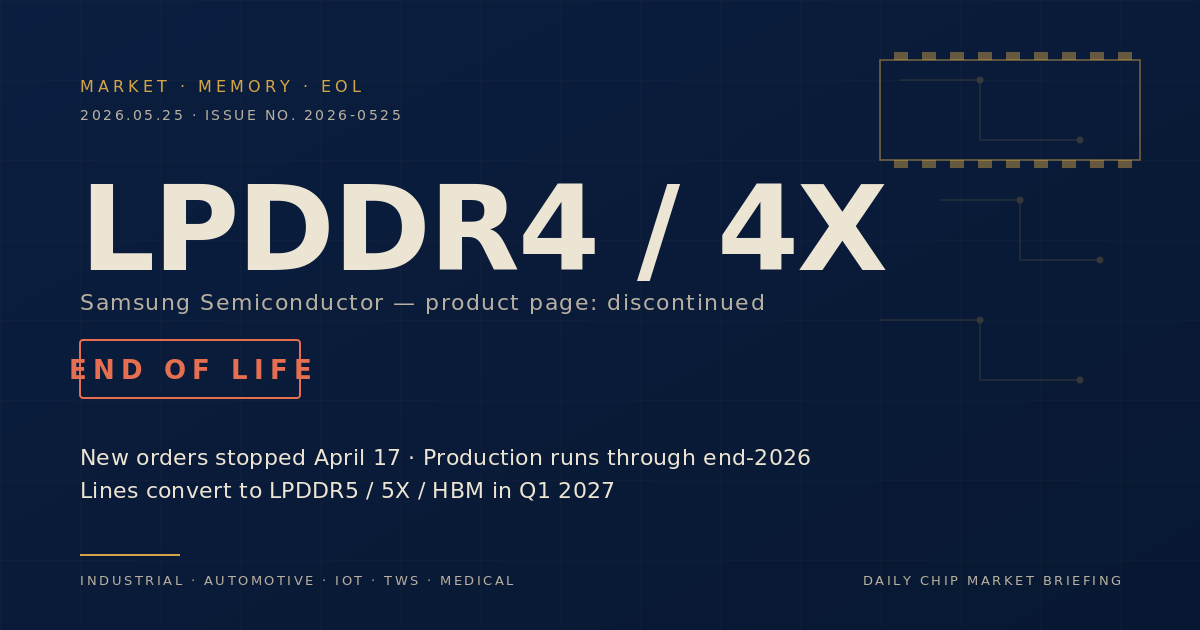
Samsung's product pages now mark LPDDR4 and LPDDR4X as discontinued. New orders have stopped, production runs out by end-2026, and lines fully convert to LPDDR5/5X and HBM in Q1 2027. For mobile SoCs the impact is manageable. For industrial, automotive infotainment, IoT and medical devices — where product lifecycles run 5 to 15 years — this is the start of a difficult forced migration.
Samsung has quietly closed a chapter that lasted more than a decade. The product pages for LPDDR4 and LPDDR4X on Samsung Semiconductor's website now carry the same line: "This product has been discontinued." New orders stopped being accepted on April 17. Existing commitments will be produced through the end of 2026. In the first quarter of 2027, the lines will be fully converted to LPDDR5, LPDDR5X and HBM.
For most consumer headlines, the framing is about smartphones — entry-level SoCs from Qualcomm and MediaTek that still pair with LPDDR4X, and the modest price pressure those handsets may face. That framing misses where the actual disruption lands.
The real exposure is not in smartphones
LPDDR4 and LPDDR4X are designed into far more than budget phones. They sit inside automotive infotainment head units, telematics modules, TWS earbuds, industrial gateways, medical monitoring equipment, ruggedized handheld devices, IoT controllers, single-board computers and a long tail of products that share one trait: a product lifecycle measured in years, not quarters.
A consumer phone refresh cycle is 18 to 24 months. An industrial gateway is often expected to ship the same hardware for 7 to 10 years. An automotive infotainment platform, once homologated, can stay in production for the full vehicle program — 8 to 12 years is common. A class II medical device may need to remain spare-part-supported for 10 years past last shipment.
For all of these categories, a 2027 cutoff is not a comfortable runway. It is a deadline that quietly arrived this April.
LPDDR5 is not drop-in
The natural reaction is "we'll move to LPDDR5." That reaction underestimates the cost of the migration.
LPDDR4/4X and LPDDR5/5X differ on three layers that matter for any production hardware. Operating voltage is different. Signal IO and timing are different. The package and ball pattern, while sometimes physically similar, are not always electrically interchangeable. In practice a switch from LPDDR4X to LPDDR5 is a board respin, often with PCB layer adjustments, signal integrity re-validation and a fresh PMIC configuration.
For products under regulatory or industry certification — automotive AEC-Q grade, medical 60601, industrial IEC certifications — a memory swap typically triggers re-qualification. Re-qualification means lab time, test cycles, and a paperwork chain that can run 6 to 18 months before product can ship again.
This is the part most procurement teams have not internalized. The Samsung announcement is not a sourcing problem. It is an engineering project.
What buyers can realistically do now
There are three actions that have to happen in parallel, not in sequence.
First, run a focused BOM audit specifically against LPDDR4, LPDDR4X and any memory module that uses Samsung dies. Identify the affected programs, their forecasted volume through 2030, and the latest date by which each program needs a confirmed memory source.
Second, open Last-Time-Buy conversations with authorized distributors immediately. Samsung's framing — "produced through end-2026 for existing commitments" — means allocation discipline is already tightening. Programs that file LTB demand in Q3 2026 will be competing for a smaller and smaller pool. Programs that wait until Q4 are likely to find the pool empty or rationed to top-tier customers.
Third, scope the LPDDR5 migration engineering effort honestly. Pull hardware, firmware and qualification teams into a single review. Estimate the cost in engineering hours, certification fees and lost ship time. For many products the answer will be that migration is the only viable path. For some — especially those late in the product lifecycle — the right answer may be to LTB enough inventory to cover the program through its natural end-of-life.
The wider direction the market is heading
Samsung is not alone in this move. Micron has signaled a similar intent across its older mobile DRAM portfolio. SK hynix is still producing LPDDR4X for now, which makes it the residual supply source for the next 12 to 18 months — but treating any single remaining supplier as a permanent fallback is not a supply strategy.
The underlying force is structural. HBM commands four to eight times the average selling price of LPDDR. With AI accelerator demand absorbing every wafer the leading-edge memory fabs can convert, the economics of keeping legacy LPDDR lines open get worse every quarter. The decision Samsung made in April is the decision the entire industry is on track to make over the next 18 months.
For OEMs, EMS providers and design houses, that means LPDDR4 will increasingly be sourced through three channels in declining order of comfort: remaining authorized stock from SK hynix and channel partners, last-time-buy allocations, and secondary market inventory whose value will quietly appreciate as primary supply disappears.
The first two require timing and supplier relationships. The third requires the ability to source, qualify and trace legitimate inventory in a market where the line between genuine remaining stock and questionable material is the difference between a working product and a recalled one.
What the Samsung announcement really signals is that the AI-driven reshaping of memory production has now reached the floor of the market. Not just HBM at the top, not just DDR5 in servers — the foundation layer that long-lifecycle electronics has relied on for a decade is being pulled out from under them. Programs designed in 2020 with a 10-year support assumption now have a 2-year window to decide their next move.