
Samsung's HBM4E Sample Lead Has Already Reshaped 2027 AI Memory Procurement — A Strategic Read for OEM and Hyperscale Buyers
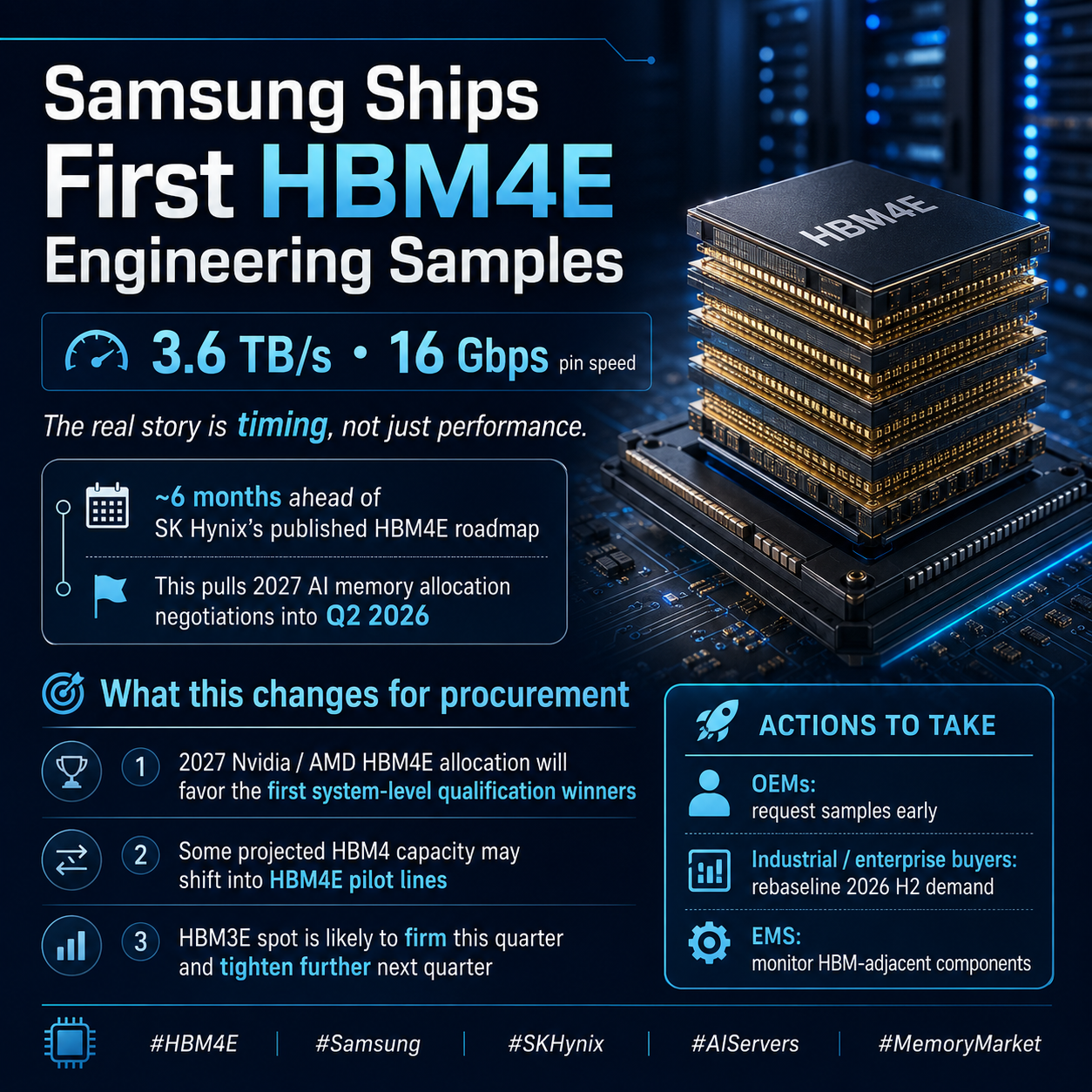
Samsung's May 30 delivery of the industry's first HBM4E engineering samples — at 3.6 TB/s and 16 Gbps pin speed — is being reported as a performance milestone. For OEM, EMS, and hyperscale procurement teams, the substantive impact is different. It pulls the 2027 HBM allocation negotiation cycle into Q2 2026, redistributes 2026 H2 HBM4 capacity assumptions, and forces buyers to revisit second-source qualification timelines that had been comfortably parked. This briefing outlines what changes and why the response window is narrower than it appears.
On May 30, 2026, Samsung shipped the industry's first HBM4E engineering samples — 3.6 TB/s bandwidth, 16 Gbps pin speed, 12-Hi stack — to its lead AI accelerator customers. The shipment lands approximately six months ahead of SK Hynix's published HBM4E sample plan (2H26) and roughly nine months ahead of SK Hynix's mass production target of 2027. Micron, with its 2026 HBM4 capacity already fully committed, is qualifying HBM4E on a timeline broadly consistent with SK Hynix.
Most market commentary on the event has focused on the performance numbers. For procurement teams making 2026 H2 and 2027 commitments today, the more consequential read is structural. Samsung's sample lead does three things that buyers must price into ongoing supplier negotiations.
First, it accelerates the start of 2027 HBM allocation conversations from where the industry had pencilled them — Q4 2026 or Q1 2027 — into this quarter. The HBM3E precedent is instructive. SK Hynix secured its disproportionate Nvidia share for HBM3E not by superior headline performance, but by completing system-level qualification ahead of competitors, and by being the first vendor with confidence in volume yields at the configurations Nvidia required. Whoever now completes system-level HBM4E qualification first is the vendor that locks the larger share of the 2027 Nvidia Rubin Ultra and post-Rubin allocation. Procurement teams that defer engagement with Samsung's HBM4E samples until the end of 2026 are effectively conceding their preferred 2027 allocation slot to peers who engage in the current quarter.
Second, the announcement shifts assumptions about Samsung's 2026 H2 HBM4 capacity. If Samsung is on track for HBM4E pilot production within the next two quarters — which the sample shipment implies — then a portion of the HBM4 capacity that customers expected to consume in 2026 H2 will quietly be reassigned to HBM4E pilot wafers and qualification runs. This is not a sudden allocation cut, and Samsung is unlikely to flag it explicitly. But the practical effect is that the 2026 H2 HBM4 supply visibility that buyers received in Q1 2026 carried an embedded optimism that is now less defensible. Order books drawn on that visibility should be revisited.
Third, the sample lead changes the HBM3E spot market dynamic that brokers and EMS contract manufacturers have been managing for the past two quarters. The chain runs as follows: Samsung HBM4E pilot capacity consumes a portion of Samsung HBM4 wafer output; HBM4 tightness for 2026 H2 server platforms drives customers to backfill with HBM3E; HBM3E spot supply, already drawn down by the rebound in H200-class deployments throughout the trade-truce window, comes under fresh pressure. Each link in this chain is independently observable today. Samsung's announcement is the trigger that connects them within a single quarter rather than across two.
The strategic response divides cleanly across three buyer profiles.
Hyperscale and AI accelerator OEMs should treat HBM4E sample engagement with Samsung as a Q2 priority rather than an H2 task. The qualification cycle for an HBM stack — covering die-level, package-level, and system-level testing — is typically six to nine months even when a vendor and customer have prior generational alignment. To be ready for 2027 H1 platform launches and 2027 H2 allocation lock-ins, qualification work needs to start now, in parallel with SK Hynix and Micron qual streams that began earlier.
Industrial and enterprise server OEMs that consume HBM3E in nearline AI inference and high-bandwidth accelerator cards should re-baseline their 2026 H2 demand against the assumption that HBM3E spot availability tightens through the third and fourth quarters. Long-term agreements with secondary channel partners covering decommissioned data-center pull HBM3E die make more sense in June than they will in September.
EMS contract manufacturers servicing AI server programs face an under-discussed second-order risk. HBM4E at 16 Gbps pin speed materially compresses signal integrity and power integrity margins on accelerator substrates. The companion components that ride alongside HBM4E qualification — high-speed retimers, re-drivers, low-noise PMICs, and high-precision regulators — will tighten on the same timeline as the HBM4E ramp. The supply chain narrative of the past two quarters has centered on HBM itself; the next two quarters will add the HBM-adjacent components to the same tight list.
The closing observation worth holding is the difference between a performance story and a timing story. A performance story changes what your next platform can do. A timing story changes when you have to make your decisions. Samsung's HBM4E sample shipment is unambiguously the second kind. The narrowing of the response window is the actual content of the announcement, and procurement teams that read it that way will spend the next twelve months negotiating from a stronger position than peers who treated it as a press release about bandwidth.