
When a Memory Keynote Meets an Allocation Wall: What Samsung's FMS 2026 Roadmap Does — and Doesn't — Do for 2027 Sourcing
Samsung's FMS 2026 unveil of zHBM, HBM5, and a 400+ layer V10 NAND is a genuine statement of technical direction — and a genuine trap if procurement teams read a 2028 roadmap into 2027 supply. This piece separates roadmap from availability, and lays out how OEM and EMS buyers should — and shouldn't — let next-gen density inform allocation decisions over the next 18 months.
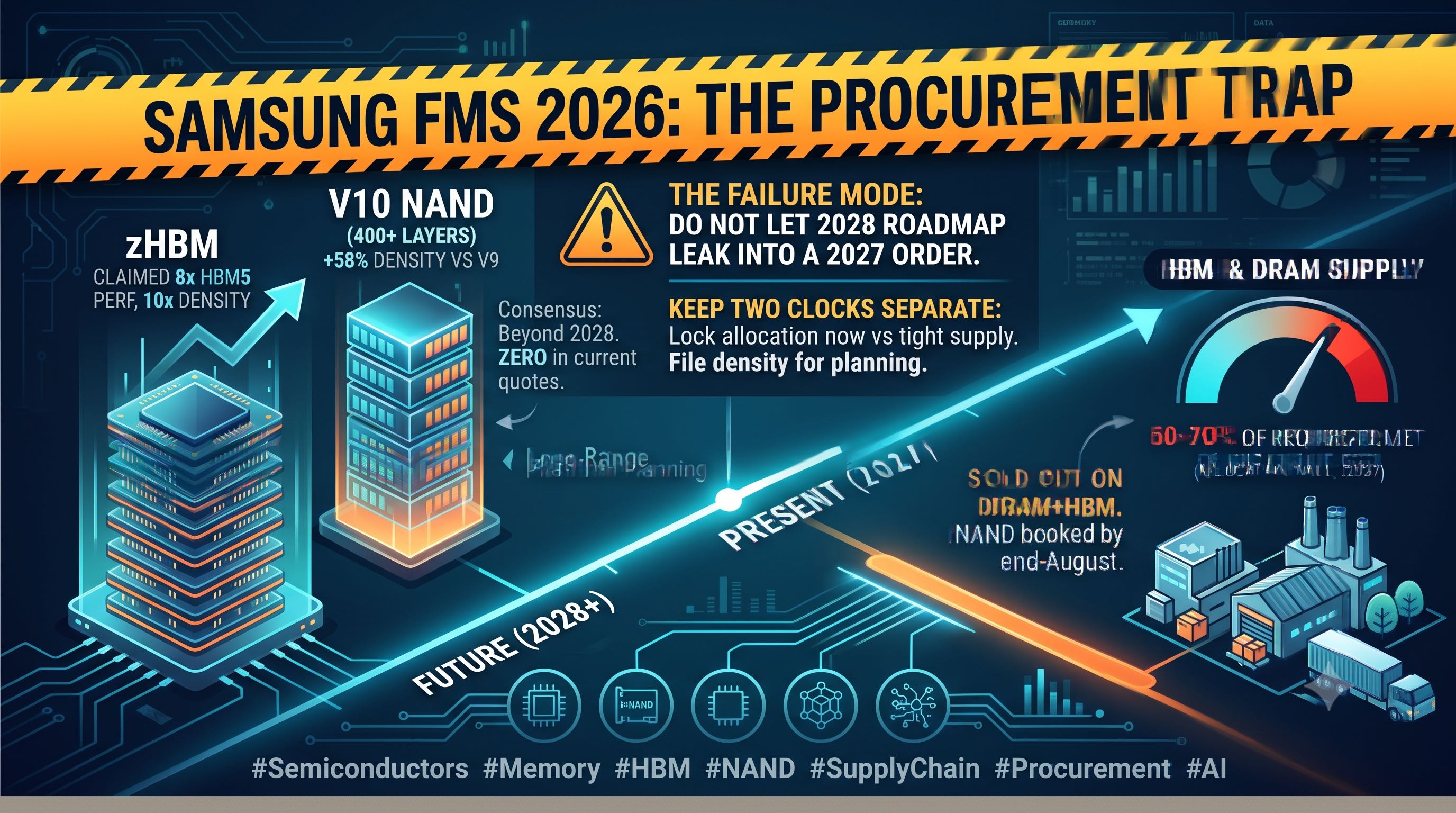
At the Future of Memory and Storage 2026 conference in Santa Clara on August 4, Samsung laid out an unusually complete picture of where AI memory is heading. The centrepiece was zHBM — a fully 3D-stacked architecture that places high-bandwidth memory directly on top of the accelerator, with Samsung claiming roughly eight times the performance of HBM5, more than ten times the density, triple the energy efficiency, and thermal resistance cut by more than half. Alongside it, the company revealed the industry's first 400-plus-layer V10 BV-NAND, delivering a 58 percent density gain over the current V9 generation, plus zNAND-O and confirmation that HBM4E has been sampling to customers since May. For anyone building a two-to-three-year technology narrative, it was a strong showing.
For anyone building a 2027 sourcing plan, it changes almost nothing — and understanding why is the more valuable exercise. The critical qualifier attached to zHBM is that it carries no production timeline. Industry expectation places it only after HBM5 reaches volume, which realistically means beyond 2028. A concept that stacks memory on logic with multi-wafer bonding and tens of thousands of I/O connections is architecturally impressive and commercially distant at the same time. None of it is available to quote against in the planning horizon that matters to most buyers today.
The V10 NAND announcement deserves a more careful read, because a density number is the kind of figure that quietly reshapes expectations. A 58 percent density improvement over V9 is a real process step, and over time it does bend the cost-per-bit curve for high-capacity storage in a meaningful way. But density at the wafer level is not supply at the channel level. The part still has to move through qualification, tooling, and yield ramp before it translates into bits a buyer can actually receive, and even then the near-term allocation picture is governed by capacity that was committed long ago. A denser die in the roadmap does not add gigabytes to next year's shipment schedule.
This distinction matters more than usual right now because of the backdrop the keynote landed against. The market is operating under a hardening narrative that 2027 DRAM and HBM capacity across Samsung, SK Hynix, and Micron is effectively sold out, with buyers reportedly receiving only 60 to 70 percent of requested allocation and NAND expected to be fully booked by the end of August. That is a structural allocation wall, not a pricing wobble, and it is the single most important fact shaping memory procurement into next year. Dropping an eight-times-performance, plus-58-percent-density roadmap into that environment invites exactly the wrong inference — that relief is arriving. It is not. The wafers that would relieve 2027 are already allocated, and a next-generation node cannot ramp fast enough to change that math.
The practical guidance for OEM and EMS buyers, then, is to keep two clocks strictly separate. On the procurement clock, the priority through the back half of 2026 is unchanged: lock 2027 allocation now, negotiate long-term agreements against today's tight supply, and do not let a spec keynote soften the urgency of getting into the queue. On the near-term tactical clock, tight parts — DDR4 and DDR5 spot, enterprise SSD and QLC NAND — continue to demand short orders, quantity locks, and compressed quote windows, with DDR4 spot still trading inverted above HBM3e as of this week. The roadmap belongs to a third, much longer clock: 2028-and-beyond product architecture, where the V10 density step and the eventual arrival of zHBM genuinely should inform platform decisions and long-range cost models.
The failure mode to avoid is letting the third clock leak into the first. Every cycle has a moment where a supplier's technical vision and a buyer's immediate scarcity are described in the same headlines, and the discipline that separates a well-run sourcing function from a reactive one is the refusal to trade a 2028 roadmap against a 2027 order. Samsung's FMS showing is a credible map of where memory is going. It is not, and should not be mistaken for, a schedule of when your parts arrive.