
When Memory Costs Cross Into Logic: What Qualcomm's September Across-the-Board Hike Signals for OEM and EMS Sourcing Strategy
Qualcomm's decision to raise Snapdragon prices across the board on September 1 — explicitly attributed to wafer, test, advanced-packaging, and memory input costs — marks a structural inflection. Memory inflation is no longer contained to the memory line item; it is now propagating into logic and SoC pricing. This piece examines the pass-through mechanism, the likelihood of follow-the-leader repricing across SoC vendors, and what OEM and EMS buyers should change in their BOM cost models and negotiation posture.
For the better part of a year, the memory shortage has been treated by procurement organizations as a bounded problem. DRAM and NAND were the line items that moved; everything else on the bill of materials was assumed to hold. Buyers built their quarterly cost models around that boundary, hedging memory separately and leaving logic, analog, and passive lines to their own, slower-moving dynamics. Qualcomm's September announcement is the clearest sign yet that the boundary has failed.
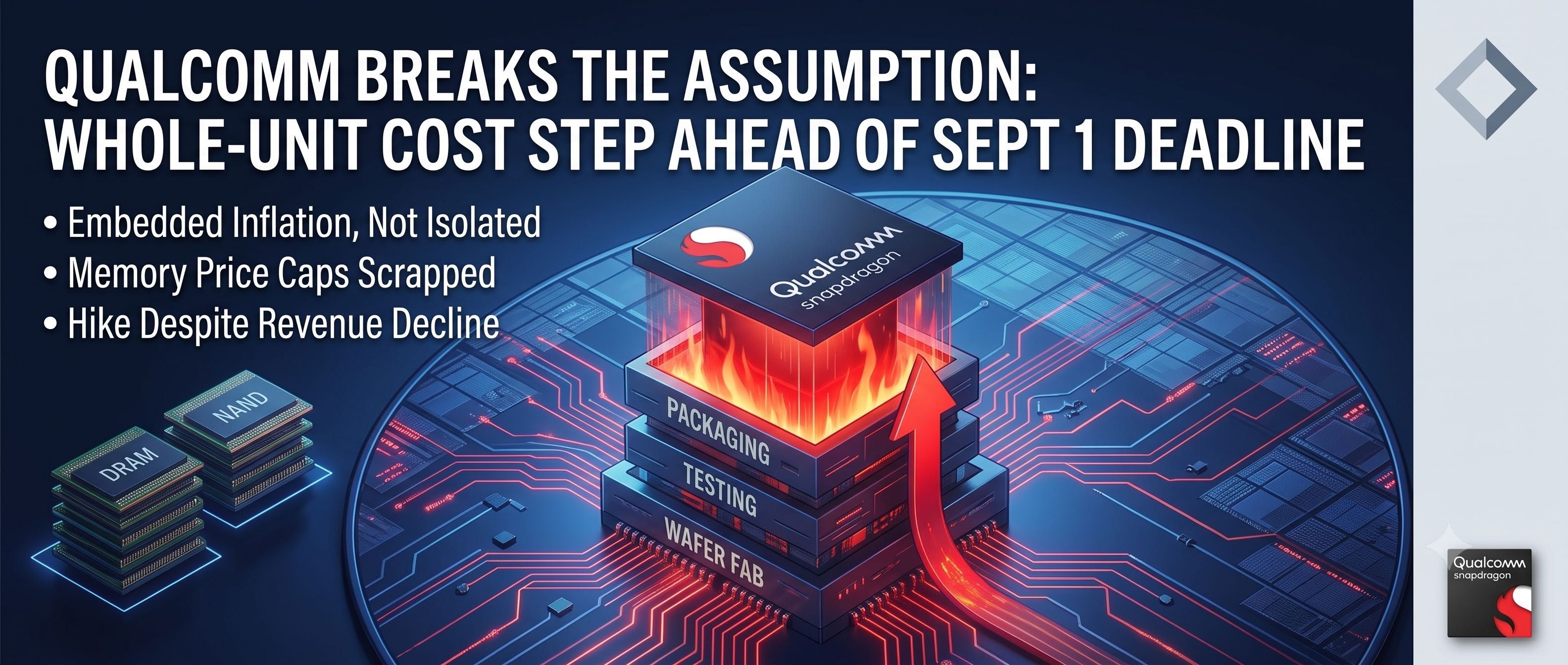
On its fiscal third-quarter earnings call, Qualcomm confirmed an across-the-board price increase on its Snapdragon platform effective September 1. The company declined to quantify the move, but market expectations cluster in the double-digit percent range. What matters more than the magnitude is the rationale management chose to make public. Chief Executive Cristiano Amon framed it in the plainest possible terms — costs went up, so prices go up — and the company attributed the increase to a broad-based rise in input costs spanning wafer fabrication, assembly and test, advanced packaging, memory, and other materials. In other words, this is not a margin-expansion play dressed up as cost recovery. It is a supplier that can no longer absorb its own input inflation, choosing to pass it downstream in a single, announced step.
The significance for sourcing is that memory inflation has changed form. Until now, it arrived on a buyer's desk as a memory quote: a higher DRAM contract, a steeper NAND print, an enterprise-SSD lead time stretching past the quarter. Those are line-item events, and they can be hedged at the line-item level. What Qualcomm has done is convert that same underlying inflation into a logic-device price sheet. The cost did not originate in the Snapdragon die; it originated in the memory, substrate, and packaging that surround it — and it is now embedded in a single price the OEM pays for the SoC. That embedding is precisely what makes it harder to manage, because it is no longer visible as a memory cost at the point of purchase.
The pass-through mechanism is worth stating explicitly, because it determines where the next moves come from. A module maker or SoC vendor that consumes rising memory and packaging inputs faces a choice between compressing its own margin and raising its price. For most of the past several quarters, competitive dynamics and soft end-demand pushed these vendors toward absorption. Qualcomm's handset chip revenue was down roughly 20 percent year over year in the quarter, with the company itself pointing to a bottoming China market — hardly the backdrop of a vendor raising prices from a position of demand strength. That it is raising anyway tells you the cost pressure has overwhelmed the demand caution. And once the largest merchant SoC supplier has moved openly, the decision to follow becomes materially easier for the rest of the field. MediaTek and other SoC houses face the same input curve; Qualcomm's move de-risks their own repricing by establishing that the market will accept it.
Upstream conditions make a reversal unlikely in the planning horizon that matters to a buyer setting Q4 and early-2027 BOM costs. SK hynix has reportedly removed price caps from its long-term supply agreements, diverging from the more conservative structure Micron has maintained, which means contract prices can now track spot more fully when shortages push the market higher. Samsung has been targeting increases of up to 20 percent on third-quarter DRAM, with independent forecasts modeling a landing in the low-to-mid teens. The rate of increase is narrowing from the extraordinary prints of early 2026, but narrowing is not the same as peaking, and there is no ceiling structure left at the top supplier to cap the pass-through. For a buyer, the practical implication is that the input cost feeding Qualcomm's decision is not going to relax on a timeline that would make waiting a viable strategy.
What should change in an OEM or EMS sourcing posture follows directly. First, the pre-September pricing window on Snapdragon-based designs should be treated as a firm deadline, not a monitoring exercise; where demand is committed, the pre-hike quote should be locked now. Second, and more consequentially, the BOM cost model should stop treating memory as the only inflating line. The whole-unit cost of a Snapdragon-based build is about to step, and any customer-facing cost commitment that assumed a stable SoC line needs to be revisited before it becomes a loss. Third, buyers should pre-position for follow-the-leader repricing rather than react to it; a design running an alternative SoC is exposed to the same input curve, and a formal notice from that vendor should be an expected event, not a surprise. Fourth, on the memory lines themselves, the negotiation posture should hold: short-dated validity, tight-part framing, and a readiness to counter the "the increase is slowing, so it must be topping" argument with the cap-removal and shortage-duration evidence that is now on the record.
The larger point for anyone managing a multi-quarter cost model is that the mental boundary between memory and everything else has stopped being useful. The shortage that began in the DRAM and NAND lines is now propagating through the devices that consume them, and it is doing so in the form of announced, embedded price increases that are far harder to isolate and hedge than a contract print. Qualcomm is the first large supplier to make that propagation explicit. The organizations that adjust their models to expect it — rather than the ones that keep pricing memory as a contained problem — will be the ones holding accurate landed costs when the second and third SoC vendors follow.