
C- and X-Band Radar Front Ends Move From Discrete RF Chains to System-Level Architectures
Qorvo’s October 2 C- and X-band launches combine beamforming, direct FEM drive, switched BAW filtering and high-efficiency GaN power. Selected external drivers, filters, switches and routing stages can be removed, while qualification shifts toward the complete receive-and-transmit chain. Mixed sample and production status makes lifecycle and approved-configuration control central to procurement.
Architecture-Level Change
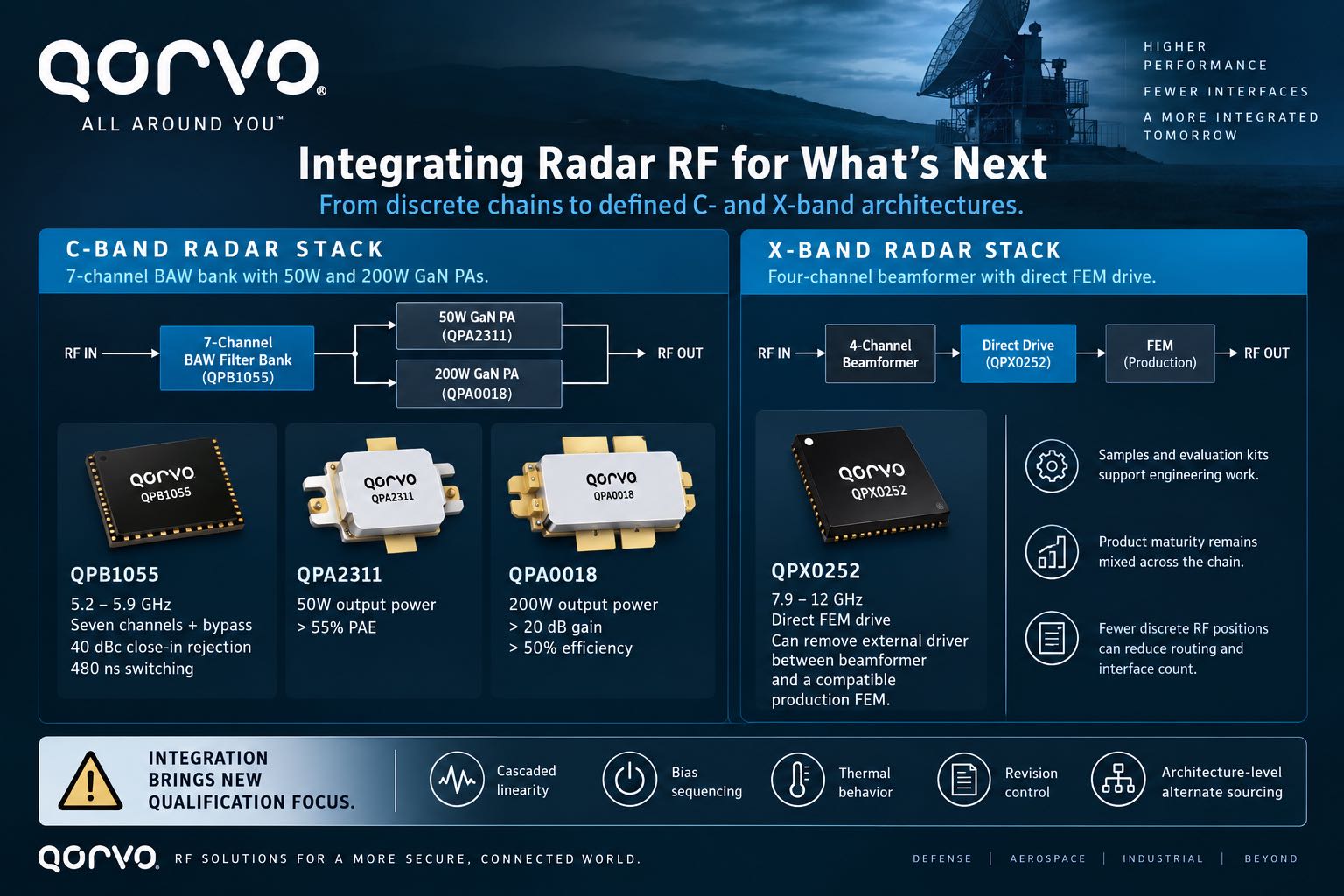
Qorvo’s two radar releases at European Microwave Week on October 2, 2026, point to a broader change in RF front-end design. The company introduced an X-band architecture centered on the QPX0252 beamformer IC and compatible front-end modules such as the QPF5012, while its C-band release combined the QPB1055 switched filter bank with the QPA2311 and QPA0018 GaN power amplifiers. Taken together, the products shift more of the receive, transmit and control chain from a collection of independently selected parts toward a defined system architecture.
For radar OEMs, EMS providers and component buyers, the commercial significance is not limited to a lower line-item count. Mechanical density, RF interfaces, DC power, heat and control timing are increasingly shaped by interactions among a matched group of devices, making architecture-level sourcing and qualification more important than isolated component comparison.
X-Band Direct FEM Drive
The QPX0252 is a four-channel beamformer IC covering 7.9 to 12 GHz. Its transmit output can directly drive compatible Qorvo front-end modules, including the QPF5012, removing the external driver amplifiers normally placed between a beamformer and the FEM. Qorvo also positions companion gate-bias, drain-bias and RF switch-control devices around the same architecture, with support for sub-100 ns transmit/receive switching.
The company reports that a compatible FEM can establish a low system noise figure while the QPX0252 operates in a high-linearity receive mode. Qorvo’s own system analysis shows up to 20 dB higher cascaded input P1dB than other market offerings. That figure is a supplier-reported system comparison rather than an independent benchmark, but it clarifies the design objective: reducing lattice content without treating receive linearity, transmit drive and switching control as separate optimization problems.
C-Band Frequency Agility and Power
The C-band portfolio addresses a different source of RF complexity. Qorvo describes the QPB1055 as an integrated C-band BAW switched filter bank. It combines filtering, switching, routing and control across seven channels plus a bypass path from 5.2 to 5.9 GHz, with 40 dBc close-in rejection and 480 ns switching.
On the transmit side, the 50 W QPA2311 covers 5.3 to 5.9 GHz and provides more than 55% power-added efficiency across the 5 to 6 GHz band, along with drop-in compatibility with the TGA2307-SM footprint. The two-stage QPA0018 delivers 200 W, more than 20 dB gain and greater than 50% efficiency across 5.2 to 5.9 GHz. Its gain allows the external high-power driver stage and associated DC load to be removed.
The resulting architecture links frequency-agile reception with defined 50 W and 200 W transmit paths rather than requiring separate filter, switch, routing and driver selections for every implementation.
Qualification Boundary Expansion
A reduced BOM does not mean a smaller qualification program. It changes the boundary of qualification. Fewer external drivers, filters, switches and routing elements can lower placement count, interface count and board-space pressure, but validation must cover the complete receive and transmit path over frequency, power and temperature.
Channel-to-channel behavior, cascaded linearity, insertion loss, switching transients, bias sequencing, thermal margins and control-software timing become system-level acceptance items. Traceability also expands from part numbers to compatible device combinations, evaluation-board revisions, reference layouts and supplier configuration guidance.
Procurement records therefore need to identify each device revision together with the validated pairing, bias sequence, reference-layout baseline and evaluation-board version. A substitute or PCN review can no longer stop at package compatibility. It must determine whether the changed element preserves chain-level gain, phase, switching and thermal assumptions across the intended operating profile.
For EMS and contract manufacturing programs, process controls may become simpler where discrete stages disappear, while change control can become more consequential because one component revision may affect several linked performance parameters. Alternate-source assessment similarly moves from footprint matching toward functional equivalence across the architecture.
Mixed Availability and Sourcing Control
Availability is mixed by product stage and therefore matters to sourcing plans. QPX0252 samples and evaluation kits are available now, compatible X-band FEMs are already in production across multiple power levels and configurations, and the related bias and RF switch-control devices are sampling. For the C-band family, Qorvo states that samples and evaluation kits for the QPB1055, QPA2311 and QPA0018 are available now.
This supports engineering evaluation and early qualification, but it does not place every device at the same production maturity. Prototype BOMs may consequently combine production FEMs with newly sampled beamforming, filtering or control devices, widening the scope of lifecycle, PCN, revision and approved-vendor-list review.
Architecture-level sourcing can reduce component count while concentrating dependency on one supplier’s device combinations, application data and reference implementation. Commercial review therefore has to separate technical availability from quoted volume, committed lead time, controlled revision and long-term support. The October 2 announcements provide no pricing, lead-time, allocation or capacity data, so they do not support conclusions about shortages or price increases.
The immediate procurement signal is architectural concentration: fewer discrete RF positions, accompanied by broader platform-level qualification and supplier-dependency analysis.