
When a Chipmaker Beats, Raises Guidance, and Still Sells Off: What NXP's Q2 2026 Automotive Print Signals for OEM and EMS Sourcing Strategy
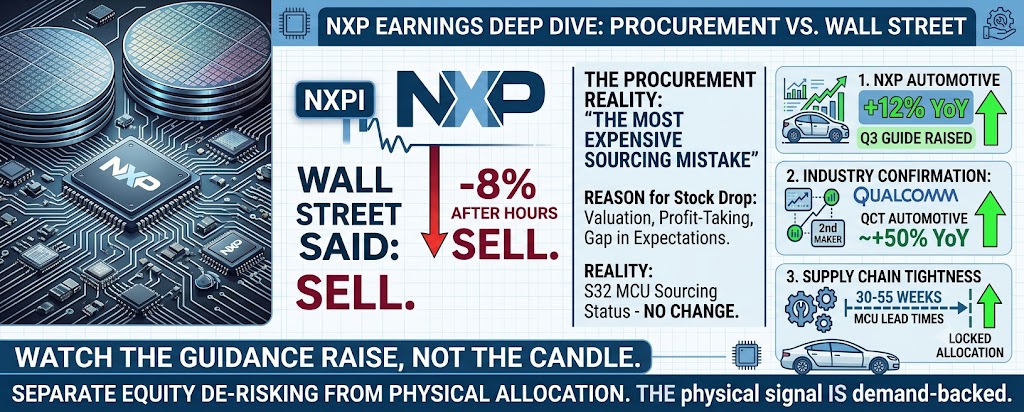
NXP delivered a record automotive quarter in Q2 2026 — a revenue and EPS beat, +12% automotive growth (+17% ex-MEMS), and raised Q3 guidance — yet the stock fell roughly 8% after hours. For OEM and EMS procurement teams, the more useful signal is the widening gap between capital-market sentiment and physical-allocation reality. This piece unpacks what the print means for automotive-grade MCU, analog, and memory sourcing over the next two quarters.
On 28 July 2026, after the US close, NXP Semiconductors reported Q2 2026 revenue of $3.5 billion and adjusted EPS of $3.61, both ahead of consensus at roughly $3.50. Automotive revenue reached $1.94 billion, up 12% year over year — or 17% once you exclude the MEMS-sensor business the company divested earlier in 2026. Management noted that its automotive growth drivers, spanning software-defined vehicle, electrification, and connectivity, now represent about 47% of automotive revenue and are compounding in the low-20% range. For the third quarter, NXP guided to a revenue midpoint of roughly $3.75 billion and an adjusted-EPS midpoint near $4.11, a step up from the quarter it had just reported.
Despite that, the shares fell about 7.7% in after-hours trading, from a prior close of $267.67 to around $247. The reflexive procurement interpretation — a supplier's stock falling must mean demand is softening and prices will ease — is almost exactly backwards, and acting on it would be a costly error. The sell-off reflects valuation and an expectations gap: the market had already discounted an automotive recovery, and a print that met rather than dramatically exceeded that expectation invited profit-taking. None of that changes the physical availability of an S32 vehicle-control MCU, an in-vehicle Ethernet PHY, or an automotive power-management device on a buyer's line.
The physical-supply signal sits in the operational lines, not the share price. Automotive revenue up 12% (17% ex-MEMS), a raised forward guide, and a growth-driver mix compounding in the low-20s all point to automotive silicon demand that is not rolling over. Qualcomm, reporting its own fiscal Q3 on 29 July, pre-signaled QCT automotive revenue growth of approximately 50% year over year — a second major supplier corroborating the same direction. Against a backdrop where microcontroller lead times still run 30 to 55 weeks, automotive-grade memory increasingly moves to long-term contract, and passive-component allocation remains locked, the tightness in automotive parts is demand-backed rather than sentiment-driven. The after-hours move has no bearing on quote posture.
For OEM and EMS teams, the practical implications are straightforward but easy to get wrong under commercial pressure. First, resist the negotiating frame that reads a supplier's share-price decline as a mandate to concede on price; the correct discipline is to separate equity de-risking from allocation reality, because quarterly shipments and forward guidance both moved up. Second, continue to treat automotive MCU, analog, and auto-grade memory as allocation-constrained, long-lead categories — the shortfall that Tier-1s cannot cover on their own long-term agreements continues to spill into the distribution and secondary channel, where spot inventory retains genuine pricing power and short quote validity is warranted.
Third, and more strategically, watch the guidance revision rather than the daily tape. A supplier willing to raise next-quarter revenue guidance is expressing confidence in its backlog and utilization, and that is a far more reliable read on the automotive cycle than any single after-hours print. Fourth, procurement should internalize the 'financial market versus physical allocation' divergence as a durable analytical habit. This was not unique to NXP in the last week: SK Hynix also posted record Q2 results while its shares had de-rated ahead of the print. Both memory and automotive silicon confirm the same underlying pattern — suppliers are earning record margins, parts remain tight, and capital-market sentiment moves on its own schedule that procurement should not mistake for a demand signal.
The takeaway for sourcing strategy is a posture of continuity, not relief. NXP's quarter was up, its next-quarter guide is up, and the automotive supply picture — long MCU lead times, contractualized memory, locked passives — is unchanged by an 8% share-price move. Teams that hold their allocation discipline through the noise of an earnings-week sell-off will be better positioned than those that read a supplier's valuation correction as an invitation to loosen their own terms.