
RTX Spark Establishes a Multi-OEM Windows Platform for High-Capacity Local AI
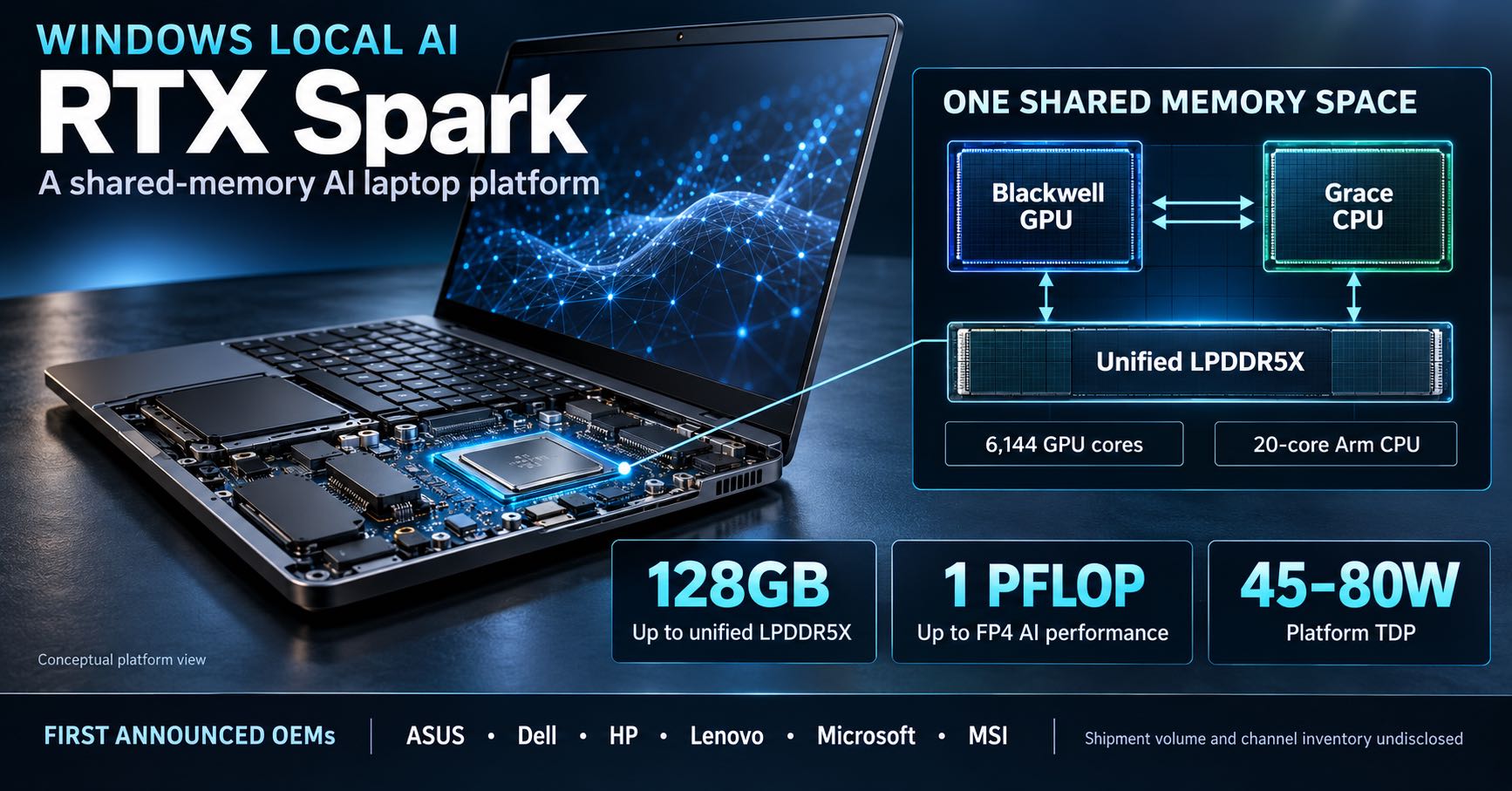
NVIDIA launched RTX Spark laptops on October 16 through ASUS, Dell, HP, Lenovo, Microsoft and MSI. The platform combines Blackwell RTX graphics, a Grace Arm CPU and unified LPDDR5X memory, with the upper configuration reaching 6,144 GPU cores, a 20-core CPU, 128GB of memory and 1 PFLOP of FP4 AI performance. A second tier uses 5,120 GPU cores, an 18-core CPU, up to 32GB of memory and 827 TFLOPS of FP4 performance. The launch expands local AI capacity within Windows, while shipment volume, channel inventory and broad component demand remain undisclosed.
A Platform Launch Across Six PC Brands
NVIDIA's October 16 announcement established commercial availability for RTX Spark laptops from ASUS, Dell, HP, Lenovo, Microsoft and MSI. The vendor list turns RTX Spark into a multi-OEM Windows platform rather than a single-system experiment. It also gives the architecture several routes into professional mobile computing, ranging from established enterprise PC portfolios to devices sold directly within the Windows ecosystem.
The common platform does not erase product-level differences. Each manufacturer retains control over industrial design, thermal capacity, storage, connectivity, display, firmware, support and regional sales execution. Commercial availability therefore needs two readings: the architecture has reached the market, while the actual configuration and delivery position remain specific to each OEM SKU. That distinction is central to enterprise qualification and supply planning.
Blackwell and Grace Redefine the Mobile Compute Stack
RTX Spark combines a Blackwell RTX GPU with a Grace Arm CPU. NVIDIA states that MediaTek collaborated on the CPU design, adding a clear partner relationship to the silicon platform. The result is not simply a discrete GPU attached to a conventional notebook processor. CPU computing, accelerated AI and graphics are organized around a shared memory subsystem within one mobile platform.
This design expands the range of processor architectures represented in high-performance Windows PCs. It also moves compatibility analysis closer to the center of the purchase decision. Arm-native software, emulation, GPU frameworks, drivers, security controls and fleet-management agents all affect deployment readiness. Hardware capability can create the addressable workload range, but the software environment determines how much of that range is usable in production.
Two Configurations Create Distinct Deployment Classes
The upper published configuration includes 6,144 GPU cores, a 20-core Arm CPU, a 256-bit memory interface and up to 128GB of unified LPDDR5X memory. NVIDIA lists AI performance of up to 1 PFLOP at FP4 precision. The platform TDP range is 45W to 80W, indicating that OEM thermal implementation remains material to sustained mobile performance.
The second configuration uses 5,120 GPU cores and an 18-core Arm CPU, with up to 827 TFLOPS of FP4 performance and up to 32GB of memory. This is a material separation in memory capacity as well as compute resources. The upper tier is positioned for models and working sets that benefit from a large local pool, while the lower tier addresses workloads that fit within a more conventional mobile memory envelope. Neither tier should be treated as representative of every announced laptop.
Unified LPDDR5X Expands Local Model Capacity
The defining architectural feature is the unified memory pool shared by the CPU and GPU. In the 128GB configuration, model weights, context, application state and working data can reside within a larger common address space than systems constrained by a smaller discrete graphics memory allocation. This is particularly relevant to local inference, model development and selected tuning workflows where model fit is a gating factor.
Capacity alone does not determine application performance. Memory bandwidth, data movement, model quantization, software kernels and sustained power all influence the usable result. The 128GB ceiling also belongs to the highest configuration, not to the full family. The launch therefore demonstrates a high-capacity local AI design, but it does not establish an industry-wide change in PC memory content or a market shortage of LPDDR5X.
Local AI Becomes One Layer of Hybrid Intelligence
Microsoft's hybrid intelligence framework places local devices and cloud systems in complementary roles. RTX Spark adds a more capable local layer for workloads shaped by response time, offline execution or data-residency requirements. Model experimentation and inference can occur on the endpoint when the workload fits, while cloud infrastructure continues to provide elastic training, centralized services, collaboration and fleet-level control.
This model avoids treating local AI as a complete substitute for data-center computing. Enterprise deployments generally span identity, policy, model distribution, observability and shared data services even when inference runs locally. The practical value of RTX Spark therefore depends on a workload map that separates model capacity, latency, privacy, energy use and operational management. Peak FP4 throughput answers only one part of that map.
OEM Scale Improves Choice but Increases Validation Work
Six named brands create the conditions for broader adoption and multiple commercial form factors. They also introduce variance across cooling, battery behavior, memory capacity, storage, I/O, wireless implementation and support terms. A platform-level comparison can narrow the field, but enterprise buyers and system integrators still need exact model data for qualification and lifecycle planning.
A structured comparison can begin with GPU tier, CPU core count, unified-memory capacity, memory interface, power range and certified software. Regional availability, warranty and fleet-management compatibility follow as separate fields. This approach preserves the benefits of a shared architecture without assuming that devices carrying the same platform name deliver identical sustained performance, service coverage or supply characteristics.
The Market Signal Is Architectural, Not Volumetric
The October launch confirms that Blackwell graphics, Grace CPUs and high-capacity unified LPDDR5X memory have moved into commercially available Windows laptops across multiple OEMs. It also confirms two published performance tiers and places MediaTek within the CPU design collaboration. These facts support an architectural market signal: local AI PCs now include a mobile platform designed around much larger shared memory and integrated Arm computing.
The announcement does not disclose shipments, sell-through, channel inventory, production allocation, memory purchasing volumes or component lead times. It cannot support a conclusion about broad PC demand, memory pricing or shortage conditions. The next evidence points are concrete SKU availability, enterprise software certification, the mix of 32GB and 128GB systems, and OEM delivery performance. Until those data emerge, RTX Spark is best measured as a platform expansion rather than a volume forecast.