
When the Overlooked Half Reprices Fastest: What Samsung's Q2 NAND ASP Signals for OEM and EMS Storage Sourcing Through 2027
Samsung's Q2 2026 earnings call disclosed something the HBM-dominated narrative has obscured: NAND average selling prices rose faster than DRAM's this quarter — roughly +60% versus +40% QoQ. With enterprise SSD now the largest single NAND application and capacity locked to cloud LTAs into 2027, storage sourcing has bifurcated. This analysis frames the enterprise-versus-consumer split and its allocation logic for OEM and EMS buyers.
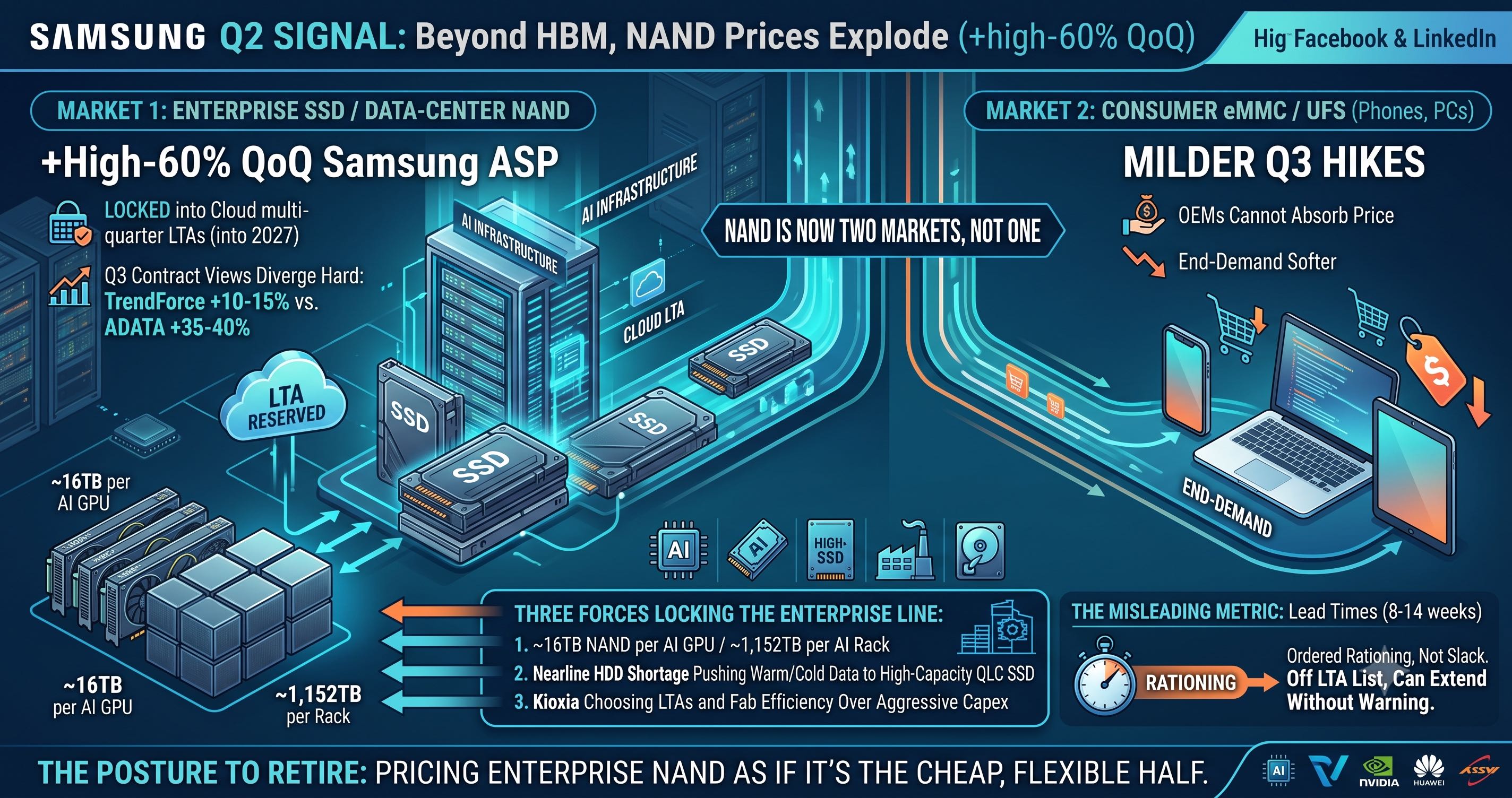
The memory story of mid-2026 has been told almost entirely through HBM and server DRAM. That framing is not wrong, but it has crowded a material signal off the page. On its 07-30 second-quarter earnings call, Samsung disclosed its own average selling prices, and the split inside those numbers deserves more attention than it has received: DRAM ASP rose by roughly the mid-40 percent range quarter over quarter, while NAND ASP rose by the high-60 percent range. The part of the memory complex most buyers treat as the softer, more elastic half repriced faster this quarter than the part everyone is anxious about.
For OEM and EMS sourcing teams, the more consequential development sits underneath that headline number. NAND is no longer a single market with a single price behaviour. It has bifurcated into two segments whose supply-demand conditions are diverging sharply, and treating them with one procurement posture is now a measurable risk. On one side is enterprise SSD and data-center NAND, which has become the single largest NAND application — past client SSD and past smartphones — and whose capacity is being consumed by hyperscaler and cloud multi-quarter long-term agreements that already extend allocation into 2027. On the other side is consumer-facing eMMC and UFS, where Q3 contract increases are visibly milder because OEMs cannot absorb higher costs and end-demand is softer, weakening supplier pricing power in that channel specifically.
The Q3 contract picture makes the enterprise tightness concrete, and it is worth quoting precisely because forecasters disagree. TrendForce projects NAND contract prices rising 10 to 15 percent quarter over quarter — a deceleration from prior quarters. ADATA's chairman, by contrast, has cited supplier notices of 35 to 40 percent increases for the same window. That gap is not noise; it reflects a market where server-grade allocation is being priced very differently from the blended average. For a sourcing team, the safe planning assumption for enterprise-class NAND is the upper end of that range, not the moderating headline figure — because the parts most exposed to the moderation are precisely the consumer categories an enterprise BOM is least likely to be buying.
Three structural forces explain why the enterprise line stays locked rather than loosening. First, the AI compute build-out consumes NAND at a scale that reframes what "demand" means: a single high-end AI accelerator is associated with roughly 16TB of TLC or QLC NAND, and a standard AI server rack with an estimated 1,152TB — storage is now a first-order line item in accelerator deployment, not an afterthought. Second, the nearline HDD shortage is displacing warm and cold data that historically lived on disk onto high-capacity QLC SSD, adding a second demand vector on top of the AI-inference vector. Third, and most telling, suppliers are choosing discipline over expansion: Kioxia has been explicit that it is prioritising long-term agreements, BiCS process migration and fab efficiency over aggressive capacity addition. When the supply side deliberately declines to chase the cycle, the tightness is a policy, not an accident.
This is where a widely repeated data point becomes a trap if read literally. Enterprise SSD lead times of 8 to 14 weeks are, correctly, the shortest among major semiconductor categories in 2026. But a short lead time in an allocation-gated market signals orderly rationing, not slack. Buyers who are inside a long-term agreement see predictable delivery; buyers who are not can watch that same 8-to-14-week window extend without warning if a supplier reallocates toward a contracted account. The metric that reassures the casual observer is, for the sourcing professional, a reminder to secure allocation rather than to relax it.
For OEM and EMS teams, the practical posture follows directly from the bifurcation. Enterprise and data-center NAND should be planned and quoted against the upper end of the Q3 range, with allocation — not price alone — as the primary objective; where an AI or server BOM carries high-capacity QLC SSD, the priority is locking volume commitments rather than chasing a low term price that a supplier has little incentive to honour. Consumer eMMC and UFS, by contrast, can be sourced more opportunistically on shorter terms while the softer end-demand persists. The one posture to retire entirely is the legacy assumption that NAND is the cheap, flexible half of the memory BOM; Samsung's own quarter has inverted that, and sourcing strategy through 2027 should be built on the segment that is actually setting the pace.