
When the Allocation War Reaches the Handset: What the 2026 Mobile-DRAM Squeeze Means for OEM and EMS Sourcing Strategy
The 2026 memory supercycle is usually narrated through HBM and server DDR5, but its sharpest structural consequence is now landing one tier down — in mobile and consumer DRAM. As the big three route roughly 70% of DRAM output to AI servers, LPDDR pricing has repriced violently, memory has become the dominant line in a handset BOM, and OEMs are responding with order cuts and spec downgrades. For sourcing organizations, this reframes consumer-grade memory from a commodity refill into a managed-allocation problem.
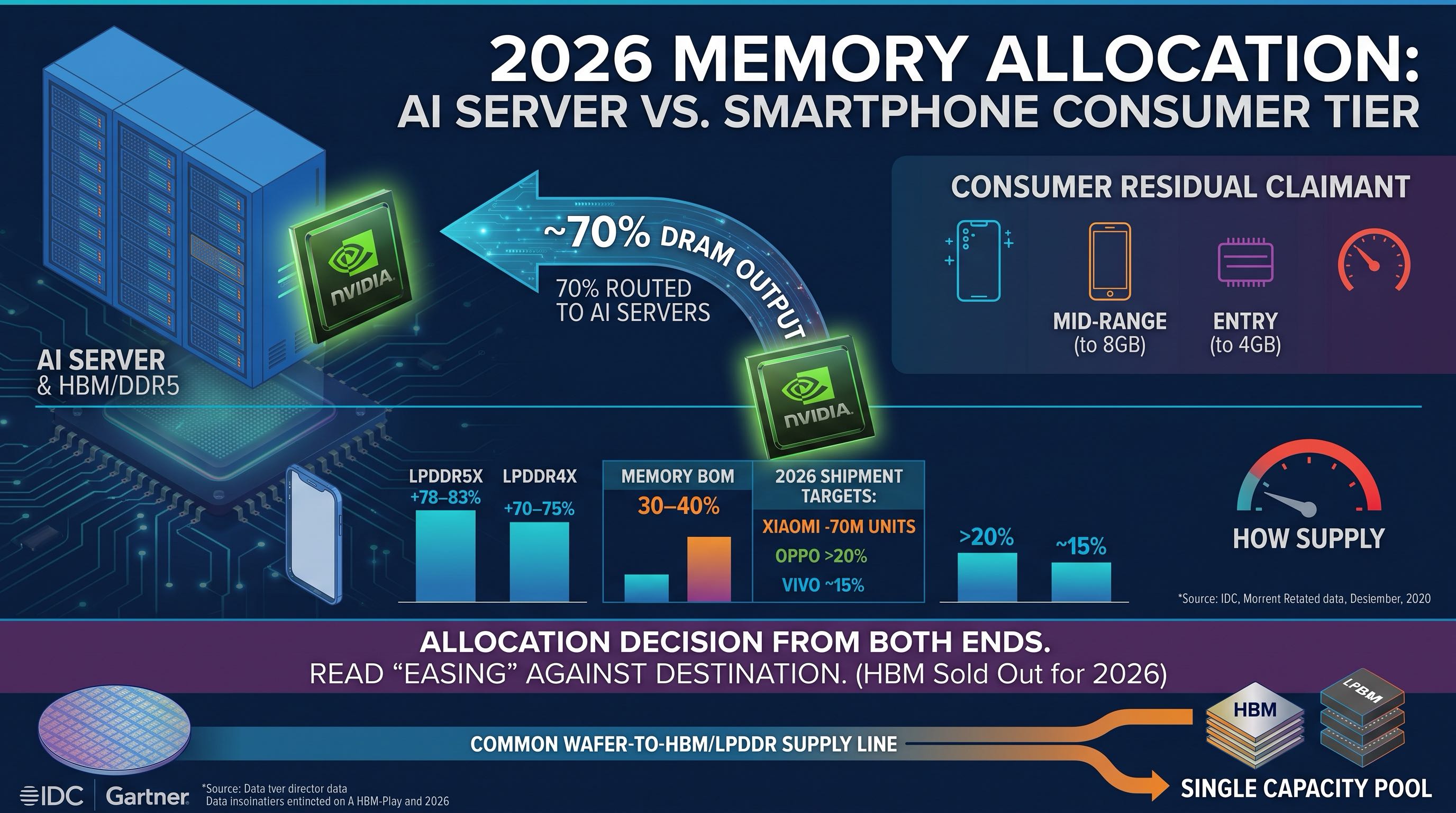
The 2026 memory supercycle has been narrated, almost entirely, through the lens of high-bandwidth memory and server DDR5 — the components that sit closest to the AI accelerators driving the whole cycle. That framing is accurate but incomplete, and the incompleteness is now expensive. The most consequential second-order effect of the supercycle is not happening in the data center at all; it is happening one tier down, in the mobile and consumer DRAM that sits inside the devices most of the world actually buys. Because HBM, LPDDR, and server DDR5 are all produced by the same three companies on the same fabrication lines, the allocation decision that favors an NVIDIA GPU is, mechanically, an allocation decision that starves a mid-range smartphone. With Samsung, SK Hynix, and Micron together controlling more than 95% of global DRAM and routing on the order of 70% of output to AI servers, the consumer tier has become the residual claimant on capacity — and residual claimants get whipsawed.
The price action reflects that residual status with unusual severity. LPDDR5X contract pricing rose roughly 78–83% quarter-on-quarter in Q2 2026, with LPDDR4X close behind at 70–75%, and on a representative mid-range design the memory content alone moved from around $40 to around $110 in six months. The more strategically important number, though, is not the percentage but the share: memory, which historically accounted for 10–15% of a handset bill of materials, now represents 30–40% on average. When a single commodity line crosses a third of total BOM cost, it stops behaving like a component and starts behaving like a constraint on the entire product roadmap — it dictates which SKUs are viable, which configurations must be dropped, and which price bands can still be served at all.
OEMs have already moved from modeling this to executing against it, and the execution is visible in both volume and specification. On volume, Xiaomi trimmed its 2026 shipment target by as many as 70 million units, with OPPO cutting more than 20% and Vivo around 15%; smartphone shipments fell roughly 11% in Q2 — the weakest second quarter since 2013 — and IDC now projects full-year 2026 volume down 12.9% to about 1.12 billion units. On specification, the retreat is systematic: premium models step back from 16GB to 12GB, mid-range devices fall to 8GB, entry-level converges on 4GB, and even flagship programs such as the Pixel 11 are reported to be shipping with reduced RAM. The clearest casualty is the sub-$100 tier, where memory now consumes too much of the build cost for the economics to close, and an entire affordable segment is being quietly deprecated.
For sourcing organizations, the practical reframing is that consumer-grade memory can no longer be treated as a commodity refill governed by spot logic. It has become a managed-allocation problem, and it should be run with the same discipline that buyers already apply to constrained analog, MLCC, and MCU categories. Three adjustments follow directly. First, isolate the memory line on every consumer BOM and size its exposure independently, because its volatility and lead-time behavior no longer correlate with the rest of the bill. Second, rebuild quote discipline around uncertainty: shorten quote validity, write lead-time and escalation clauses explicitly, and stop committing old prices against three-month deliveries, because the delta and the delay will otherwise be absorbed by the intermediary rather than the end customer. Third, treat OEM order cuts as a liquidity event in the secondary channel — cancellations flush memory and modules that were locked to now-cancelled programs, creating short-lived inventory pockets that reward buyers positioned to move quickly but punish anyone who mistakes a mismatch release for a trend reversal.
That last distinction matters because the tape will tempt sourcing teams into exactly the wrong conclusion. Q3 server-DRAM contract increases have narrowed to 13–18% quarter-on-quarter, down sharply from the roughly 81% surge of Q1, and the natural instinct is to read deceleration as the beginning of relief. It is not. The moderation reflects a high comparison base and softening consumer demand, not any loosening of physical supply; HBM remains sold out for 2026 and server DDR5 remains tight. The consumer squeeze and the server-price moderation are not contradictory signals — they are the same signal viewed from two ends of the same allocation decision. Sourcing strategy for the remainder of 2026 should be built on that understanding: plan consumer memory to scarcity, price it to uncertainty, and read every apparent sign of easing against the question of where the capacity actually went.