
Why the 2026 MLCC Crunch Will Outlast the AI Memory Cycle: An Industrial OEM and EMS Procurement Briefing on 1206/1210 High-Capacitance Supply
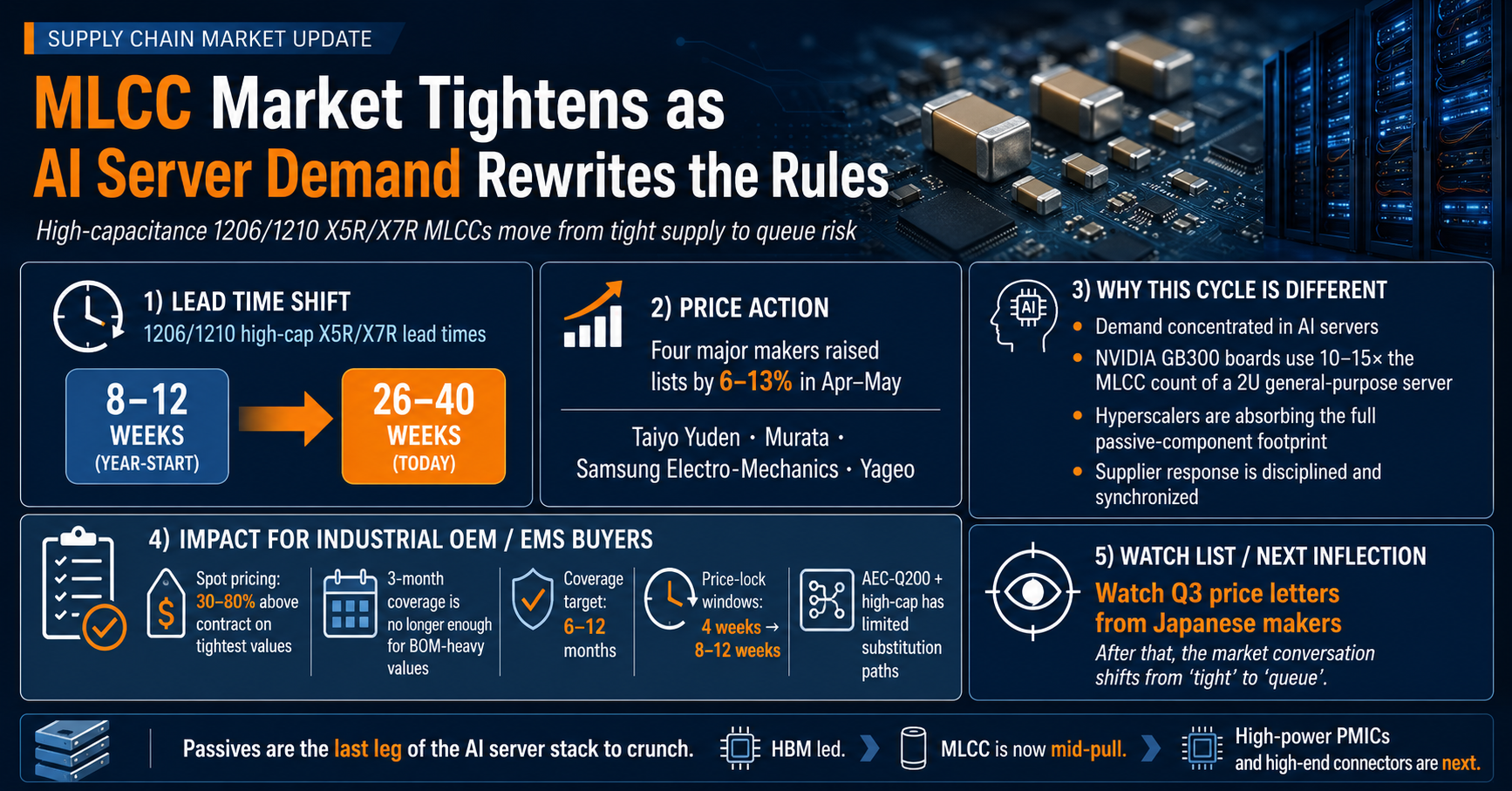
The 2026 multilayer ceramic capacitor cycle is structurally different from 2017-2018. AI server boards now consume MLCCs at 10-15x the rate of general-purpose servers, and four major makers have responded with coordinated 6-13% list increases that pushed 1206/1210 high-capacitance lead times from 8-12 weeks to 26-40 weeks. For industrial OEMs and EMS buyers, this is not a temporary spike but a multi-year repricing of an entire passive-component class. This briefing walks through what is driving the squeeze, where the substitution paths still work, and how procurement teams should restructure their MLCC sourcing posture for 2026 H2 and 2027.
For the procurement teams managing industrial and EMS bills of materials, the most consequential supply event of the second quarter of 2026 has not been another DRAM contract reset or another microcontroller end-of-life notice. It has been the quiet, coordinated repricing of multilayer ceramic capacitors at the four manufacturers that effectively define the global high-capacitance market — Taiyo Yuden, Murata, Samsung Electro-Mechanics, and Yageo. Between April and May of this year, each of these makers issued list increases in the range of 6 to 13 percent, concentrated on consumer-grade and automotive low-capacitance parts but with clear ripple effects on every adjacent capacitance band. At the same time, lead times for 1206 and 1210 form factor high-capacitance X5R and X7R parts — the workhorse decoupling and bulk-bypass capacitors that sit on every AI server motherboard, every modern industrial power converter, and every high-density energy storage controller board — moved from a market-standard 8 to 12 weeks at the beginning of the calendar year to a current quoted range of 26 to 40 weeks. For the buyers and program managers reading this, that single shift may matter more than any other component event of the quarter, because it changes the inventory mathematics of any program that ships in volume in the second half of the year.
A structurally different cycle from 2017-2018
The first thing worth saying clearly is that this is not a repeat of the 2017-2018 MLCC crunch. That cycle was driven by automotive electrification stacking on top of consumer demand and a still-healthy industrial baseline; the high-capacitance crunch then was distributed across multiple end markets and was largely worked out within eighteen months as Japanese makers added capacity. The 2026 cycle is structurally different in two important ways. First, the demand driver is concentrated in a single end market — AI server hardware — which is consuming MLCCs at a rate that is roughly ten to fifteen times higher per board than the general-purpose servers that dominated the demand mix as recently as 2023. A single NVIDIA GB300 baseboard is, in MLCC count terms, the equivalent of roughly ten 2U enterprise servers from the prior generation. Hyperscalers absorbing entire racks of GB300 and B300 systems are not just consuming GPU silicon and HBM memory; they are also absorbing the entire passive-component footprint of those racks, which is dominated by exactly the 1206 and 1210 high-cap parts now in shortest supply. Second, the manufacturer response has been more disciplined and more synchronized than in the prior cycle. The four major makers have moved within weeks of each other, with similar percentage hikes and similar messaging around "capacity flex repositioning for AI" or equivalent corporate framing. This signals a shared view among the suppliers that the AI demand backdrop is durable enough to justify margin-protective behavior rather than the volume-protective behavior that characterized the latter half of the 2017-2018 cycle.
What it means for industrial OEM and EMS buyers
The procurement implication for industrial OEMs and EMS shops, then, is that the standard schedule-plus-rolling-top-up inventory model that has worked for high-capacitance MLCCs for the better part of a decade is no longer functional for 2026 H2 and into 2027. A 26 to 40 week lead-time posture from the four largest suppliers, combined with secondary-market pricing running 30 to 80 percent above contract pricing on the tightest values, means that buyers can no longer assume that a placed order at contract price will convert into actual deliveries against a six-month or nine-month build schedule. The standard buyer response — pulling inventory coverage from approximately three months to approximately six to twelve months on the highest-risk values, running formally qualified dual sources on every BOM-critical capacitor, and lengthening price-lock windows from the traditional four weeks to eight or twelve weeks — represents working capital deployment of a magnitude that most industrial OEMs have not had to commit since the 2018 peak. For EMS shops with thin gross margins and finite balance sheets, the same response is simply not financeable at the same scale; EMS buyers will need to rely more heavily on customer-funded inventory positions, vendor-managed inventory arrangements, and the secondary spot market — with the understanding that secondary-market pricing on Murata GRM-series and Taiyo Yuden EMK-series high-cap parts is already running well above any normalized contract benchmark and is likely to widen further if a Q3 second-wave hike materializes.
Where substitution works, and where it breaks
The substitution conversation deserves more nuance than the trade press has given it. There is real room to work the capacitance ladder across alternative suppliers — Yageo, Walsin, Samsung Electro-Mechanics, Vishay, and KEMET all maintain credible 1206 and 1210 high-cap X5R and X7R portfolios — and for consumer-grade and standard industrial programs, validating a second source against a tightly-defined performance envelope is the single highest-leverage action a procurement team can take this quarter. The substitution path narrows sharply, however, at the AEC-Q200 plus high-capacitance corner of the matrix, which is precisely the corner that automotive, industrial high-reliability, and AI server power-stage designs all share. Parts in that corner are subject to qualification timelines that run several months even for tightly-controlled BOM changes, and the supplier base that maintains a fully qualified AEC-Q200 high-cap lineup is materially narrower than the broader MLCC supplier base. For programs in that corner, substitution is not a near-term lever; the realistic procurement plays are coverage extension, price-lock contract renegotiation, and direct engagement with original manufacturer allocation teams to secure place in the production queue.
The signals to watch into 2026 H2
Looking forward into the second half of the year, the procurement signals worth watching most closely are the Q3 price letters that the Japanese makers typically issue in July and August, the order-flow disclosures around Murata's positioning on NVIDIA Rubin baseboard ramps, and the capacity rebalancing announcements from Samsung Electro-Mechanics and LG Innotek as those firms reallocate among consumer, automotive, and AI server end markets. If a Q3 second wave of list increases materializes, and if AI server board volume continues to ramp through Q3 and into Q4, the most likely outcome is that 1206 and 1210 high-capacitance parts transition from "tight" to "structurally unavailable at contract" — meaning that even secondary-market spot acquisition will require waiting in a queue rather than simply paying a premium. Procurement teams that have already restructured their MLCC sourcing posture by that point will be in a meaningfully different position from teams that have not, both in terms of program continuity and in terms of margin preservation. The passive-component crunch is, in many respects, the final and most under-priced leg of the broader AI-driven supply tightness that has already hit memory, HBM, advanced packaging, and high-end foundry capacity. For industrial OEM and EMS procurement teams, the work of repositioning for it is not work that can wait until the second half of the year.