
When the Passives Reprice as a Bloc: What the 2026 MLCC Wave Signals for OEM and EMS Sourcing Strategy Beyond the Memory Cycle
The memory super-cycle has absorbed most sourcing attention through 2026, but a parallel and structurally distinct tightening is now underway in multilayer ceramic capacitors. Samsung Electro-Mechanics' portfolio-wide 30% increase took effect August 1, Taiyo Yuden raises from September 1, and book-to-bill ratios across the Japan-Korea leaders have reached five-year highs. This analysis unpacks what a bloc-wide passive repricing means for BOM cost models, allocation posture, and supplier strategy at the OEM and EMS level.
For most of 2026, the sourcing conversation has been a memory conversation. DRAM contract prices moving 90%-plus quarter-on-quarter, NAND repricing behind it, HBM crowding out conventional wafer capacity, and the majors rewriting contract mechanics toward short terms and post-settlement pricing. That story is real, and it is not over. But it has also crowded out attention from a second tightening that is now moving with its own logic — and that second tightening sits in the passives, specifically multilayer ceramic capacitors.
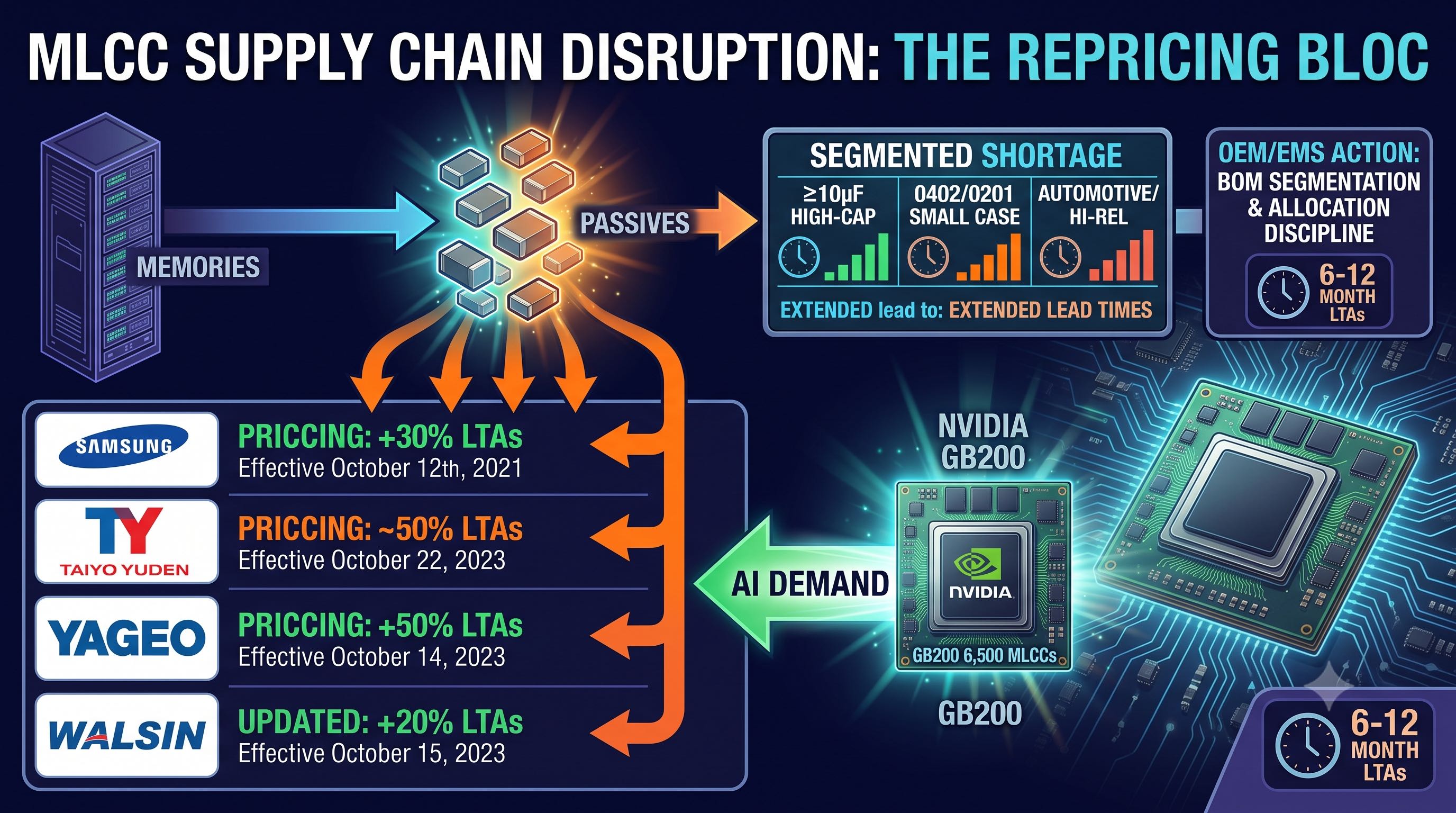
The dated events are unambiguous. Samsung Electro-Mechanics implemented a portfolio-wide 30% price increase effective August 1, applied without series exemptions. Taiyo Yuden issued a customer letter on July 23 requesting adjusted shipment pricing from September 1, declining to publish a uniform percentage and citing raw-material inflation in barium titanate, nickel powder, and rare-earth additives. Yageo moved roughly 50% on July 1, and Walsin lifted consumer grades 5-15%. Four suppliers repricing inside a single quarter is not a set of coincidences; it is a supplier bloc re-basing its price floor at the same time, which is a materially different signal than any one vendor chasing cost.
The demand driver behind it is the same AI infrastructure build that has been reshaping memory, expressed through a different bill of materials. A single NVIDIA GB200 board carries on the order of 6,500 MLCCs, and that content intensity — layered onto automotive electrification, where high-reliability and high-capacitance parts are already structurally scarce — has pushed June monthly shipments from Murata, Samsung Electro-Mechanics, and Taiyo Yuden to a five-year high. The order book confirms the tightness rather than merely implying it: June book-to-bill ratios reached 1.30 at Murata, 1.31 at Samsung Electro-Mechanics, and 1.25 at Taiyo Yuden. A book-to-bill above one means incoming orders are outpacing shipments and backlog is accumulating, and Murata's reading has now moved past the peak that preceded the 2018 capacitor shortage — a cycle many procurement teams still carry as institutional memory.
For an OEM or EMS buyer, the operative distinction is that this shortage is highly segmented, and treating it as a blanket crisis wastes capital while treating it as business-as-usual strands lines. The acute pressure is concentrated in high-capacitance values at or above 10µF in compact 0402 and 0201 packages, together with automotive-qualified and high-reliability series, where lead times are commonly reported in the 26-to-40-week range and some families extend beyond 52 weeks. Standard low-capacitance commodity parts remain comparatively available. The correct response is therefore not a portfolio-wide panic buy but a BOM segmentation exercise: identify the constrained capacitance-case-grade combinations, quantify exposure by program, and move those specific lines onto allocation-grade sourcing discipline while leaving commodity values on normal terms.
That discipline has three practical components. First, cost models need to absorb the increases as a new floor rather than a temporary spike, because a bloc-wide re-basing is unlikely to reverse while book-to-bill sits above 1.25 and AI-server content intensity keeps climbing. Second, calendar management has to widen beyond memory: the near-term sourcing window now contains Microchip repricing on August 14, a Vishay SQ4532 last-time-buy on August 23, and the Taiyo Yuden effective date on September 1, and the passive deadline is the one most likely to slip through a memory-focused review. Third, the just-in-time posture that has governed passive procurement for years is the wrong instrument at these backlog levels; six-to-twelve-month long-term agreements with committed volumes on the constrained lines are the appropriate hedge, and buyers who wait for spot confirmation of tightness will be negotiating from behind an already-extended lead time.
The larger point for sourcing strategy is that the AI-driven supply shock is not confined to the components that make headlines. Memory has dominated the narrative because its price moves are enormous and its end-use is obvious, but the same demand engine is now re-pricing the passives that populate every board it touches — and it is doing so with less visibility and, in the constrained tiers, comparable lead-time risk. The teams that come through this cycle in the best position will be the ones who read the passive repricing as a structural signal in its own right, segmented their BOMs early, and secured the high-capacitance and automotive-grade lines before the calendar forced the decision for them.