
Micron's June 24 Print Is a Read-Through, Not Just an Earnings Event: What the HBM Supercycle Test Means for OEM and EMS Memory Sourcing
On June 24, Micron reports fiscal Q3 into one of the widest analyst spreads of the year. For procurement teams, the value of this release is not the stock reaction but the read-through it offers on whether memory makers keep diverting capacity into HBM. This piece breaks down the three signals that matter — gross margin, multi-year contract visibility, and capex — and how each maps to mainstream DRAM and NAND availability through the rest of 2026.
On June 24, after the market closes, Micron Technology reports fiscal third-quarter results, and the release arrives into one of the widest analyst disagreements the semiconductor sector has seen this year. Wall Street revenue estimates span roughly $33.7 billion to $40.9 billion — a gap of more than $7 billion, or about a fifth of the midpoint — set against the company's own guidance of approximately $33.5 billion, plus or minus $750 million, with non-GAAP earnings per share near $19.15 and gross margin around 81%. For comparison, the same quarter a year earlier earned $1.73 a share. That kind of step-change only happens when a historically commoditized supplier briefly captures genuine pricing power, and the central question the market is now asking is whether that power is structural or simply the late innings of another memory cycle.
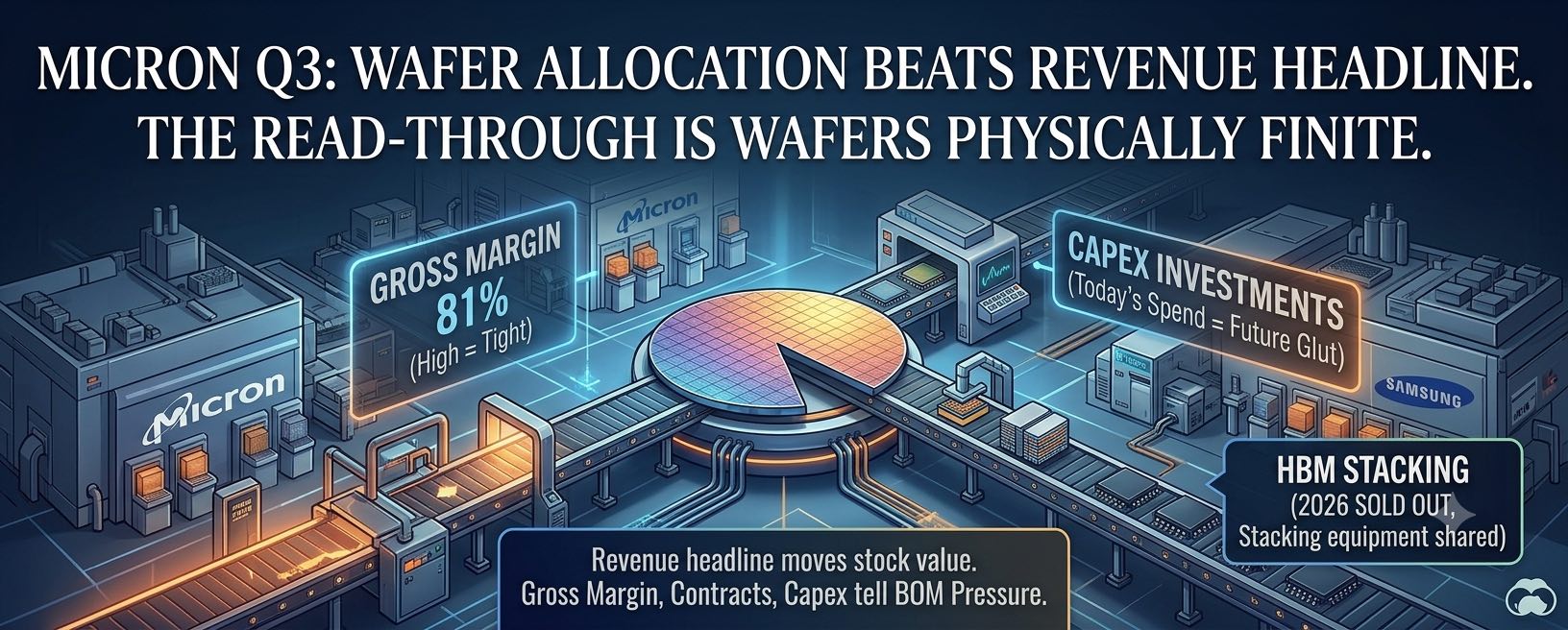
For an investor, the framing is about a multiple and a thesis. For a procurement organization, the framing is entirely different. The Micron print is not a position to trade; it is a read-through on capacity allocation, and capacity allocation is what determines whether the conventional DRAM and NAND lines that feed your bill of materials get backfilled or stay starved. The mechanism is straightforward and worth restating plainly: high-bandwidth memory is not made on separate, dedicated equipment that appears on demand. It is stacked DRAM produced on the same fabs, by the same three suppliers — Micron, SK Hynix, and Samsung — that also make the DDR5, DDR4, LPDDR, and enterprise SSD your contract manufacturers consume. Every wafer committed to HBM for AI accelerators is a wafer not making mainstream memory, and Micron has already stated that its entire calendar-2026 HBM output is sold out under multi-year contracts, increasingly of three-to-five-year duration, with HBM4 12H 36GB shipping in volume since the first calendar quarter for NVIDIA's Vera Rubin platform and a 48GB 16-high HBM4 already sampled. That is the supply backdrop behind TrendForce's second-quarter contract-price guidance of 58 to 63 percent quarter-on-quarter increases for conventional DRAM and 70 to 75 percent for NAND — figures we treat here as continuing background rather than a fresh weekly signal.
The first signal to extract from the call is gross margin, and it deserves more weight than the revenue headline that will move the stock in the opening minute of after-hours trading. The guided 81 percent sits far above Micron's historical norm and is the cleanest available measure of how much pricing power HBM and tight conventional supply are actually conferring. The reason margin matters more to a buyer than revenue is mechanical: when memory supply begins to loosen, margin compresses before volume does, because makers defend utilization by conceding price first. A margin that holds or expands on this call is direct evidence that the squeeze on mainstream parts has further to run; a margin that slips, even with strong revenue, is the earliest credible hint that pricing is approaching a ceiling and that the most acute scarcity may be behind you. Procurement teams should read the margin line as a leading indicator for their own availability, not as a financial footnote.
The second signal is contract visibility, specifically what management says about 2027 and beyond. The shift from spot and short-term purchasing toward three-to-five-year agreements is the most consequential structural change in the memory market in years, because it converts a historically boom-and-bust commodity into something closer to a contracted, capacity-reserved business. If Micron extends its sold-out commentary credibly into 2027 and 2028 on this call, the implication for buyers is uncomfortable but clear: the largest blocks of leading-edge capacity are being reserved years ahead by hyperscalers and accelerator makers, and the merchant pool available for general-purpose OEM and EMS demand will remain structurally thin. The third signal, capex, cuts the other way and is the one veterans watch for the eventual turn. Micron has been spending several billion dollars a quarter to expand capacity, and historically it is precisely this spending that ends every upcycle by tipping supply back into surplus. Aggressive capex guidance is reassuring for long-term availability but is also the seed of the next correction; disciplined capex sustains pricing but prolongs scarcity. Neither outcome resolves quickly, which is the point.
For sourcing strategy, the practical conclusion is to decouple your decisions from the stock's reaction entirely. A sell-off on a "priced-for-perfection" disappointment would say a great deal about valuation and almost nothing about whether your LPDDR5 or enterprise SSD allocation improves next quarter; the near-term shortfall in mainstream memory is a function of where wafers are physically going, not where the shares close on June 24. The disciplined posture is to pre-position mainstream memory demand on your own production timeline rather than waiting for the print, to qualify second sources and the secondary channel ahead of need rather than under duress, and to align NCNR commitments with realistic payment and consumption schedules so that a high-water-mark purchase does not become stranded inventory if the cycle does eventually turn. Listen to the call in this order — does margin hold near 81 percent, does revenue land inside or above the guided range, what is said about 2027 supply contracts, and how aggressive is the capex plan — and treat the four answers as a sourcing briefing rather than an investment verdict. The revenue number will dominate the headlines; the other three will tell you how long your bill of materials stays under pressure.