
Energy-Aware 65V Monitoring Expands the Qualification Envelope for 48V Automotive and AI Power Systems
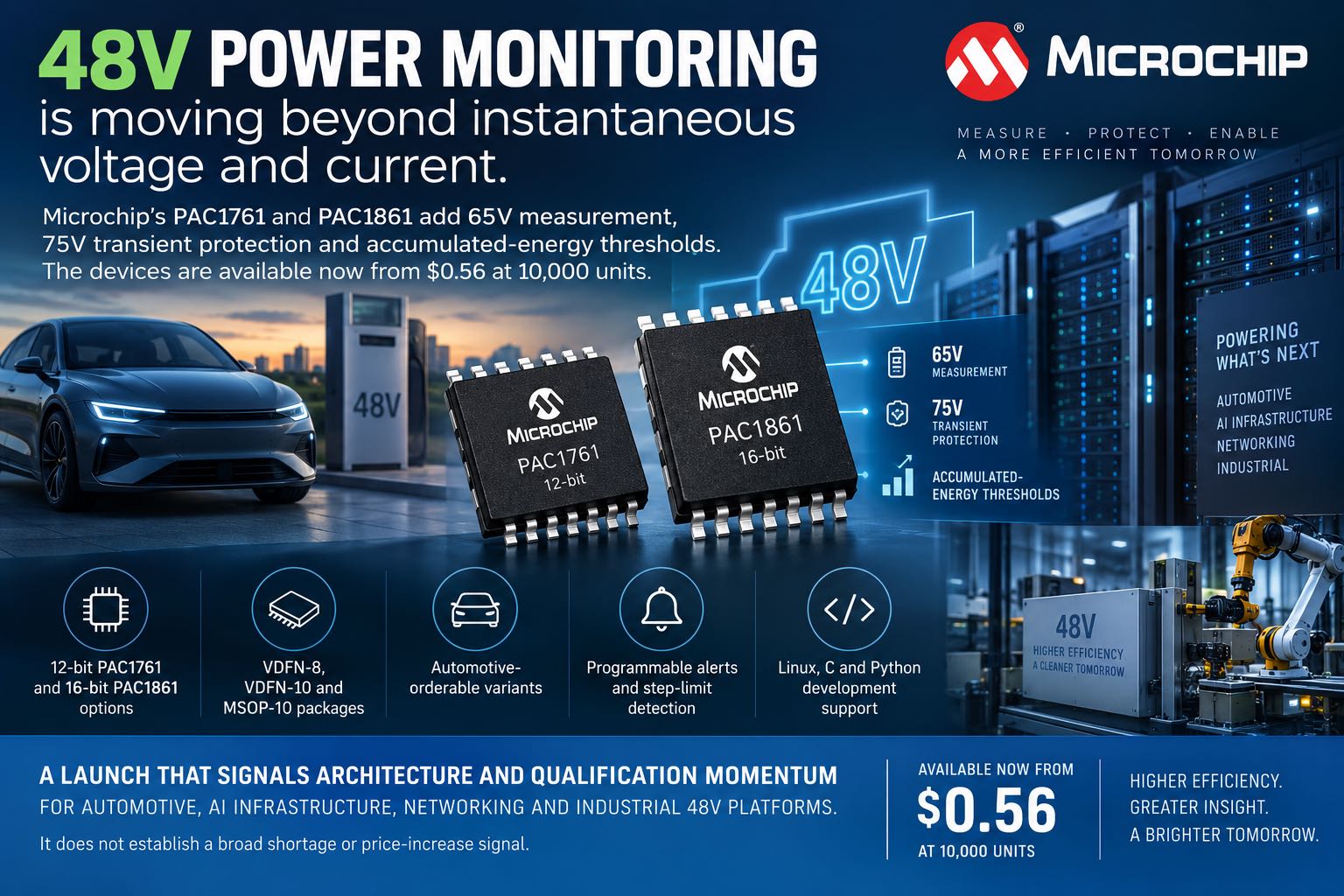
Microchip has introduced the PAC1761 and PAC1861 digital power-monitor families for 48V architectures. The devices combine 65V measurement, 75V transient protection and accumulated-energy data. The launch broadens the qualification checklist for automotive, AI infrastructure, networking and industrial power systems without establishing a shortage signal.
Why 48V monitoring is changing
The migration toward 48V distribution is moving beyond a narrow data-center design choice. Automotive, networking, industrial automation, telecom and high-density servers use higher bus voltages to reduce current for a given power level and to control conduction losses. That shift also raises the importance of measurement headroom and transient resilience. Microchip's September 24 release addresses this layer with the PAC1761 and PAC1861 families. PAC1761 and PAC1861 are 65V digital power monitors for 48V systems. They provide 75V transient protection, programmable alerts, step-limit detection, and accumulated-energy thresholds. The 12-bit PAC1761 and 16-bit PAC1861 are available in VDFN-8, VDFN-10 and MSOP-10 packages, including automotive-orderable options. Initial 10,000-unit pricing starts at US$0.56. The relevant procurement signal is not a component shortage. It is the widening qualification scope around power telemetry, protection and lifecycle energy data. For OEM and EMS qualification, the evidence should be mapped to system requirements, approved-vendor strategy and lifecycle controls before a sourcing conclusion is drawn.
From instantaneous readings to accumulated energy
Conventional monitors provide useful snapshots of voltage, current and power. A 48V platform also experiences fast load steps, repetitive peaks and energy use that matters over longer intervals. Accumulated-energy registers allow firmware to compare actual consumption against operating budgets, battery availability or thermal envelopes. Programmable thresholds can turn the monitor into part of the control loop instead of leaving it as a passive instrument. This architecture is increasingly relevant where AI accelerators, network processors, motors or vehicle loads create rapid changes that a slow supervisory path may miss. For OEM and EMS qualification, the evidence should be mapped to system requirements, approved-vendor strategy and lifecycle controls before a sourcing conclusion is drawn.
Headroom and protection
A nominal 48V rail cannot be treated as a 48V maximum. Startup events, switching behavior, cable inductance and load changes can produce excursions above nominal voltage. The new devices measure up to 65V and specify 75V spike protection, leaving a practical margin between steady-state operation and transient events. That margin can simplify external protection choices, although it does not remove the need for system-level validation. The key comparison points are common-mode range, shunt measurement accuracy, alert latency, temperature behavior and the transient profile defined for the end application. For OEM and EMS qualification, the evidence should be mapped to system requirements, approved-vendor strategy and lifecycle controls before a sourcing conclusion is drawn.
Qualification and sourcing implications
Pin-compatible package options create a useful design lever. A platform can select 12-bit or 16-bit resolution according to accuracy and cost targets while keeping part of the board architecture stable. Automotive-orderable variants extend the family into programs that require controlled qualification and change management. Availability at launch and public volume pricing reduce early sampling friction, but production qualification still depends on package, grade, firmware drivers and calibration flow. Second-source planning remains function-based because register maps and accumulated-energy behavior are rarely interchangeable across suppliers. For OEM and EMS qualification, the evidence should be mapped to system requirements, approved-vendor strategy and lifecycle controls before a sourcing conclusion is drawn.
What changes in the BOM
The monitor sits at the intersection of the shunt, power path, host controller and protection network. A higher-feature device may remove some supervisory logic or reduce software polling overhead, yet it can also increase validation work around alert thresholds and energy counters. Linux, generic C and Python support make evaluation easier across server and embedded platforms. The bill-of-material effect should therefore be evaluated at subsystem level: monitor price, shunt tolerance, protection components, MCU load, telemetry bandwidth and fault-response requirements all contribute to the final cost. For OEM and EMS qualification, the evidence should be mapped to system requirements, approved-vendor strategy and lifecycle controls before a sourcing conclusion is drawn.
Market interpretation
The launch confirms that 48V adoption is creating demand for more capable mixed-signal monitoring rather than only for higher-power conversion stages. The commercial signal is broad application coverage, from AI servers and PoE infrastructure to industrial and automotive systems. It does not establish a general shortage or price increase for power-monitor ICs. The next evidence points are design-win disclosures, automotive qualification uptake, distributor inventory depth and whether comparable 65V energy-aware monitors appear across multiple suppliers. Until those indicators develop, the release is best read as a qualification and architecture signal. For OEM and EMS qualification, the evidence should be mapped to system requirements, approved-vendor strategy and lifecycle controls before a sourcing conclusion is drawn.