
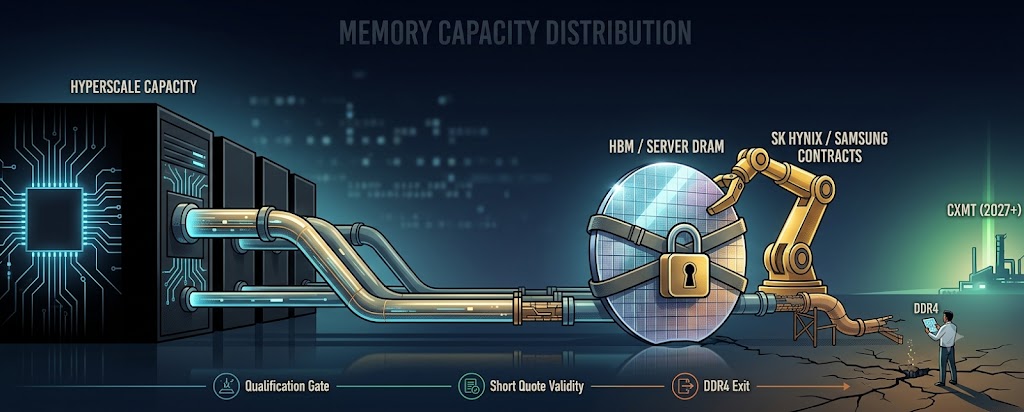
When Memory Supply Goes to Contract: What Korea's ~$950B AI-Chip Pacts Signal for OEM and EMS Allocation Strategy Through 2030
Korea's weekend announcement of ~$950B in SK Hynix and Samsung supply commitments to US hyperscalers is not a capacity-expansion story that eases the market. It is a demand-side lock-in that formalizes hyperscaler priority over merchant and commercial channels for leading HBM and server DRAM. For OEM and EMS sourcing teams, the practical question is no longer whether memory stays tight, but where in the allocation chain your program sits — and what to change now.
On July 25-26, during President Lee Jae Myung's visit to San Francisco, the Korean presidential office announced two supply commitments that, taken together, reset the framing of the memory market for the rest of the decade. SK Hynix will supply Nvidia and other companies with roughly US$750 billion of memory over five years, with high-bandwidth memory at the center of the arrangement. Samsung Electronics separately signed a US$200 billion memorandum of understanding with Broadcom covering advanced memory and foundry services for AI-chip production. The meetings that produced these commitments were held with Nvidia's Jensen Huang, OpenAI's Sam Altman, Anthropic's Dario Amodei, and Broadcom's Hock Tan — the demand-side principals of the AI build-out, not intermediaries. Reporting to date does not tie the pacts explicitly to any broader US-Korea trade or tariff settlement, so for sourcing purposes they should be read as commercial supply commitments rather than as policy instruments.
For OEM and EMS procurement organizations, the instinct on reading a headline like "makers sign nearly a trillion dollars in supply deals" is to expect capacity to follow and pricing pressure to ease. That instinct is precisely wrong here, and acting on it would be expensive. These are not agreements to build incremental merchant supply that will circulate through distribution. They are agreements that assign the output of leading-edge HBM and server DRAM to a small set of hyperscale accounts on multi-year terms. The memory makers had already been observed prioritizing DDR5 margin over an accelerated HBM4 ramp; the effect of these pacts is to convert that revealed preference into contractual obligation. Whatever marginal allocation had been reaching the merchant channel, the spot market, and commercial-grade programs now has a lower ceiling, because the top of the supply stack is committed further out than before.
The correct way to metabolize this signal is to locate your own programs on the allocation chain and plan from that position rather than from the headline. Programs that compete directly with hyperscale demand — server DDR5 RDIMM, HBM-adjacent components, enterprise SSD, the power and interconnect content that populates AI racks — should be treated as structurally short through the arrival of new capacity in the first half of 2027, and sourcing teams should assume that contractual priority sits above them, not beside them. Programs one or two tiers removed — industrial control, networking, automotive electronics that still depend on DDR4 and legacy DRAM — face a second-order squeeze, because the same makers that are committing leading capacity to hyperscalers have already exited or curtailed the older nodes those programs rely on. It is the industrial tier, sitting at the back of the allocation queue while the front of the queue is contractually locked, that carries the most under-appreciated risk in this configuration.
There is a genuine supply-side development in the same window, and it deserves to be weighed carefully rather than dismissed or overstated. CXMT, China's leading DRAM manufacturer, listed on the Shanghai STAR Market on July 27, raising approximately RMB 57.9 billion in the largest STAR Market IPO to date and drawing subscription demand of roughly 212 times the offering. The proceeds are directed at DRAM capacity expansion, and CXMT already holds a meaningful global DRAM share. For a sourcing organization, the disciplined reading is that domestic Chinese supply is now capitalized to expand on a multi-year horizon, which is a real and growing second-source consideration for commercial and PC-class DRAM — and simultaneously that none of this alters leading-edge server or automotive availability in the near term. The two facts are not in tension; they simply operate on different timelines. The error to avoid is using the expansion narrative as a negotiating lever against current leading-edge quotes, where it has no near-term substance and will not survive contact with a supplier who knows their own allocation position.
Practically, that argues for a two-track qualification posture. On the commercial and PC track, the second-source window is opening in a way that justifies beginning or accelerating CXMT qualification now — pulling documentation, scheduling evaluation builds, and establishing the lead-time and consistency baseline that will let you move volume when the ramp materializes, rather than starting the clock after the shortage forces your hand. On the leading server and automotive track, the discipline is to hold qualified sources, keep quote validity short, and resist the temptation to treat an as-yet-unqualified domestic part as leverage. Qualification, lead time, and lot-to-lot consistency remain the gate, and in the automotive and high-reliability segments that gate is neither short nor negotiable.
Two near-term anchors should shape the next several days of quoting. SK Hynix reports Q2 results on Wednesday, July 29 (Seoul morning); the sourcing-relevant content is the HBM4 shipment guidance and the second-half HBM supply/demand outlook, not the absolute profit figure, and DDR5 and server-memory quotes should stay on 24-48 hour validity until that guidance is on the table. Beyond it, the manufacturer price actions that took effect through July — TI's third increase of the year, Infineon's second, the ST MCU actions that have pushed lead times toward 52 weeks, and the NXP, Molex and TE adjustments — remain the operative pricing baseline. The sensible posture into and through this week is to quote from the new schedules, hold validity short, and treat the $950B pacts for what they are: confirmation that the tightest part of the memory market has been contracted away from the channel, and a reason to secure allocation and qualify alternatives on a planned timeline rather than a reactive one.