
When a Specialty-Memory Designer Books a 400% Profit Jump: What Ingenic's H1 2026 Guidance Signals for OEM and EMS Sourcing of Legacy DRAM, SRAM and NOR
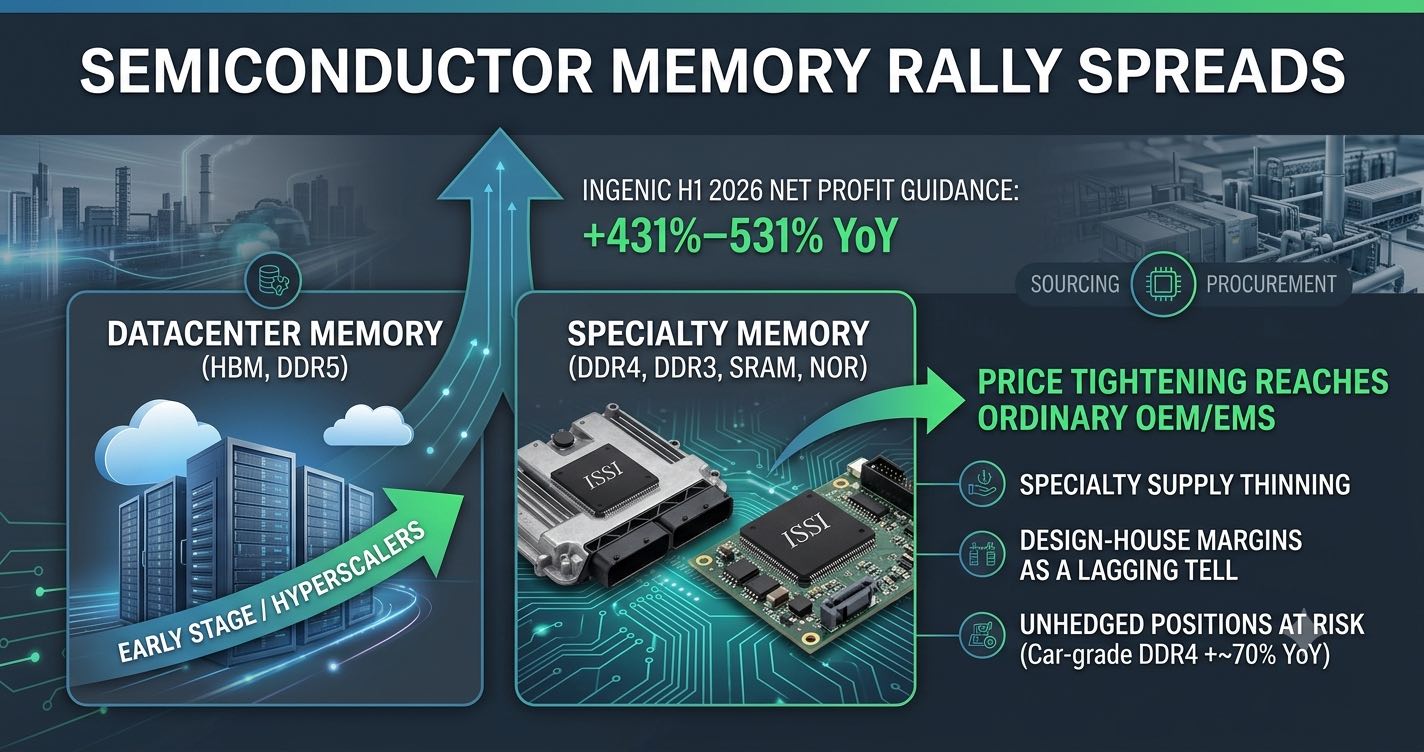
Ingenic Semiconductor guided first-half 2026 net profit up 431%-531% year-on-year on July 13, driven by the memory super-cycle lifting prices across its DRAM and Flash portfolio, including the ISSI specialty lines. For OEM and EMS sourcing teams, the print matters less as an earnings event than as confirmation that the rally has propagated from HBM and DDR5 into the legacy and specialty segments that populate industrial and automotive bills of materials.
On July 13, Ingenic Semiconductor (SHE:300223) filed preliminary first-half 2026 guidance with the Shenzhen Stock Exchange, projecting net profit of CNY 1.079–1.282 billion, an increase of 431% to 531% year-on-year against CNY 203 million in the prior-year period, with revenue up approximately 77% to around CNY 3.99 billion. The company attributed the swing to the ongoing memory super-cycle, which has lifted pricing across its DRAM and Flash products. That portfolio is anchored by ISSI, the specialty-memory business Ingenic acquired, whose product families span automotive- and industrial-grade DRAM, SRAM, and NOR Flash rather than the leading-edge datacenter parts that have dominated headlines all year. For sourcing organizations, this distinction is the entire point of the disclosure, and it deserves to be read carefully rather than filed away as another quarterly beat in a sector full of them.
For most of the first half, the memory narrative has been about hyperscaler demand pulling HBM, and about the major DRAM makers reallocating wafer capacity toward DDR5 and enterprise SSD to capture the richest margins. That framing is accurate, but it is also incomplete, and its incompleteness is precisely where procurement risk has been accumulating. The parts that fill industrial control boards, automotive platforms, networking equipment, and long-lifecycle embedded designs are not HBM stacks or bleeding-edge DDR5 modules; they are specialty DDR4 and DDR3, SRAM, low-density NOR, and SLC NAND. These are the components that ISSI and its peers supply, and until now the market has treated them as a comparatively insulated backwater. Ingenic's profit line closes that assumption. When a design house whose revenue is concentrated in specialty memory more than quadruples its earnings on price rather than volume, the tightening has demonstrably crossed from the glamour segments into the parts that ordinary OEM and EMS teams actually have to buy every week.
The strategic implication is that specialty memory has lost its historical role as a relief valve. In prior cycles, when mainstream DRAM and Flash went short, sourcing teams could often step sideways into niche parts on the assumption that the majors were not competing for that capacity and that pricing there would stay comparatively stable. The current cycle inverts the logic entirely. Because the majors are steering capacity away from legacy nodes, the specialty layer is structurally thinner, supplied by a smaller set of players such as ISSI, Nanya, and Winbond, and therefore more exposed to sharp price elasticity when any single line runs short. A BOM that leans on automotive-grade DDR4 or DDR3 should now be modeled as more volatile than a comparable consumer design, not less, and sourcing teams that still carry these parts at last year's cost basis are quietly running an unhedged position. Independent industry reads that place automotive-grade DDR4 up roughly 70% year-on-year — a continuation of an established trend rather than a fresh weekly signal — are consistent with exactly the margin expansion Ingenic has now reported.
There is a practical way to use an earnings print like this without over-reading it. Design-house margins are a lagging but reliable confirmation mechanism: by the time a fabless specialist reports a margin spike, its downstream distribution and spot channels have already been absorbing higher prices for a quarter or more, which means the disclosure validates physical-market conditions that sourcing teams should have been pricing into contracts and quotes already, and it raises the probability that those conditions extend through the third quarter. The appropriate response is not to chase the stock or to treat the guidance range as a precise figure — it is preliminary, and the 431%–531% band is deliberately wide — but to revisit any open contract, safety-stock policy, or customer quote that still assumes legacy and specialty memory behaves like an ordinary commodity. Teams that need DDR4 and its specialty cousins beyond 2027, when supply concentrates further at Nanya and Winbond and pricing reflects scarcity more than cost, should be securing multi-year coverage now and treating these components with the same sourcing discipline they would apply to any single-sourced, allocation-constrained part.