
800VDC Solid-State Protection Moves Into the AI Data Center Distribution Layer
Infineon and SolarEdge are extending an existing power collaboration into solid-state circuit breakers between the transformer and compute rack. The move broadens the semiconductor opportunity from conversion to protection, sensing and control. Commercial demand remains dependent on reference designs, standards and validation.
Solid-state protection enters the 800VDC distribution layer
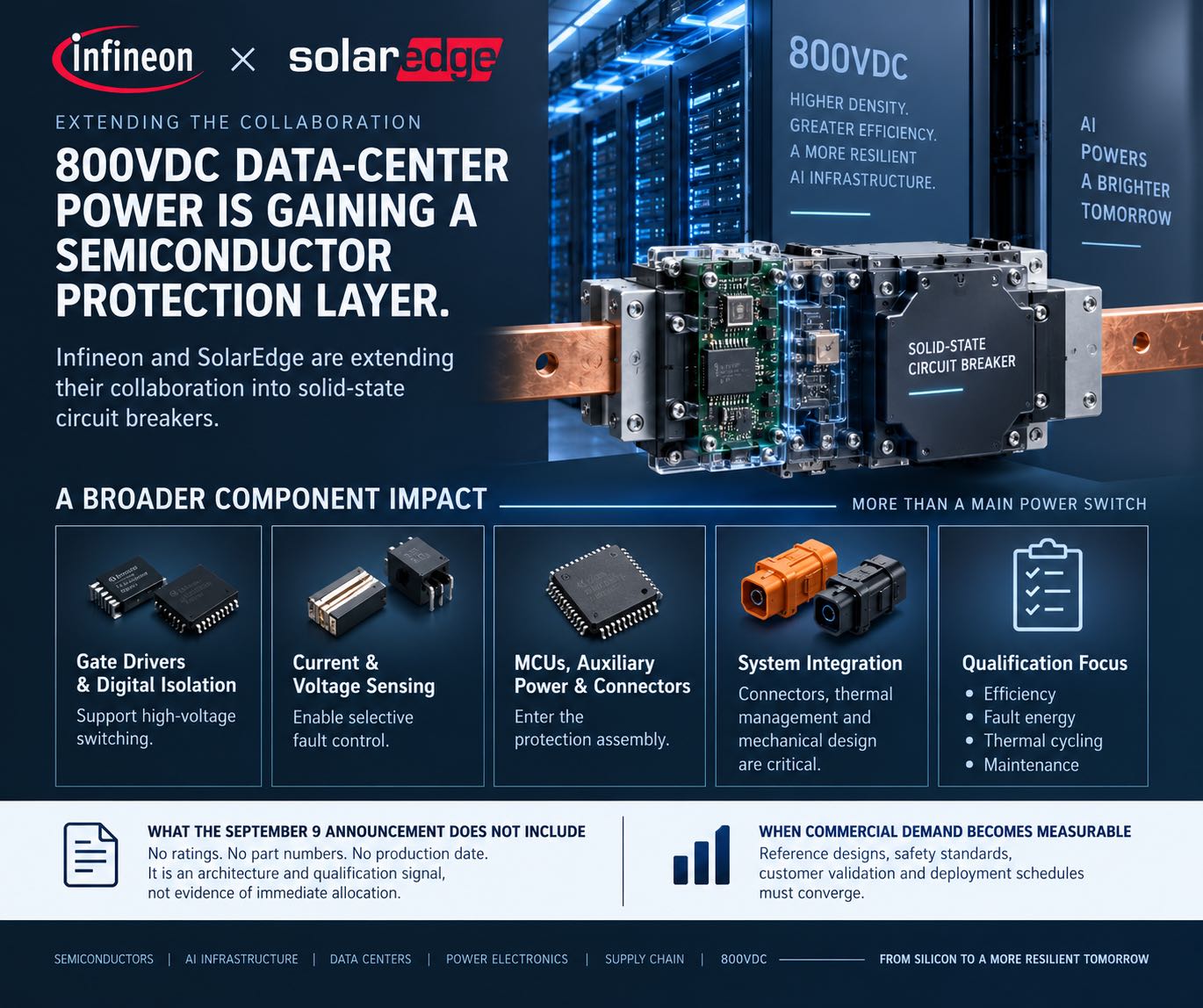
Infineon and SolarEdge announced on September 9, 2026 that they are extending their collaboration to solid-state circuit breakers for 800VDC AI and hyperscale data centers. Their earlier work covered silicon carbide components for a solid-state transformer platform. The new scope addresses the distribution layer between the transformer and compute racks, with an end-to-end direct-current architecture spanning the medium-voltage grid connection, distribution and rack.
A mechanical breaker interrupts current with moving contacts. A solid-state circuit breaker uses semiconductor switches and electronic controls to isolate a fault. Direct-current systems lack the natural zero crossing available in AC systems, making arc control and fault-energy limitation more demanding. The companies state that solid-state protection can interrupt DC faults orders of magnitude faster than electromechanical breakers, although no switching time, current rating or commercial part number was disclosed.
The component map expands beyond compute silicon
An 800VDC protection design can require main power switches, gate drivers, digital isolation, current and voltage sensing, control MCUs, auxiliary power, connectors and thermal-management components. Power devices must balance conduction loss with short-circuit withstand, surge behavior and lifetime. Protection logic must also isolate a local rack fault without unnecessarily disconnecting a broader section of the data center.
Engineering demand normally precedes production purchasing. Prototype activity can create requirements for evaluation modules, sensors, controllers and test equipment before a qualified rack architecture exists. Volume follows only after efficiency, fault selectivity, thermal cycling, safety and system interoperability have passed validation. The announcement contains no bill of materials, supplier allocation or production date, so it does not establish a shortage for a specific semiconductor.
SiC exposure remains a design question
Infineon and SolarEdge previously disclosed SiC content in their solid-state transformer work, but the new SSCB announcement does not specify the switching material. At 800VDC, SiC may offer attractive switching speed and efficiency. Cost, conduction loss, fault ruggedness and control complexity will determine whether the final implementation uses Si MOSFETs, IGBTs, SiC MOSFETs or a hybrid topology.
This uncertainty means market tracking should extend beyond SiC wafer capacity. Useful evidence will include module topology, the number of parallel die, gate-drive requirements, isolation ratings, cooling method and safety certification. Each design choice changes the value and volume of power semiconductors, drivers, sensors and passive components in the protection assembly.
Higher rack density changes power architecture
AI accelerators, networking and high-bandwidth memory are raising rack-level power. Repeated AC-to-DC conversion stages consume space and introduce losses. A higher-voltage DC bus can reduce current and conductor loss at a given power level, but it also raises insulation, fault isolation and service requirements. Solid-state protection is therefore an enabling control layer for higher power density, not simply a one-for-one breaker replacement.
The commercial evaluation must consider end-to-end efficiency, fault-clearing energy, selective coordination, redundancy and maintenance. Faster interruption can lose its advantage if steady-state semiconductor losses are excessive. Efficient devices can still fail to reach scale if certification, replacement practice or system interoperability remains unresolved.
Milestones that convert architecture into demand
The first milestone is a specification covering voltage, current, interruption time and efficiency. The second is a public reference design naming Infineon power, driver or sensing devices. The third is prototype, certification or customer-validation disclosure from SolarEdge. The fourth is alignment between 800VDC industry frameworks and rack interfaces.
The collaboration confirms that AI data-center power development is moving beyond conversion efficiency into high-speed DC protection. Near-term effects remain concentrated in co-development and qualification. Medium-term semiconductor demand will depend on product release, standards and deployment schedules. The addressable component set is broad, but procurement volume cannot be quantified until a reference design and commercial platform are disclosed.
A separate consideration is lifecycle behavior. Data centers require predictable maintenance intervals and controlled failure modes. Semiconductor protection introduces diagnostic data and programmable logic, which can improve condition monitoring, but also adds firmware, cybersecurity and obsolescence requirements. Qualification must therefore cover not only electrical performance but also field replacement, software control and long-term component availability.
The economics will be measured at system level. Reduced copper, fewer conversion stages or higher rack utilization may offset the cost and loss of semiconductor switches. Conversely, a design that performs well in fault tests may not scale if cooling or redundancy adds too much capital expense. Public evidence is not yet sufficient to decide that balance. The announcement is a credible architecture signal and a starting point for component qualification, while product-level demand remains pending.