
Infineon CYT4EN Reframes Automotive Cockpit Architecture Around an MCU, External LPDDR4 and Dual Displays
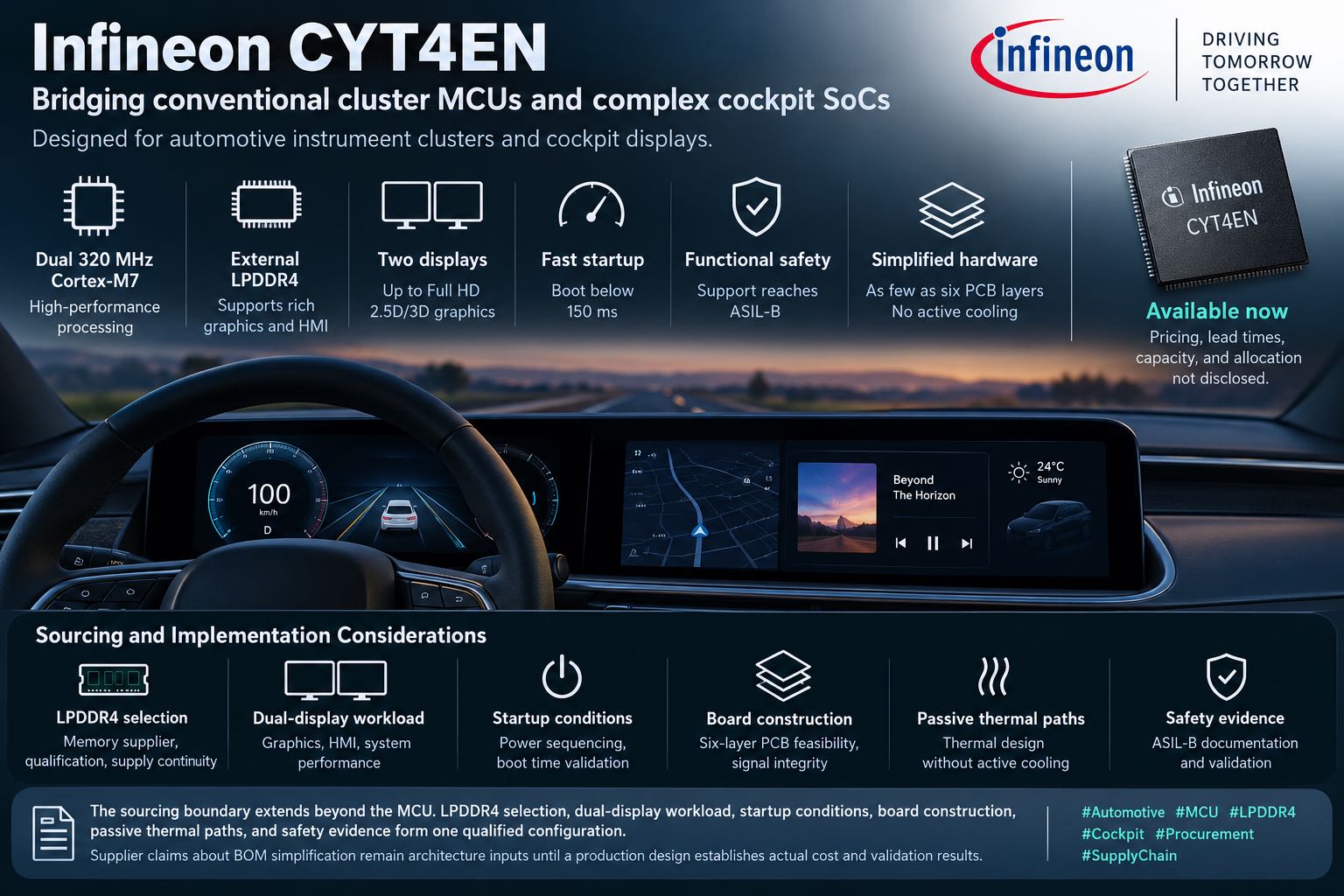
Infineon’s October 6, 2026 launch of the TRAVEO T2G CYT4EN introduces an MCU-centered option for instrument clusters and cockpit displays. Two 320 MHz Arm Cortex-M7 cores, external LPDDR4, two simultaneous displays, Full HD support, and 2.5D or 3D graphics move the platform into workloads often associated with more complex SoCs. Boot below 150 ms and functional safety up to ASIL-B reinforce its deterministic automotive profile. Claims for six-layer PCBs and operation without active cooling can reshape system planning, although program economics still require board-level evidence and supplier quotations.
An MCU-Centered Cockpit Architecture
Infineon introduced the TRAVEO T2G CYT4EN on October 6, 2026, for automotive instrument clusters and cockpit display systems, including two-wheelers. The product occupies a deliberate architectural position. It extends an automotive MCU platform with external high-bandwidth memory and more capable graphics rather than adopting the full hardware and software model of a complex cockpit SoC. For vehicle manufacturers and Tier 1 suppliers, this creates a distinct design path where deterministic startup, functional safety, display capability, board complexity, and thermal behavior can be balanced within one MCU-centered subsystem.
The significance lies in the boundary of the platform. Infineon says the device can reduce system complexity and bill-of-materials content relative to SoC-based implementations, including designs that do not require additional microcontrollers for selected management and in-vehicle communication functions. That statement is a supplier architecture claim, not a quantified program saving. Controller consolidation may remove components and interfaces, while the implemented system still includes external memory, power conversion, vehicle networking, display connectivity, protection, software, and validation. A commercial comparison remains specific to the vehicle program and cannot be reduced to the purchase price of the principal processor.
The launch also provides no pricing, lead-time, allocation, or capacity information. Its value is therefore architectural and technical, with market availability requiring separate evidence from quotations and supply commitments.
Processing, Memory and Display Workload
CYT4EN integrates two Arm Cortex-M7 cores running at up to 320 MHz. The graphics subsystem uses external LPDDR4, placing memory bandwidth outside the MCU package while retaining the control model of a microcontroller platform. This arrangement supports advanced 2.5D graphics and 3D scene rendering, two displays operating simultaneously, and resolution up to Full HD. It is intended for cluster and cockpit display functions rather than representing a general claim for every infotainment workload.
External LPDDR4 is an important system and sourcing boundary. Memory density, speed, package, temperature grade, supplier revision, power rails, routing topology, signal integrity, initialization, and error handling all become part of the validated configuration. The architecture can provide more display bandwidth without moving to a larger SoC stack, but it also links MCU and memory changes. A nominally equivalent LPDDR4 substitution can alter startup behavior, graphics margin, power, or layout assumptions, so approved configurations need traceability across silicon revisions, software releases, and board versions.
Dual-display capability also needs workload definition. Resolution, frame rate, layer count, color depth, animation, camera content, and safety overlays compete for graphics and memory resources. The official maximum of Full HD establishes a capability ceiling, while production acceptance still depends on the specific pair of displays and the complete software image. Platform qualification should use the intended concurrent workload rather than independent single-screen demonstrations.
Deterministic Startup and Functional Safety
Infineon specifies a deterministic boot time below 150 ms for CYT4EN and contrasts that result with the multi-second initialization commonly associated with complex SoC platforms. In an instrument cluster, early presentation of telltales, warnings, and essential vehicle state can be a first-order requirement. Startup time therefore becomes part of the architecture decision rather than a secondary user-experience metric.
The published figure still requires a defined test envelope. Cold and warm starts, low-voltage events, temperature extremes, LPDDR4 initialization, retained states, software integrity checks, and both displays active can produce different paths to the first valid frame. OEM and Tier 1 acceptance criteria need to identify what is visible at the 150 ms boundary, which functions are fully initialized, and how degraded or recovery states behave. The deterministic claim is valuable precisely because it can be tested against an explicit condition set.
CYT4EN supports functional safety up to ASIL-B. This provides an MCU basis for safety-related cockpit functions, but it does not assign ASIL-B automatically to the finished cluster. The system safety concept, partitioning, diagnostics, display supervision, software integration, fault response, and evidence package remain program responsibilities. Processing capability, startup behavior, and safety must be qualified together because the display path can carry both convenience content and safety-relevant information.
PCB and Thermal Assumptions Under Review
Infineon states that CYT4EN can enable simplified PCB layouts with as few as six layers and avoid active cooling because of optimized power efficiency. These claims address two recurring sources of cockpit-system complexity: high-speed board construction and thermal hardware. They can materially influence an early platform study, but they are not guaranteed outcomes for every production design.
A six-layer board depends on LPDDR4 escape and length control, display and camera interfaces, vehicle networks, power integrity, electromagnetic compatibility, ground reference continuity, safety partitioning, connector placement, and manufacturer design rules. Changes in screen count, connector location, memory package, or enclosure geometry can alter the layer requirement. The correct comparison is the production routing study for the target system, not a generic layer-count assumption.
Operation without active cooling similarly retains a thermal engineering workload. Ambient range, sustained graphics utilization, dual-display load, package and board thermal resistance, neighboring heat sources, enclosure conduction, passive spreading, and component derating determine the final margin. Removing a fan or active cooling element may reduce mechanical content and failure points, but the financial effect remains unverified until the complete thermal solution and manufacturing cost are compared. No validated saving amount appears in the announcement.
For program governance, the six-layer and passive-cooling targets can be recorded as assumptions with owners, test conditions, and closure criteria. This preserves their potential value without treating supplier positioning as completed platform validation.
Procurement and Lifecycle Implications
Infineon says the TRAVEO T2G CYT4EN is available now. That status marks commercial introduction, but it does not disclose committed volume, standard lead time, allocation, production capacity, or long-term pricing. The launch therefore provides no basis for a shortage, price increase, delivery improvement, or broad automotive MCU market conclusion.
Procurement control should follow the architecture. The exact CYT4EN ordering code and silicon revision, approved LPDDR4 devices, validated board revision, dual-display workload, boot-software baseline, safety evidence, and thermal configuration form one controlled set. A PCN or alternate-memory proposal can affect multiple acceptance dimensions even if the changed component appears functionally similar. EMS build records and AVL structures need enough detail to preserve the qualified pairing rather than treating the MCU and memory as unrelated line items.
The platform also changes make-or-buy boundaries. Fewer controllers and a simpler cooling concept can reduce selected assembly and integration tasks, while greater concentration in one MCU-memory-display combination can increase the impact of revisions. Alternate sourcing must therefore consider system equivalence across startup, graphics, thermal behavior, and safety, not only pinout or nominal capacity.
CYT4EN’s central market signal is the expansion of MCU-based cockpit design. Its commercial outcome will be determined by program-specific BOMs, validation results, quotations, lifecycle commitments, and production ramps that are not contained in the launch announcement.