
Espressif's Q3 Inventory Build Shows the Working-Capital Cost of Longer Memory Procurement Lead Times
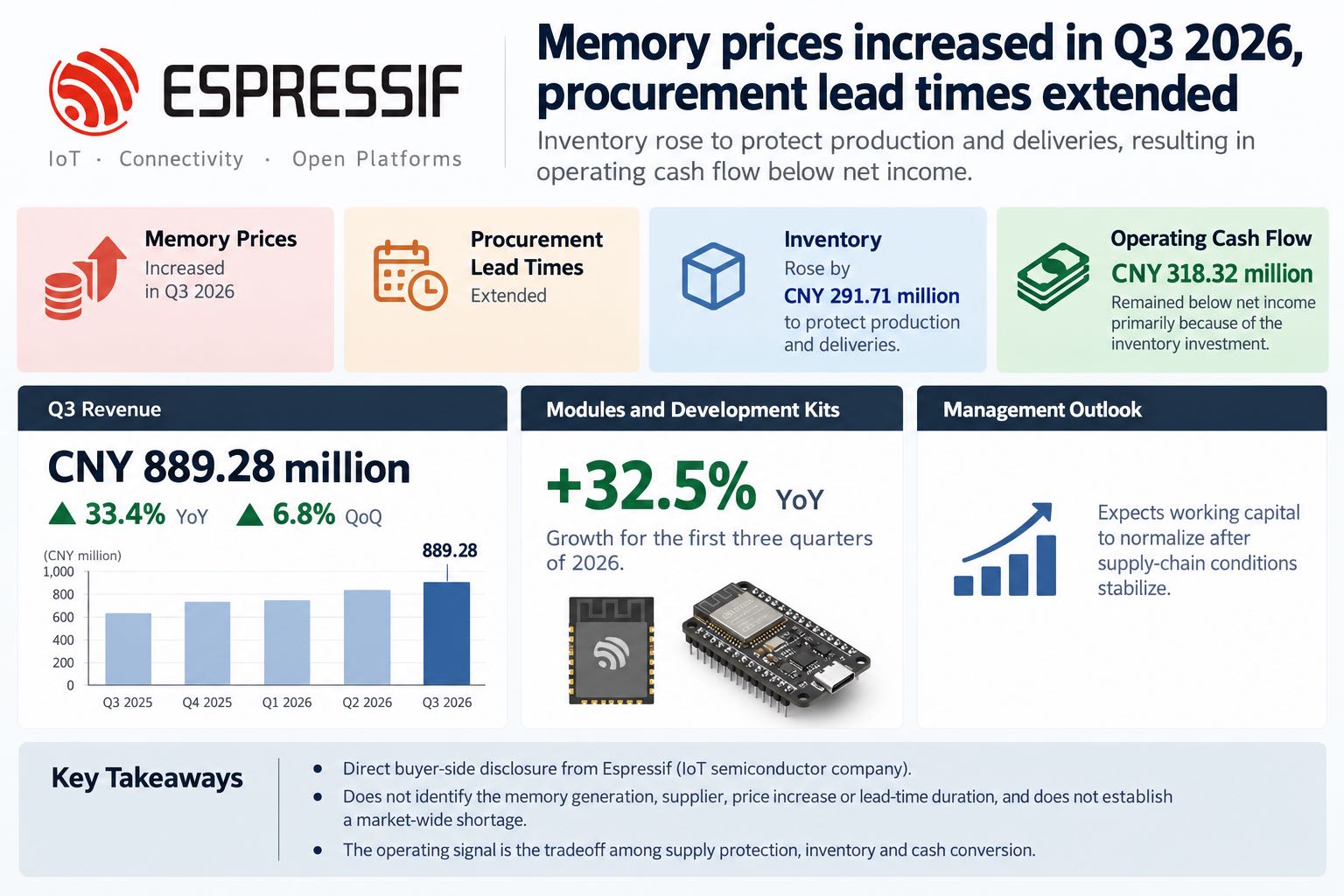
Espressif reported that memory prices increased and procurement lead times extended during the first three quarters of 2026. The IoT semiconductor supplier deliberately increased inventory to protect supply, production and deliveries, raising inventory by CNY 291.71 million from year-end 2025. Operating cash flow of CNY 318.32 million remained below net income primarily because of that investment. The disclosure provides a buyer-side operating signal, but its scope is limited to Espressif and does not demonstrate a broad memory shortage or a common price path across technologies.
A Procurement Disclosure Rather Than a Market Index
Espressif's Q3 2026 report provides a direct statement about the purchasing conditions experienced by an IoT semiconductor company. During the reporting period, memory prices increased and procurement lead times extended. Management responded by building inventory to secure supply and maintain stable production and deliveries.
The source is valuable because it connects an input-market condition to a specific operating response. Its scope is also tightly defined. Espressif does not identify the memory technology, generation, density, supplier, contract structure, percentage price change or number of additional lead-time weeks. The report does not state that all memory categories or semiconductor buyers faced the same pattern.
The evidence therefore supports a company-level conclusion. Espressif encountered higher memory purchase prices and longer replenishment cycles. A market-wide shortage, a synchronized price increase or a forecast for a named memory product would require additional data.
Inventory as a Buffer for Production and Delivery
Inventory increased by CNY 291.71 million from the end of 2025. Espressif calls the increase a strategic reserve intended to secure supply and ensure stable production and deliveries. The wording identifies operational continuity as the objective rather than presenting the balance simply as unsold stock.
An inventory buffer can reduce exposure to procurement delays by moving materials onto the balance sheet earlier. It can also support production scheduling when input availability becomes less predictable. The same action lengthens the cash-conversion cycle because cash is committed before products are completed, sold and collected.
The reported CNY 291.71 million is the change in total inventory, not a disclosed purchase value for memory alone. The document does not separate raw materials, work in process and finished goods in its management explanation, nor does it allocate the increase to product families. The figure should remain linked to Espressif's overall inventory position.
The Working-Capital Cost Appears in Operating Cash Flow
Net cash provided by operating activities was CNY 318.32 million during the first three quarters. Espressif says the inventory build was the primary reason this figure was below net income. The procurement response is therefore visible in financial statements as well as in narrative commentary.
This linkage matters for interpreting quarterly performance. Revenue and accounting profit can grow while cash conversion weakens temporarily because the company funds additional stock. The difference does not by itself indicate deterioration in demand or collections; management explicitly attributes the main effect to inventory investment.
Espressif expects this deliberate working-capital investment to normalize as supply-chain conditions stabilize. The statement is an expectation rather than a completed event. It does not specify when conditions will stabilize, how much inventory will be released or whether price and lead-time pressure will ease at the same pace.
Growth Context Across Chips and Modules
Third-quarter revenue was CNY 889.28 million, up 33.4% year over year and 6.8% quarter over quarter. Revenue for the first three quarters reached about CNY 2.37 billion, an increase of 23.9% year over year. The underlying table reports Q3 revenue of CNY 889,277,202 and nine-month revenue of CNY 2,369,988,496 on a rounded-yuan basis.
Modules and development kits generated 32.5% year-over-year growth during the first three quarters. Espressif relates module adoption to a maturing IoT ecosystem and demand for pre-certified solutions that simplify hardware development. This provides an operating backdrop for the company's inventory policy.
It does not establish causation between product growth and memory procurement conditions. The report does not quantify memory content by chip, module or development kit, and it does not assign the inventory increase to those categories. Revenue growth and procurement pressure belong in the same operating period but remain separate facts.
A Different Signal From PC Memory Cost Pressure
Espressif's disclosure concerns the experience of an IoT chip and module supplier purchasing inputs. Its central mechanism is the tradeoff among supply protection, production continuity, inventory and operating cash flow. A PC supply-chain analysis would instead require system bill-of-material shares, OEM production, channel inventory and end-market shipment data.
Keeping those contexts separate prevents a company-specific statement from being absorbed into a broader memory narrative. Espressif offers strong evidence for what happened inside its own procurement and working-capital cycle. It offers no direct evidence about memory cost shares in PCs, supplier-wide utilization or retail and spot-market behavior.
Indicators for the Next Reporting Period
The next report can be assessed through four linked indicators. Total inventory will show whether the buffer continues to rise or begins to normalize. Operating cash flow relative to net income will show whether working capital is releasing or absorbing more cash. Updated language on memory prices and lead times will show whether the purchasing environment has changed. Revenue mix will provide context for production and delivery requirements.
These indicators should not be collapsed into a single shortage measure. Inventory can change because of procurement timing, production planning, sales mix or delivery schedules. Cash flow can change for reasons beyond stock. A repeated company statement about prices and lead times would provide the clearest direct comparison with the Q3 disclosure.
The current record is precise: Espressif paid more for memory, faced longer procurement lead times, and invested in inventory to protect its own production and deliveries. The company expects normalization after supply-chain conditions stabilize, but neither a market-wide conclusion nor a fixed recovery timetable is supported.