
When HBM Crowds Out DDR5: The Wafer-Allocation Math That Keeps Server Memory Tight Through 2027
A record Korean export print and a memory-led equity rally grabbed the headlines this week, but the more durable story for OEM and EMS sourcing teams sits one layer down in the wafer allocation. HBM and DDR5 draw from the same DRAM capacity, at roughly a three-to-one exchange, and the leading maker is signaling that it will keep favoring DDR5 margin over an aggressive HBM4 ramp. This piece walks through why server-grade DDR5 tightness is structural rather than cyclical, and what that means for planning through H1 2027.
This week's memory headlines were loud in the usual way. South Korea reported that first-20-days July exports rose 62.9% year over year on a working-day-adjusted basis — the highest for any July on record — with AI-related chip exports up 180.6%, and the equity tape responded in kind, with Micron up 12% and SanDisk up 14% into the print (Bloomberg; Motley Fool, 07-21). For a sourcing team, though, the export beat and the stock move are the surface. The variable that actually governs your server-memory availability over the next several quarters is quieter, and it lives inside how the memory makers choose to spend a finite pool of DRAM wafers.
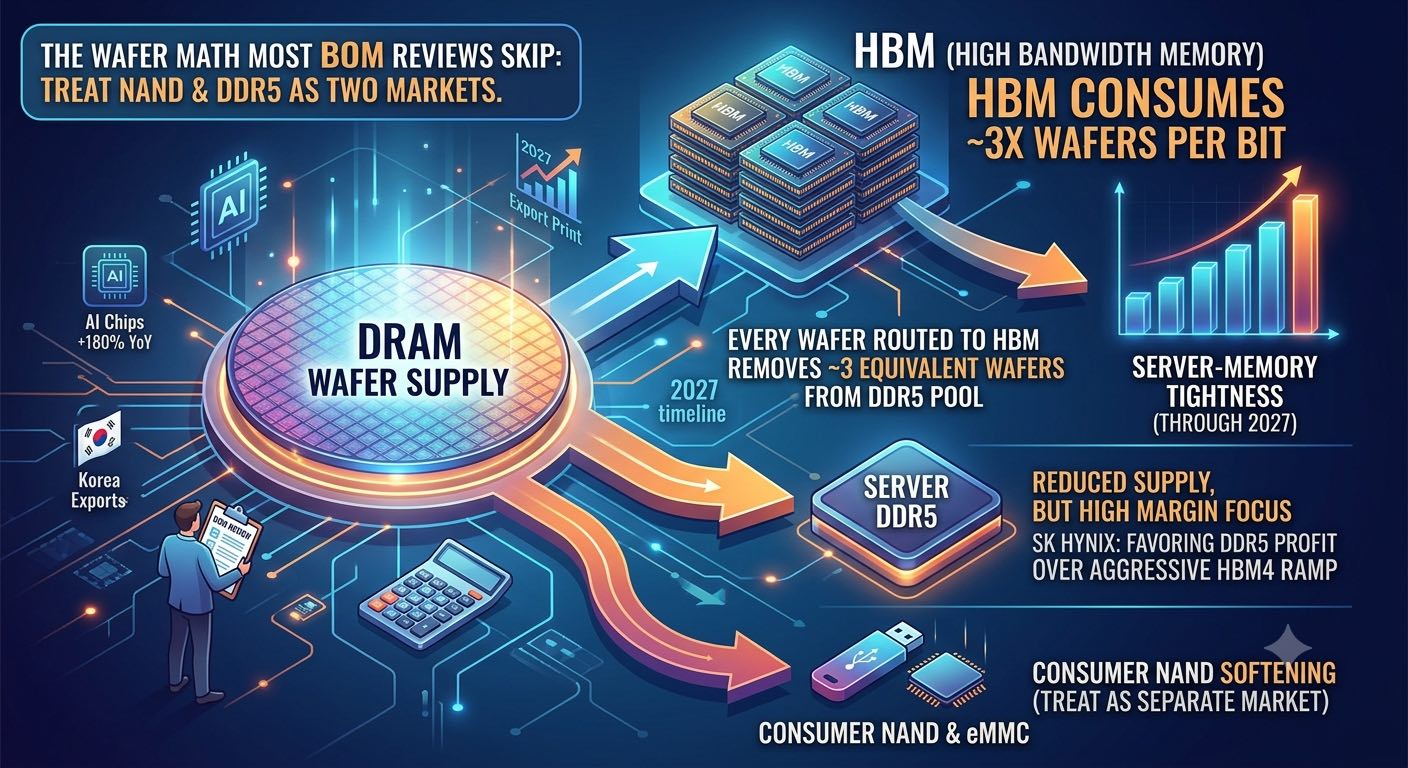
The mechanism is simple to state and easy to underweight. High-bandwidth memory and standard DDR5 are manufactured from the same DRAM wafers, but HBM consumes that capacity far less efficiently on a per-bit basis. It is bit-density-light and process-heavy — the through-silicon vias, the die stacking, the known-good-die yield loss all mean that a wafer routed to HBM yields a fraction of the shippable density it would have as commodity DDR5. The rule of thumb circulating across the supply base is roughly three-to-one: each wafer committed to HBM removes on the order of three equivalent wafers from the DDR5 pool. That ratio, not any single demand headline, is what a planner should carry into a capacity model, because it converts every incremental AI-accelerator build into a direct subtraction from server-DIMM availability.
What makes the current window unusual is that the makers are leaning into the trade-off deliberately, and saying so. SK hynix — the HBM share leader — has been cited as prioritizing DDR5 profitability over an accelerated HBM4 ramp. Read that carefully: it is not a story about HBM being unwanted, it is a story about high-density server DDR5 being so profitable right now that even the company best positioned in HBM is pacing its next-generation ramp to protect DDR5 margin. For a buyer, the implication is uncomfortable but clarifying. Supply is not going to rotate back toward relieving commodity server DIMM tightness out of goodwill; it will keep flowing to whichever line clears the highest margin, and for the moment that line is the one you need.
The supply-side relief that would break this pattern is real but distant. The capacity that matters — SK hynix's M15X and Micron's Idaho expansion among the visible projects — is broadly modeled to contribute meaningful DDR5-relevant output only from the first half of 2027. That timing is the single most important number in this whole discussion for anyone building a 2026 sourcing plan, because it defines the length of the gap. This is not a one-quarter squeeze to be waited out with a thin buffer; it is a structural condition that persists across the back half of 2026 and into the following year, and it should be planned as such rather than as a transient spike.
It is worth being precise about what is not tight, because the contrast is where sourcing teams most often misread the market. NAND is behaving very differently from DRAM: contract calls for the third quarter span a wide 0-to-15% range, consumer NAND and eMMC demand is softening, and the price pass-through on consumer parts appears to have topped. Enterprise SSD, notably, carries the shortest lead times of the major categories at eight to fourteen weeks, with QLC capacity booked through 2026 but constrained by allocation rather than fab output. None of that consumer-side cooling has any bearing on the availability of high-density server RDIMM. Allowing a "memory is coming down" narrative — which is true for a specific and separate set of parts — to inform how you contract server DDR5 is the exact error the wafer math warns against.
For planning purposes, the practical posture follows directly from the mechanism. Treat server DRAM and consumer storage as two independent books with independent price and validity assumptions, and resist any customer or internal pressure to collapse them. Keep quote validity on high-density DDR5 short until the near-term data points land — SK hynix's second-quarter results tonight will refine the HBM shipment trajectory and the DRAM ASP framing, and those two disclosures matter more to your 2026 DIMM cost than any equity move. Where you can, use the relatively better-supplied enterprise SSD channel to keep programs moving, and clear slow consumer NAND and eMMC inventory into current strength rather than holding for a rebound that the demand data does not support. Above all, anchor the capacity plan to the one variable that actually drives it: the share of DRAM wafers the makers assign to HBM. As long as that share keeps rising and next-generation server capacity remains a 2027 event, server-memory tightness is not a risk to hedge occasionally — it is the base case to design around.