
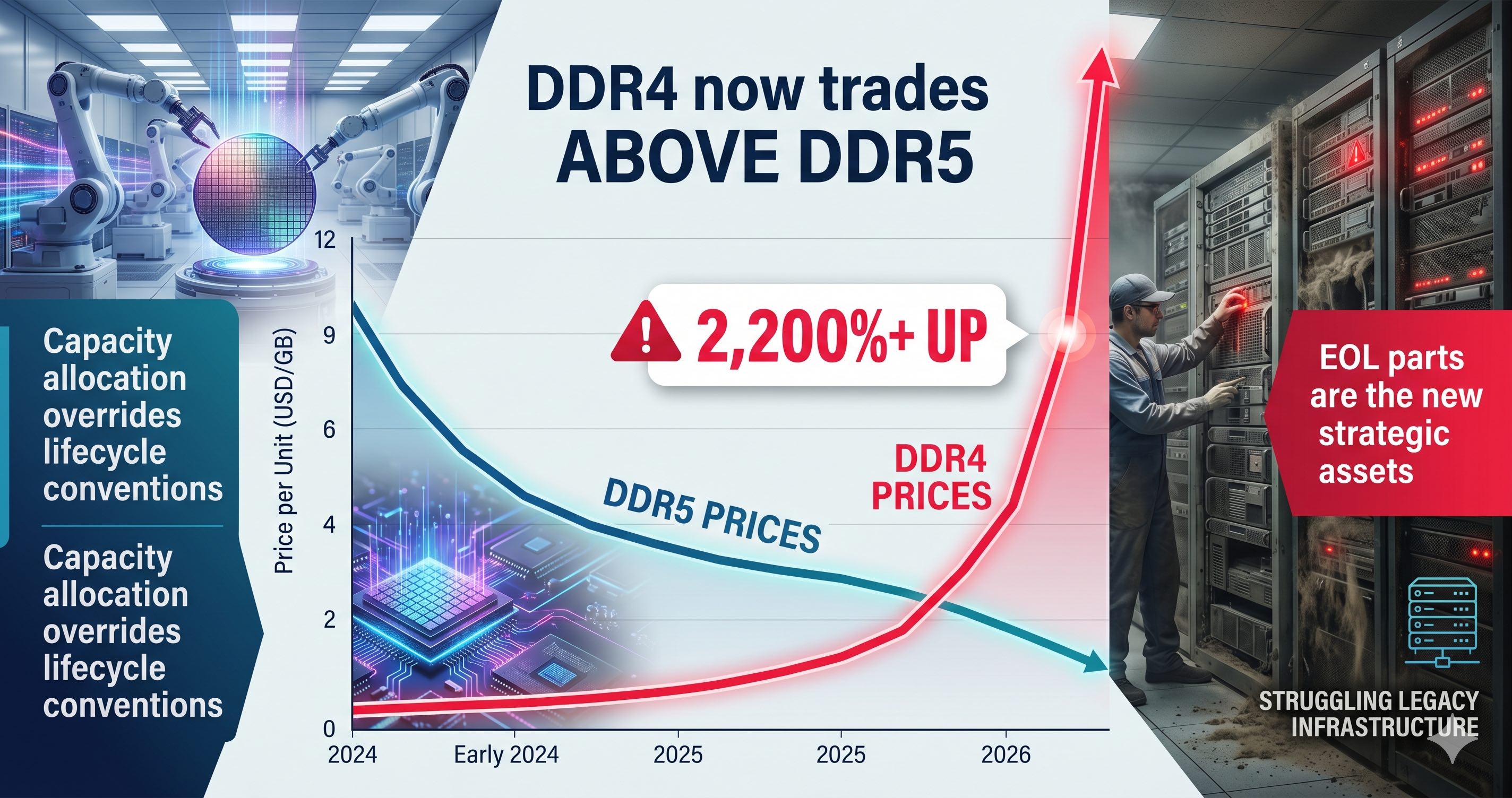
When EOL Logic Inverts: Why DDR4 Trading Above DDR5 Should Reshape OEM and EMS Memory Sourcing
A price inversion in which a legacy memory generation costs more than its successor is not a quirk — it is a signal about how capacity allocation now overrides product-lifecycle convention. For OEM and EMS buyers, DDR4 trading above DDR5 reframes how end-of-life parts should be planned, costed and governed across the BOM.
For most of the past three decades, the memory market has followed a dependable rhythm. A new DRAM generation ramps, the previous one slides down the cost curve, and procurement teams plan end-of-life transitions with the comfortable assumption that the older part will only get cheaper as it ages out. That assumption has now failed in an unusually visible way: DDR4 spot pricing has moved above comparable DDR5, some DDR4 SKUs sit more than 2,200% above their 2024 lows, and a handful of makers have begun reopening DDR4 lines they had already slated for retirement. When the outgoing generation outpriced the incoming one, the convention that organized a generation of sourcing playbooks quietly broke.
The mechanism is worth stating plainly, because the lesson is bigger than DDR4. Samsung, SK Hynix and Micron operate under a hard ceiling of wafer capacity, and within that ceiling every wafer carries an opportunity cost. DDR5, LPDDR5X and high-bandwidth memory each return materially more margin per wafer than DDR4, and with AI infrastructure absorbing memory at unprecedented rates, the makers have rationally tilted capacity toward those higher-value products. DDR4 was pushed to end-of-life and last-time-buy notices were issued. What the makers could not do, however, was relocate demand. A vast installed base — industrial controllers, networking equipment, surveillance systems, medical devices, legacy server platforms — remains architecturally committed to DDR4, on BOMs that cannot be redesigned on the timescale of a supply decision. Structurally contracting supply met structurally sticky demand, and price did the only thing it could.
For OEM and EMS organizations, the inversion forces a reframing of how end-of-life is treated inside the BOM. The traditional posture toward an EOL part is managed wind-down: consume remaining stock, qualify a successor, transition gracefully. That posture implicitly assumes the EOL part is depreciating. When the EOL part is appreciating instead — and appreciating faster than almost anything else on the board — the same part becomes a balance-sheet and continuity exposure that deserves explicit governance rather than passive run-out. The first discipline is therefore visibility: a current, accurate map of every DDR4 line item, its annual consumption, its last-time-buy status and the remaining window. Organizations that cannot produce that map quickly are the ones most exposed, because they will discover their commitments only after the window has closed.
The second discipline is a genuine cost comparison rather than a reflexive one. Because DDR4 now trades above DDR5, the long-standing logic that staying on the older part is the cheaper path no longer holds automatically. Where a DDR4 device can be replaced by a pin- and density-compatible DDR5 part, the fully loaded cost of a design-side qualification — engineering time, re-validation, documentation — should be weighed against the cost of buying increasingly scarce DDR4 through the secondary channel for the remaining product life. In some programs the redesign will be the more expensive path; in others, particularly long-lived industrial platforms, paying up for DDR4 may still be rational. The point is that the answer is now genuinely uncertain and must be calculated per program, not assumed.
The third discipline concerns the secondary channel, which the inversion has repriced from a fallback into a strategic supply. Clean, traceable DDR4 inventory with verifiable date codes is now a scarce and valuable asset, and the buyers who can authenticate and qualify channel stock quickly will hold an advantage over those who treat the secondary market as a last resort. That advantage, however, is bounded by diligence: in a market where the prize is large, authentication, traceability and counterfeit screening matter more, not less. The same conditions that make the secondary channel valuable also make it riskier, and the governance that surrounds it should tighten in proportion to the stakes.
The broader signal is the one OEM and EMS leaders should carry forward. The DDR4 inversion is not an anomaly to be waited out; it is an early, legible example of a market in which capacity allocation, driven by AI economics, now overrides the product-lifecycle conventions that procurement once treated as laws of nature. The consensus view holds that meaningful relief is unlikely before the end of 2026, with some analysts extending that horizon into 2027 and 2028. Organizations that internalize the lesson — that an end-of-life part can become one of the most valuable and most contested items on the board — will plan their last-time-buys, their redesign trade-offs and their channel relationships as deliberate strategy. Those that keep treating EOL as a quiet administrative wind-down will keep being surprised, and will keep paying for the surprise.