
When the Tape and the Physical Market Diverge: What the July 2026 Semiconductor Sell-Off Does and Does Not Tell OEM and EMS Sourcing Teams
In the week of 6–13 July 2026, semiconductor equities gave back roughly 10% across two sessions even as the SIA reported record May global sales of $120.6B and Samsung guided second-quarter operating profit to KRW 89.4T. For procurement organisations, this divergence is not a paradox to be resolved but a distinction to be operationalised. This analysis separates what the equity market repriced from what the physical market actually did, and sets out the sourcing implications for the balance of 2026 and beyond.
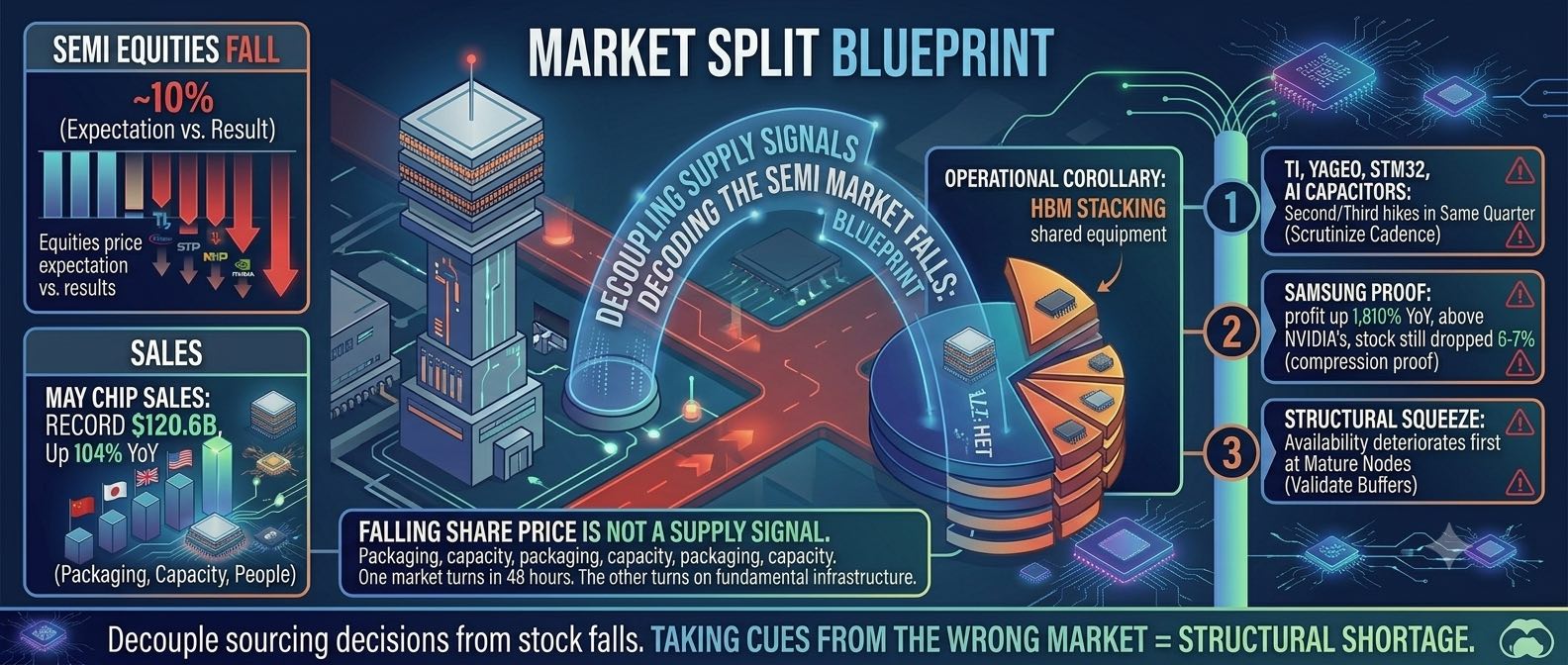
The week of 6 July 2026 produced an unusually instructive divergence, and procurement organisations would be well served to understand it before it is misread inside their own businesses. Semiconductor equities, having closed the strongest first half in the sector's history, gave back roughly ten percent across two consecutive sessions as capital rotated away from AI-linked names. In the very same week, the Semiconductor Industry Association reported that global semiconductor sales in May reached $120.6 billion — the highest monthly total ever recorded, up 9.2% sequentially and 104.1% year over year, marking a fifteenth consecutive month-on-month increase — and Samsung Electronics guided second-quarter operating profit to KRW 89.4 trillion, an increase of 1,810.3% against the prior year. The tape fell. The physical market did not.
The instinct to resolve this into a single narrative should be resisted, because the two markets are answering entirely different questions. An equity market prices the distance between a result and what was already expected of it. A physical market prices whether a given part can be placed in a given box on a given date. These questions can, and this week did, move in opposite directions.
Samsung's own print is the clearest available demonstration. Against an operating profit that rose more than eighteenfold year over year — a quarterly figure that exceeded NVIDIA's, and the company's third consecutive record — the shares fell six to seven percent on the day of the announcement. The cause was revenue of KRW 171 trillion against a consensus of KRW 172.18 trillion: a shortfall of just over one trillion won, or under one percent. After a half-year in which the sector's benchmark ETF appreciated 82%, several quarters of good news had already been discounted into the multiple. At that level of anticipation, a sub-one-percent miss compresses valuation. It says nothing whatsoever about whether DRAM is obtainable. Sourcing teams who read the resulting red screens as evidence of a loosening market will have drawn precisely the wrong inference from precisely the right data.
What the physical market did this week, in fact, was continue to tighten. Samsung's memory division is estimated to have contributed approximately KRW 90 trillion of operating profit on its own, and a figure of that magnitude is not assembled from volume; it is assembled from price. DRAM and NAND remain in ascent with no easing whatsoever on the server side. The same directional pressure is visible across analog and power, where Texas Instruments commenced its third price increase of the year on 1 July across core lines including power management ICs and MOSFETs, Infineon's second increase took effect the same day, STMicroelectronics implemented a second microcontroller adjustment on 28 June, and NXP's revision became effective on 1 June. In passive components the movement is more pronounced still: YAGEO raised official list pricing across its entire capacitor portfolio by approximately fifty percent effective 1 July, spanning MLCC, aluminium electrolytic, tantalum, polymer aluminium, film and supercapacitors, and — significantly — applied the increase directly to EMS and OEM accounts for the first time. Those direct accounts represent roughly 55.4% of the company's revenue, which means the buffer that previously absorbed such adjustments before they reached the end customer has been withdrawn. Secondary-market pricing on high-end AI-server capacitors has moved by as much as tenfold within a single month.
Lead times tell the same story. STMicroelectronics is quoting between sixteen and fifty-two weeks across multiple STM32 variants, with automotive-grade families occupying the long end of that range. NXP's i.MX7 and i.MX8 families are approaching thirty weeks, constrained not by wafer availability but by back-end substrate and packaging allocation. Microchip is requesting twenty-six weeks of forward visibility from its buyers. It bears emphasis that none of these developments is new to this particular week — they took effect across late June and early July — and this analysis does not present them as fresh signals. Their significance lies precisely in their persistence: across the two sessions in which semiconductor equities shed ten percent of their value, the delivered cost of a bill of materials did not decline by a single basis point.
Against this backdrop, Typhoon Bavi delivered an unscheduled and rather pointed reminder of structural concentration. The storm closed Taiwan's financial markets on 10 July, displacing TSMC's June revenue disclosure from that date to the afternoon of 13 July, with second-quarter earnings to follow on the 16th. That a single weather event can move the industry's most closely watched monthly datapoint by three days is a modest inconvenience. The underlying exposure it gestures toward is not. TSMC's 2nm capacity is confirmed sold out for the entirety of the year, and CoWoS advanced packaging capacity presently sits entirely within Taiwan. Every AI accelerator that depends on TSMC's most advanced packaging must therefore transit a single geography. For sourcing organisations still modelling wafer availability as the binding constraint on AI hardware, the constraint has in fact migrated to advanced packaging — and advanced packaging currently maintains one address.
The operational implications follow directly, and they are largely a matter of discipline rather than ingenuity. Purchase orders already placed at agreed pricing should be executed as planned; reopening them on the strength of an equity drawdown is unlikely to recover price and entirely likely to forfeit an allocation slot. Commercial teams should expect customers to invoke the sell-off as leverage in price discussions over the coming days, and should be equipped with the SIA figures when they do — a 104.1% year-over-year increase across fifteen consecutive months of growth is not the profile of a market in retreat. Bills of materials containing advanced packaging warrant four to eight weeks of buffer inventory, and secondary-channel positions are more sensibly opened as a hedge now than assembled under duress after a line has stopped. Consumer-grade components represent the one segment in this cycle where genuine negotiating room exists and where concessions can reasonably be made; server-grade and automotive-grade positions should be held. On industrial and long-lifecycle programmes, particularly those dependent on DDR4, low-density eMMC and LPDDR4, last-time-buy windows should be brought forward rather than allowed to drift.
There is, finally, a development from this week that attracted comparatively little attention and may prove the most consequential of all for the medium term. Bloomberg reported that the shortfall of high-skilled semiconductor workers in the United States could reach as many as 157,000 full-time roles by 2030, placing the construction schedules and production ramps of fabs already under way at material risk. Every capacity roadmap that assumes relief arriving in 2027 rests on an implicit assumption that the announced facilities will be completed and ramped on schedule. That assumption now carries a quantified human constraint attached to it. The distance between capacity as it appears in an investor presentation and capacity that actually ships product is, on this evidence, approximately one hundred and fifty-seven thousand unfilled positions — and no amount of capital expenditure closes that gap on a convenient timetable.
What this week ultimately offered was a clean natural experiment in the difference between two markets that are frequently, and expensively, conflated. One of them repriced by ten percent in forty-eight hours on a sub-one-percent revenue miss. The other continued to deliver record monthly sales, an eighteenfold profit increase at its largest supplier, fifty percent capacitor increases, and fifty-two-week microcontroller lead times, and it did so without registering the sell-off at all. Sourcing strategy that takes its cues from the first of these will find itself structurally short of the second.