
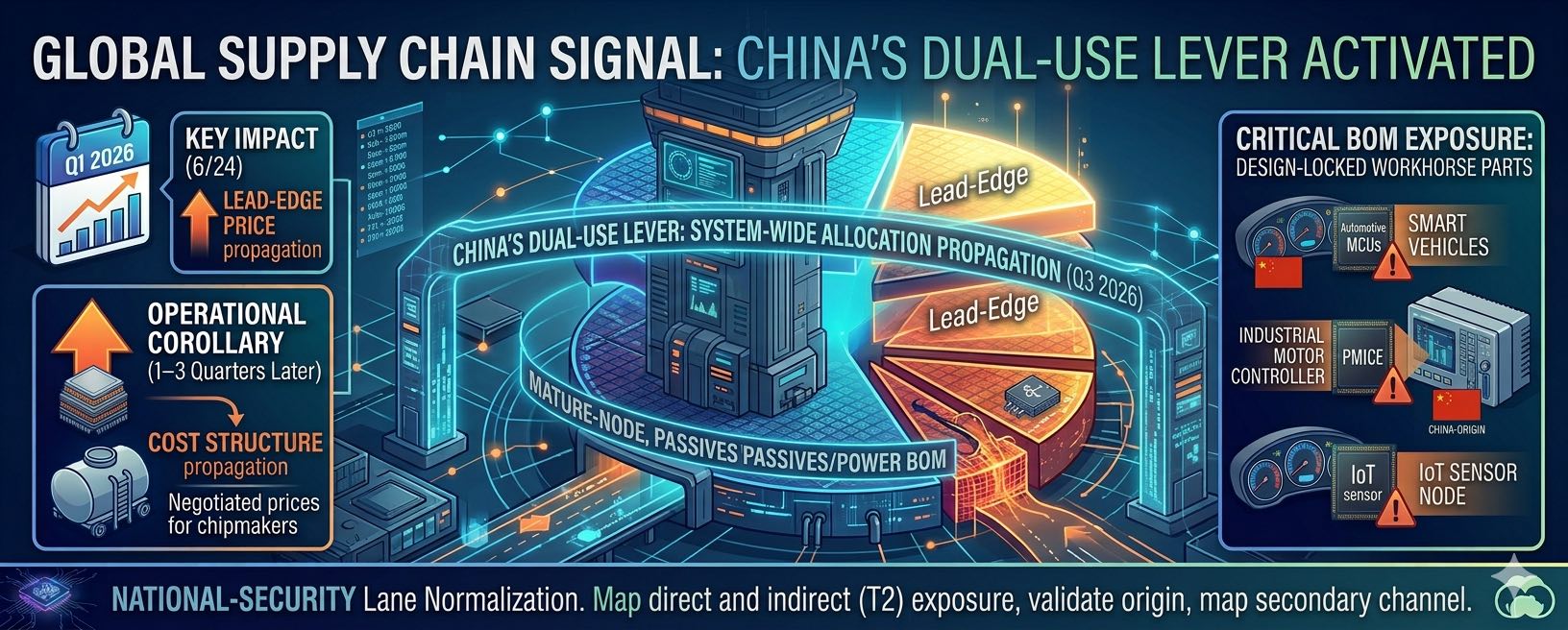
China's June 22 Dual-Use and Rare-Earth Listings Are a Sourcing Signal, Not Just a Geopolitical Headline: What OEM and EMS Procurement Teams Should Read From It
On June 22, Beijing answered Washington's early-June military-company designations with two coordinated orders: 10 US firms added to its export-control list and 46 barred from government procurement. A rare-earth miner and a magnet maker were named, and the language reached "worldwide." For OEM and EMS sourcing organizations, the durable takeaway is not the specific names — it is the normalization of dual-use logic and extraterritorial reach as routine policy tools.
When two governments trade lists, the instinct of most procurement teams is to scan for their own suppliers, find none, and move on. That instinct is reasonable, and on the narrow facts of June 22 it is also correct — the directly named entities sit far from the typical component bill of materials. But reading this episode only as a roll call of affected companies misses the part that will outlast the headline.
On Monday, June 22, China's Ministry of Commerce placed 10 US firms on its export-control list, barring Chinese companies from exporting dual-use items to them. The named parties include rare-earth mine operator MP Materials, rare-earth magnet maker USA Rare Earths, and a cluster of defense contractors working in aerospace, drones, synthetic-aperture radar, and shipbuilding. The same day, the Ministry of Finance separately barred government procurement from 46 US firms, including subsidiaries of Lockheed Martin, Boeing, General Dynamics and General Atomics, while exempting US-funded but locally registered companies. The two orders are explicitly framed as retaliation for the Pentagon's early-June addition of roughly 80 Chinese firms — including Alibaba, Baidu and BYD — to its list of "Chinese military companies."
The first thing worth internalizing is the mechanism, not the membership. The Commerce order does not merely name companies; it asserts that "institutions and individuals worldwide are prohibited from transferring Chinese dual-use goods" to the listed parties, with ongoing transactions to be suspended immediately. That is the structure of US semiconductor export controls, mirrored almost exactly. As Cameron Johnson of Shanghai-based consultancy Tidal Wave Solutions observed, the message is that "it doesn't matter where or who you are, you are bound by this regardless of circumstance." For a procurement organization with a globally distributed supply base, extraterritorial reach is the operative concept. It means that compliance exposure can travel through a third-country distributor, a transshipment hub, or a contract manufacturer two tiers down, even when no entity in your direct contract set appears on any list.
The second thing is that this is, by the consensus of the analysts quoted, a beginning rather than a conclusion. Nick Marro of the Economist Intelligence Unit described the orders as a "tit-for-tat response" consistent with China's playbook whenever Washington escalates on trade and investment tools. Johnson noted that enforcement may prove difficult in practice, partly because many named firms have already de-risked their China operations — but he also read the breadth of both directives as "probably just the beginning of the back and forth." Steve Okun, a Singapore-based analyst, was blunter still: there is "no truce" in the trade war, and the national-security lane remains active in both capitals regardless of the diplomatic warmth of the May Trump-Xi summit. A procurement team that files this under "resolved by the summit" is mispricing the trajectory.
The third thing, and the one most specific to hardware sourcing, is the rare-earth dimension. By naming a rare-earth miner and a magnet maker, Beijing put the materials layer of the supply chain back into the foreground. Rare-earth elements are not a chip input in the way silicon wafers are, but they are pervasive in the surrounding bill of materials — permanent magnets in motors and actuators, certain inductors and filters, some power and passive components, and the magnet assemblies inside sensors and speakers. The exposure for most electronics buyers is therefore indirect but real: not a sudden cutoff of a specific part number, but a rising layer of forward-supply uncertainty for any subassembly whose cost and availability depend on magnet content. That uncertainty is best handled the way any tail risk is handled — identified, quantified, and given its own line in the risk register rather than absorbed silently into a single-source assumption.
What does a disciplined response look like? It is not a scramble, because the immediate operational impact is limited. It is a methodical tightening of three things. First, source traceability: knowing, for the parts that matter, both the country of origin and the downstream destination, so that the "China-origin dual-use item to a listed party" chain can be affirmatively excluded before a purchase order is cut — with particular attention to transshipment and third-country brokering, where extraterritorial reach is most likely to surprise. Second, dual-sourcing of the genuinely sensitive lines: any single-source part that carries rare-earth content or a plausible dual-use classification deserves a qualified backup now, while the policy is still at the signaling stage and before any enforcement detail forces a hurried qualification. Third, materials-level monitoring: tracking magnet and rare-earth pricing as a leading indicator, because the first measurable movement from a rare-earth listing tends to appear in magnet-bearing assemblies well before it reaches finished semiconductors.
The strategic point underneath all of this is that the tools on display — dual-use classification applied broadly, and reach asserted regardless of jurisdiction — are not the kind that get rolled back. Specific lists are negotiable; both sides have shown they will add, exempt, and trade names as leverage shifts. The normalization of the instruments is not negotiable in the same way, because each side now has a demonstrated template the other has legitimized by using it. For OEM and EMS procurement, that argues for treating supply-chain provenance as a standing capability rather than an incident response. The organizations that will navigate the next several rounds with the least friction are the ones that can already answer, for any part, where it came from and where it is going — not because a regulator asked, but because they built the visibility before they needed it.