
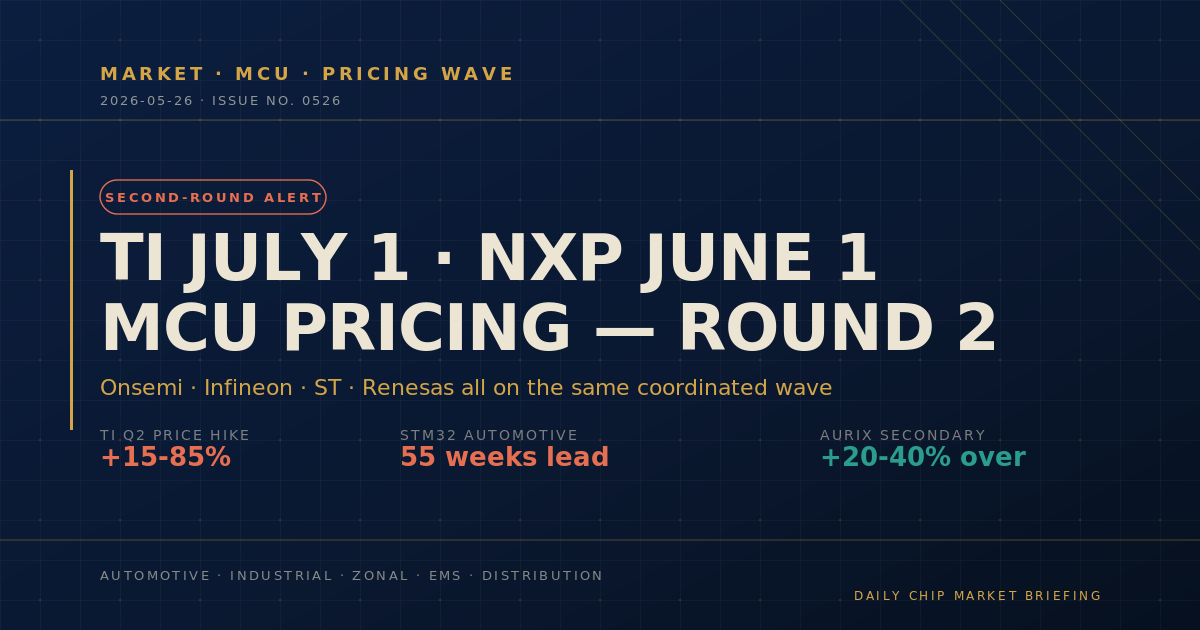
The Same-Year Second MCU Pricing Wave: What TI's July 1 And NXP's June 1 Tell Industrial And Automotive Buyers About 2026 H2
TI's July 1 second-round price increase and NXP's June 1 follow-up are not isolated supplier moves. They are the clearest signal yet that legacy-process MCU pricing has moved from annual contracts to rolling cost-plus, and that industrial and automotive procurement organisations need to restructure how they plan budgets and place safety orders through 2026 H2. This is a buyer-side analysis of the pricing mechanics, the lead-time exposure, and what disciplined sourcing teams should be planning today.
For most of the past decade, microcontroller pricing followed a familiar rhythm. Authorised distributors and OEM procurement teams negotiated annual contracts, vendors announced occasional list-price adjustments with thirty-to-ninety-day notice, and the industry budgeted on the assumption that pricing changes inside a fiscal year were unusual events rather than recurring ones. That assumption no longer holds. Texas Instruments has now communicated its second 2026 price increase, effective July 1, following an April 1 round that raised affected lines by anywhere from fifteen to eighty-five percent. NXP has followed with a second-round notice effective June 1, citing sustained pressure from raw material, energy, labour and logistics inputs. Onsemi raised in April and used its May earnings call to confirm that the increases were calibrated to return gross margin to a thirty-eight to forty percent corridor. Infineon's April 1 increase is now six weeks into the secondary market, with AURIX and PSoC channel ask-prices running five to twelve percent above pre-increase levels and select automotive AURIX SKUs trading at fifteen to twenty percent over official in spot.
The right framing for industrial and automotive procurement is that this is not four independent vendor events. It is a coordinated structural shift in how legacy-process MCU lines are priced. The legacy nodes — forty, fifty-five and ninety nanometre — where the vast majority of automotive and industrial MCUs are fabricated, are simultaneously meeting recovered post-2022 demand, AI-edge volume that did not exist eighteen months ago, and a structural reluctance from foundries to invest fresh capacity into nodes whose long-term economics are uncertain. Vendors who hold those node positions are using the pricing tools available to them, and they are doing so on a faster cadence than annual contracts can accommodate.
The lead-time picture reinforces the message. STMicroelectronics is quoting its TSX series and automotive-grade STM32 at fifty-five weeks, the longest figure in the major-vendor set and a level not seen since the 2021-2022 famine. China-manufactured STM32 volume production started March 26, but the available capacity has been allocated to long-term contract customers and does not relieve secondary-channel scarcity. Texas Instruments lead times span twenty to forty weeks across its MCU portfolio, with the highest-demand analog and embedded SKUs concentrated at the long end. Renesas reports twenty to forty-five weeks, with automotive-grade RH850 at the upper end. The new twenty-eight-nanometre RH850/U2C, launched March 6 and demonstrated at embedded world 2026, targets zonal vehicle control with four cores at three hundred twenty megahertz, dual lockstep, eight megabytes of on-chip flash and ASIL D capability; the longer-term implication is that legacy RH850/U2A and U2B inventory carries a finite premium window before the next-generation platform begins to displace it. Infineon AURIX runs twenty to thirty weeks, NXP S32 the shortest at twelve to twenty weeks, and AI-edge MCU launches across vendors are unusually arriving at sixteen to twenty-four weeks on day one.
For industrial OEMs and EMS partners, the practical question is whether the existing safety stock and contract structure are calibrated to the new pricing cadence. In most cases they are not. A standard quarterly forecast cycle, written against the assumption of one annual price adjustment, cannot absorb two same-year increases without either eroding gross margin or triggering ad-hoc requalification cycles to alternative parts. The disciplined response has three components, executed in parallel rather than sequence.
The first component is a focused exposure audit against TI, NXP, ST, Infineon, Onsemi and Renesas line items on active BOMs, layered with the date of each vendor's announced effective date and the current safety stock measured in weeks of cover. Programs with less than twenty-six weeks of cover and a critical dependency on one of the increasing vendors should be candidates for immediate safety orders ahead of the effective date, either with authorised distribution or with secondary channels that can lock date code and lot number on the purchase order. The economics of paying eight to ten percent over current market today to lock in pre-increase pricing are favourable against paying fifteen to twenty-five percent over current market four to six weeks later, even before factoring in the operational cost of urgent requalification or platform redesign.
The second component is a parallel qualification track for any program where a single-source dependency on one of the increasing vendors carries a multi-quarter operational risk. The credible second-source options vary by vendor and product family — for automotive AURIX exposure, the realistic alternatives are typically NXP S32 or Renesas RH850 on a per-platform basis, not a drop-in pin-compatible substitute. The qualification window for any of these alternatives is six to twelve months in a serious change-controlled program, and the engineering cost is real, but the strategic value of breaking single-source exposure is materially higher in a pricing environment where vendors are now executing two increases per year.
The third component is a budget posture adjustment. Annual budget cycles built on a one-increase assumption need to be re-baselined for a rolling cost-plus reality. This is uncomfortable for procurement teams who have to present revised cost lines to finance and product management, but the alternative — absorbing the gap silently and watching program margin erode quarter by quarter — produces a worse outcome at year-end. A rolling cost-plus posture also informs how safety orders are sized: instead of a single annual safety order intended to cover twelve months at the negotiated price, the better instrument is a series of smaller pre-effective-date orders timed to each announced vendor calendar. This requires tighter coordination between procurement, finance and production planning than most organisations currently maintain, and that coordination capability is itself the procurement capability that separates strong sourcing organisations from average ones in a tight-supply pricing regime.
There is also a secondary-channel observation worth absorbing. Brokers and stocking distributors with original-vendor inventory predating each vendor's effective date carry a real and quantifiable premium for PPAP-sensitive industrial and automotive customers. The premium is highest in the four-to-six weeks immediately preceding each announced effective date, and compresses quickly once new-build post-increase inventory begins to flow through the channel. For OEM and EMS sourcing organisations, this means the secondary channel is a tactical instrument for closing pre-increase windows, not a strategic long-term supply alternative. Used disciplinedly, it shortens the time between procurement intent and material in the receiving dock, which is exactly the capability that matters most when vendor calendars are moving faster than annual contract cycles.
The broader industry signal is that the AI-driven reshaping of semiconductor pricing has now extended past the leading-edge segments — HBM, advanced DDR5, 3 nm and 2 nm capacity — into the legacy-node MCU and analog foundations that industrial and automotive electronics have relied on for decades. The same demand and capacity mechanics that drove the memory pricing cycle are now operating in MCUs, and the industry should expect this to be the normal pricing cadence for legacy-node parts through 2027 rather than a transient 2026 condition. Procurement organisations that internalise this earlier will out-perform those that wait for the cycle to revert to the old cadence. The cycle is not reverting. The discipline that wins this cycle is the same discipline that wins the next one.