
When the Cost Wave Crosses Out of Memory: What the July 2026 Analog, MCU, Power and Passive Price Increases Signal for OEM and EMS Sourcing Strategy
Through the first half of 2026, procurement narratives were dominated by memory. The July repricing cycle marks a structural shift: cost pressure has crossed decisively out of memory and into analog, microcontrollers, power devices and passive components. YAGEO's broad capacitor adjustment, Texas Instruments' third increase of the year, and second rounds from STMicroelectronics, Infineon and NXP together reframe how OEM and EMS teams should model non-memory BOM cost, quote validity and inventory strategy into the second half.
For most of the first half of 2026, sourcing conversations centered on a single category. Memory pricing — HBM allocation, DDR5 contract escalation, enterprise NAND tightness — set the tone for procurement planning, cost models and executive updates. That focus was justified while the increases were concentrated. It is now incomplete. The defining development of July is that cost pressure has crossed out of memory and into the categories that OEM and EMS teams have historically treated as stable, plentiful and secondary to their sourcing risk: analog, microcontrollers, power semiconductors and passive components.
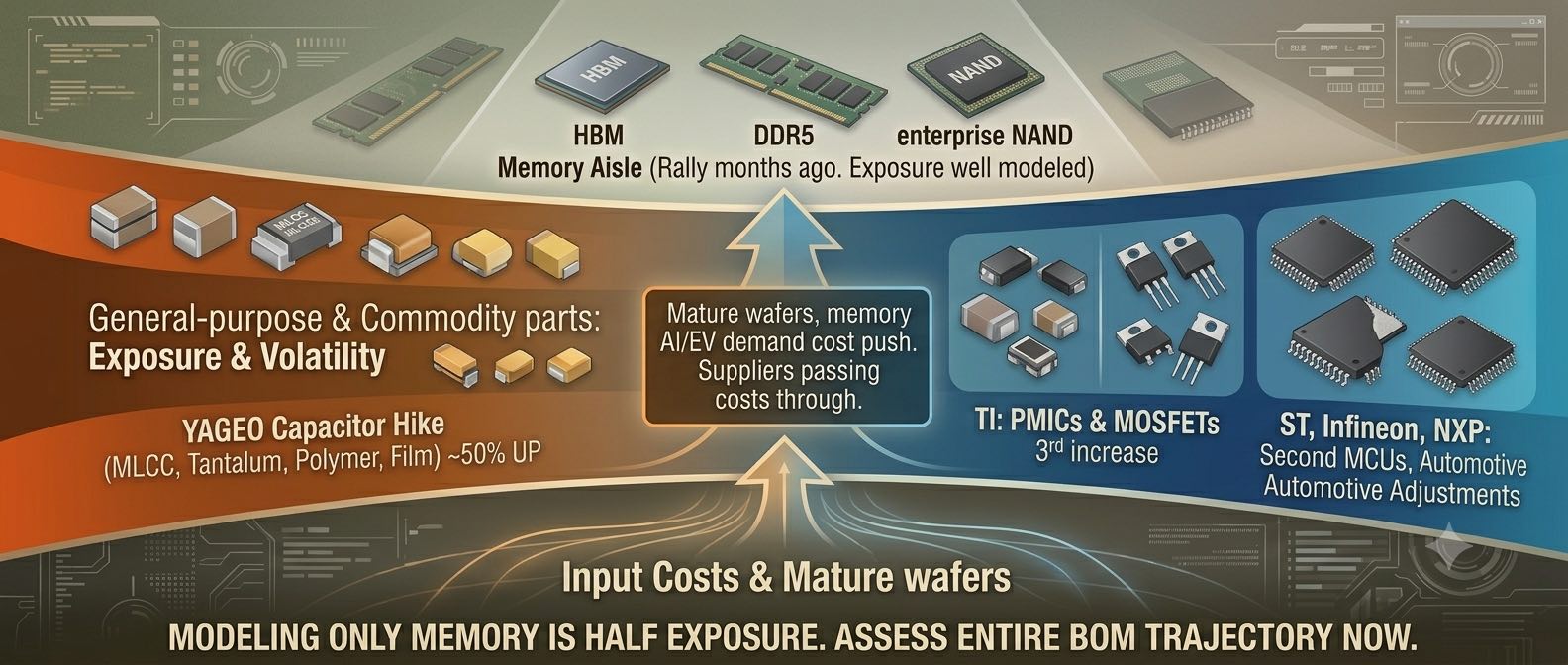
The clearest single signal came from passives. Effective July 1, YAGEO initiated its broadest capacitor price adjustment in several years, spanning multilayer ceramic capacitors, aluminum electrolytic, tantalum, polymer aluminum, film and supercapacitors. Official list prices moved up on the order of fifty percent, with steeper movement in the spot market. What makes this more than a routine adjustment is its breadth across dielectric families and, critically, its extension into general-purpose grades: by July, commodity MLCC categories used across consumer and industrial designs had entered a six-to-thirteen percent increase band. When general-purpose parts move rather than lag, the driver is structural cost rather than a localized demand event, and the implication for a BOM is systemic rather than isolated.
The semiconductor side moved in parallel and reinforces the same reading. Texas Instruments announced its third price increase of 2026, effective July 1, reaching high-volume power products including PMICs and MOSFETs, with magnitude varying by material and process technology. STMicroelectronics implemented a second microcontroller adjustment effective June 28. Infineon's second increase of the year took effect July 1, and NXP, the second-largest automotive semiconductor supplier, moved a second round from June 1, citing sustained inflation in raw materials, energy, labor and logistics. Even in graphics memory kits, AMD raised prices roughly ten percent for its board partners. No single one of these is decisive; together, across analog, MCU, power and passives, within a few weeks, they describe a cost floor rising underneath the non-memory BOM.
The mechanism connecting these actions matters for how sourcing teams should respond, because it determines durability. Three forces are at work. First, mature-node wafer costs are rising: foundries including TSMC and SMIC have lifted pricing on the legacy nodes that carry most analog, MCU and power production, tracking higher copper, silver and silicon input costs. Second, memory cost is propagating into microcontrollers, where devices with integrated on-chip memory absorb the increase first — a direct channel through which the memory super-cycle transmits into ostensibly unrelated categories. Third, recovering demand from AI infrastructure and new-energy applications gives suppliers the commercial confidence to pass cost through rather than absorb it. Cost-push reinforced by demand-pull tends to hold longer than a demand spike alone, which argues against treating this as a transient adjustment that will reverse in a quarter.
For OEM and EMS sourcing organizations, the practical consequences fall into a few areas. Cost models built around the assumption that passives and jellybean analog are stable line items need to be rerun; in many industrial and automotive BOMs, those lines are now the fastest-moving cost, not the safest. Quote validity should be reassessed, because at a cadence of three increases per year, the one-month price lock that teams have defaulted to on commodity parts no longer reflects supplier behavior. Allocation and NCNR terms warrant closer monitoring, since tightening commercial terms typically precede or accompany list increases on constrained part numbers. And inventory policy on long-lifecycle industrial and automotive designs deserves review: parts that were safe to buy just-in-time under a stable-price assumption may justify a different coverage posture when the cost floor is moving under the entire category.
The memory cycle will continue to command attention, and appropriately so. But the strategic lesson of July is that a sourcing organization modeling only the memory line is modeling half of its exposure. The other half — the analog, MCU, power and passive content that quietly fills most of the BOM — has now joined the same trajectory, and the teams that adjust their cost assumptions and buying discipline across the full bill of materials, rather than category by category, will be the ones that avoid being repriced by surprise in the second half.